


Page 102 - Cardiac Nursing
P. 102
9/0
                               0
                                    009
                                  9/2
                       9-0
                    p06
                           qxd
                         96.
                                        8:4
                                                    8 A
                                                  e 7
                                                         ra
                                                       pta
                                             M
                                           1 A
                                                 g
                                               P
         LWBK340-c03_p069-096.qxd  09/09/2009  08:41 AM  Page 78 Aptara
         L L LWB
         LWB K34 0-c 03_ p06 9-0 96. qxd  0 9/0 9/2 009  0 0 8:4 1 A M  P a a g e 7 8 A pta ra
            K34
                 03_
               0-c
                  78    PA R T  I / Anatomy and Physiology
                      20                                              hemorrhage, the change in intrathoracic volume alters the arterial
                                                                      systolic blood pressure, which decreases arterial baroreceptor stimu-
                                                                      lation, and leads to increased vasopressin secretion. 109
                       0                                         50   Natriuretic Peptides
                    Arterial pressure (Δ%)  –20  Vasopressin     30   There are three natriuretic peptides (A, B, and C) that contribute
                                                                 40
                                 Pressure
                                                                      to the regulation of blood pressure and electrolyte and volume
                                                                               110,111
                                                                                                            112
                                                                      homeostasis.
                                                                                                               and brain
                                                                                    Atrial natriuretic peptide (ANP)
                     –40
                                                                      natriuretic peptide (B-type natriuretic peptide [BNP]) are released
                                                                 20
                                                                      from granules in the atria and ventricles in response to increased
                                                                      stretch (increased preload and afterload) and hormonal stimuli
                     –60
                                                                 10
                                                                      (e.g., angiotensin II, glucocorticoids, endothelin I, cate-
                                                                      cholamines). 113,114  Of note, factors that stimulate BNP release
                                                                 0
                     –80                                              may be different in a normal versus hypertrophied ventricle and
                         C     5     10   15    20    25    30        after myocardial infarction, with hypoxia acting independent of
                                    Hemorrhage (mL/kg)                ventricular dilation to stimulate BNP release. 113  The actions of
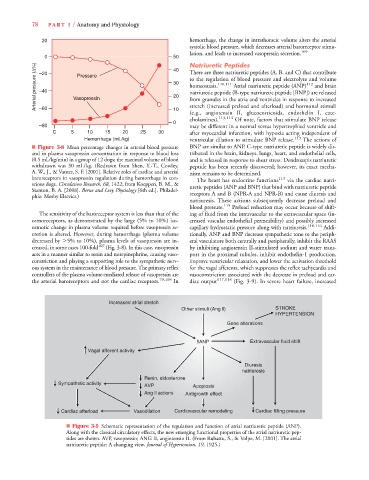
                  ■ Figure 3-8 Mean percentage changes in arterial blood pressure  BNP are similar to ANP. C-type natriuretic peptide is widely dis-
                  and in plasma vasopressin concentration in response to blood loss  tributed in the brain, kidneys, lungs, heart, and endothelial cells,
                  (0.5 mL/kg/min) in a group of 12 dogs; the maximal volume of blood  and is released in response to shear stress. Dendroaspis natriuretic
                  withdrawn was 30 mL/kg. (Redrawn from Shen, Y.-T., Cowley,  peptide has been recently discovered; however, its exact mecha-
                  A. W., J., & Vatner, S. F. [2001]. Relative roles of cardiac and arterial  nism remains to be determined.
                  baroreceptors in vasopressin regulation during hemorrhage in con-  The heart has endocrine functions 113  via the cardiac natri-
                  scious dogs. Circulation Research, 68, 1422; from Koeppen, B. M., &  uretic peptides (ANP and BNP) that bind with natriuretic peptide
                  Stanton, B. A. [2008]. Berne and Levy Physiology [6th ed.]. Philadel-
                  phia: Mosby Elsevier.)                              receptors A and B (NPR-A and NPR-B) and cause diuresis and
                                                                      natriuresis. These actions subsequently  decrease preload and
                                                                      blood pressure. 115  Preload reduction may occur because of shift-
                     The sensitivity of the baroreceptor system is less than that of the  ing of fluid from the intravascular to the extravascular space (in-
                  osmoreceptors, as demonstrated by the large (5% to 10%) iso-  creased vascular endothelial permeability) and possibly increased
                  osmotic change in plasma volume required before vasopressin se-  capillary hydrostatic pressure along with natriuresis. 110,116  Addi-
                  cretion is altered. However, during hemorrhage (plasma volume  tionally, ANP and BNP decrease sympathetic tone to the periph-
                  decreased by  5% to 10%), plasma levels of vasopressin are in-  eral vasculature both centrally and peripherally, inhibit the RAAS
                  creased, in some cases 100-fold 107  (Fig. 3-8). In this case, vasopressin  by inhibiting angiotensin II-stimulated sodium and water trans-
                  acts in a manner similar to renin and norepinephrine, causing vaso-  port in the proximal tubules, inhibit endothelin-1 production,
                  constriction and playing a supporting role to the sympathetic nerv-  improve ventricular relaxation, and lower the activation threshold
                  ous system in the maintenance of blood pressure. The primary reflex  for the vagal afferents, which suppresses the reflex tachycardia and
                  controllers of the plasma volume-mediated release of vasopressin are  vasoconstriction associated with the decrease in preload and car-
                  the arterial baroreceptors and not the cardiac receptors. 70,108  In  diac output 117,118  (Fig. 3-9). In severe heart failure, increased
                                            Increased atrial stretch
                                                                   Other stimuli (Ang ll)         STROKE
                                                                                                  HYPERTENSION
                                                                                  Gene alterations
                                                                         ANP              Extravascular fluid shift
                                     Vagal afferent activity
                                                                                        Diuresis
                                                                                       natriuresis
                                                       Renin, aldosterone
                           Sympathetic activity
                                                       AVP             Apoptosis
                                                       Ang ll actions  Antigrowth effect


                            Cardiac afterload       Vasodilation  Cardiovascular remodeling  Cardiac filling pressure

                              ■ Figure 3-9 Schematic representation of the regulation and function of atrial natriuretic peptide (ANP).
                              Along with the classical circulatory effects, the new emerging functional properties of the atrial natriuretic pep-
                              tides are shown. AVP, vasopressin; ANG II, angiotensin II. (From Rubattu, S., & Volpe, M. [2001]. The atrial
                              natriuretic peptide: A changing view. Journal of Hypertension, 19, 1925.)

