


Page 107 - Cardiac Nursing
P. 107
1 A
                                                         ra
                                               P
                                             M
                                        8:4
                                  9/2
                                                       pta
                                    009
                                                 g
                               0
                           qxd
                                9/0
                    p06
                                                    3 A
                                                  e 8
                       9-0
                         96.
            K34
                 03_
               0-c
         LWBK340-c03_p069-096.qxd  09/09/2009  08:41 AM  Page 83 Aptara
         LWB K34 0-c 03_ p06 9-0 96. qxd  0 9/0 9/2 009  0 0 8:4 1 A M  P a a g e 8 3 A pta ra
         L L LWB
                                                          C HAPTER  3 / Regulation of Cardiac Output and Blood Pressure  83
                      LONG-TERM CONTROL OF
                      BLOOD PRESSURE
                   The mechanism for the long-term control ofblood pressure has
                   traditionally been considered to involve fluid volume regulation,
                   with the mechanism  being renal pressure  diuresis–natriure-
                   sis. 200,201  There are alternative models which suggest that volume
                   diuresis–natriuresis and centralbaroreceptors play a role in long-
                   term blood pressure control. This section presents the pressure di-
                   uresis–natriuresis model, introduces the alternative models of
                   long-term arterialblood pressure control, anddiscusses the im-
                   portance ofbasal tone on the maintenance ofblood pressure.
                   Pressure Diuresis–Natriuresis Model
                   The classic model of long-term blood pressure control is based on
                   the principle that arterial pressure is maintained at a level required
                   by the kidneys to excrete a volume of urine approximately equiv-
                   alent to the daily fluid intake (minus extrarenalfluidlosses). 200,202
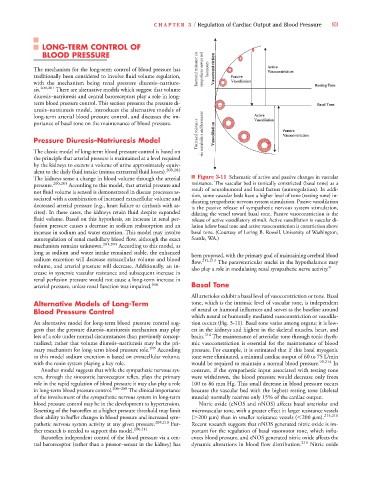
                   The kidneys sense a change in blood volume through the arterial  Figure 3-11 Schematic of active and passive changes in vascular
                   pressure. 200,203  According to this model, that arterial pressure and  resistance. The vascular bed is tonically constricted (basal tone) as a
                   not fluid volume is sensed is demonstrated in disease processes as-  result of neurohumoral and local factors (autoregulation). In addi-
                                                                       tion, some vascular beds have a higher level of tone (resting tone) in-
                   sociated with a combination of increased extracellular volume and  dicating sympathetic nervous system stimulation. Passive vasodilation
                   decreased arterial pressure (e.g., heart failure or cirrhosis with as-  is the passive release of sympathetic nervous system stimulation,
                   cites). In these cases, the kidneys retain fluiddespite expanded  dilating the vessel toward basal tone. Passive vasoconstriction is the
                   fluid volume. Based on this hypothesis, an increase in renal per-  release of active vasodilatory stimuli. Active vasodilation is vascular di-
                   fusion pressure causes a decrease in sodium reabsorption and an  lation below basal tone and active vasoconstriction is constriction above
                   increase in sodium and water excretion. This model may involve  basal tone. (Courtesy of Loring B. Rowell, University of Washington,
                   autoregulation of renal medullary bloodflow, although the exact  Seattle, WA.)
                   mechanism remains unknown. 201,204  According to this model, as
                   long as sodium and water intake remained stable, the enhanced  been proposed, with the primary goal of maintaining cerebral blood
                   sodium excretion will decrease extracellular volume and blood  flow. 212,213  The paraventricular nuclei in the hypothalamus may
                   volume, and arterialpressure will decrease. Additionally, an in-  also play a role in modulating renal sympathetic nerve activity. 8
                   crease in systemic vascular resistance and subsequent increase in
                   renal perfusion pressure would not cause a long-term increase in
                   arterial pressure, unless renalfunction was impaired. 200  Basal Tone
                                                                       All arterioles exhibit a basal level of vasoconstriction or tone. Basal
                   Alternative Models of Long-Term                     tone, which is the intrinsic level of vascular tone, is independent
                   Blood Pressure Control                              of neural or humoral influences and serves as the baseline around
                                                                       which neural or humorally mediated vasoconstriction or vasodila-
                   An alternative model for long-term blood pressure control sug-  tion occurs (Fig. 3-11). Basal tone varies among organs; it is low-
                   gests that the pressure diuresis–natriuresis mechanism may play  est in the kidneys and highest in the skeletal muscles, heart, and
                   less of a role under normal circumstances than previously concep-  brain. 214  The maintenance of arteriolar tone through tonic rhyth-
                   tualized; rather that volume diuresis–natriuresis may be the pri-  mic vasoconstriction is essential for the maintenance of blood
                   mary mechanism for long-term blood pressure role. 205  According  pressure. For example, it is estimated that if this basal myogenic
                   to this model sodium excretion is based on extracellular volume,  tone were eliminated, a minimal cardiac output of 60 to 75 L/min
                   with the renin system playing a key role.           would be required to maintain a normal blood pressure. 99,214  In
                     Another model suggests that while the sympathetic nervous sys-  contrast, if the sympathetic input associated with resting tone
                   tem, through the sinoaortic baroreceptor reflex, plays the primary  were withdrawn, the blood pressure would decrease only from
                   role in the rapid regulation of blood pressure it may also play a role  100 to 86 mm Hg. This small decrease in blood pressure occurs
                   in long-term blood pressure control. 206–208  The clinical importance  because the vascular bed with the highest resting tone (skeletal
                   of the involvement of the sympathetic nervous system in long-term  muscle) normally receives only 15% of the cardiac output.
                   blood pressure control may be in the development to hypertension.  Nitric oxide (eNOS and nNOS) affects basal arteriolar and
                   Resetting of the baroreflex at a higher pressure threshold may limit  microvascular tone, with a greater effect in larger resistance vessels
                   their ability to buffer changes in blood pressure and increased sym-  ( 200  m) than in smaller resistance vessels ( 200  m). 215,216
                   pathetic nervous system activity at any given pressure. 209,210  Fur-  Recent research suggests that nNOS generated nitric oxide is im-
                   ther research is needed to support this model. 206,211  portant for the regulation of basal vasomotor tone, which influ-
                     Baroreflex independent control of the blood pressure via a cen-  ences blood pressure, and eNOS generated nitric oxide affects the
                   tral baroreceptor (rather than a pressor–sensor in the kidney) has  dynamic alterations in blood flow distribution. 215  Nitric oxide

