


Page 100 - Cardiac Nursing
P. 100
9/0
                                             M
                                               P
                               0
                                                       pta
                                                         ra
                                                  e 7
                                                 g
                                    009
                         96.
                       9-0
                                                    6 A
                           qxd
                                           1 A
                                        8:4
                    p06
                                  9/2
            K34
               0-c
                 03_
         LWB K34 0-c 03_ p06 9-0 96. qxd  0 9/0 9/2 009  0 0 8:4 1 A M  P a a g e 7 6 A pta ra
         LWB
         LWBK340-c03_p069-096.qxd  09/09/2009  08:41 AM  Page 76 Aptara
                  76    PA R T  I / Anatomy and Physiology
                  effects. 81  The direct effects are secondary to occupation of the   Neuropeptide Y
                   -adrenergic receptors and inhibition of norepinephrine release,
                  and the indirect effects occur through inhibition of the adrener-  NPY is an amino acid peptide released with norepinephrine from
                  gic second messenger cAMP. 82,83  There are also M 1 , M 3 , and M 5  sympathetic nerve terminals. NPY has direct pressor effects and
                  receptors in the heart, which may have pharmacologic implica-  also exerts a prejunctional modulation of the release of other neu-
                  tions. 84  Of clinical importance, the negative chronotropic and  rotransmitters. For example, NPY inhibits the release of acetyl-
                  inotropic effects associated with the M 2 receptor are blocked by  choline from vagal nerve endings, thus attenuating the effects of
                  atropine.                                           the parasympathetic system on heart rate, atrioventricular con-
                                                                      duction, and atrial contractility. 90,91  In addition, NPY potentiates
                                                                      the postjunctional contractile effects of norepinephrine. In the
                  Co-transmitters                                     mesentery, 30% of the sympathetic nervous system induced vaso-
                  At the preganglionic synapse, the primary neurotransmitter for  constriction depends on NPY, 92,93  although the role of NPY
                  the sympathetic and parasympathetic nervous systems is acetyl-  varies depending on the vascular bed. NPY is also associated with
                  choline. At the neuroeffector junction in the sympathetic nervous  vascular remodeling (Y1 receptor) and angiogenesis (Y2). Phar-
                  system, the primary neurotransmitters are norepinephrine and its  macologic strategies that promote angiogenesis but inhibit the
                  precursor, dopamine, whereas the primary neurotransmitter of  pro-atherosclerotic effects of NPY may be useful in preventing or
                                                                                                     94,95
                  the postganglionic fibers of the parasympathetic nervous system  treating pathological vascular remodeling.
                  is acetylcholine. However, other neurotransmitters that augment
                  or modify the effects of the primary neurotransmitter are co-  Vasoactive Intestinal Peptide
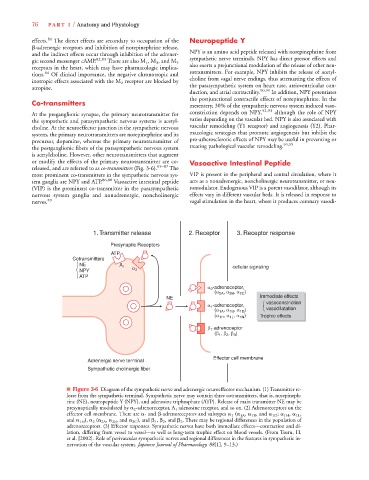
                  released, and are referred to as co-transmitters (Fig. 3-6). 85–87  The
                  most prominent co-transmitters in the sympathetic nervous sys-  VIP is present in the peripheral and central circulation, where it
                  tem ganglia are NPY and ATP. 86,88  Vasoactive intestinal peptide  acts as a nonadrenergic, noncholinergic neurotransmitter, or neu-
                  (VIP) is the prominent co-transmitter in the parasympathetic  romodulator. Endogenous VIP is a potent vasodilator, although its
                  nervous system  ganglia and nonadrenergic, noncholinergic  effects vary in different vascular beds. It is released in response to
                  nerves. 89                                          vagal stimulation in the heart, where it produces coronary vasodi-
                                      1. Transmitter release          2. Receptor    3. Receptor response

                                            Presynaptic Receptors
                                            ATP
                                Cotransmitters
                                  NE           A 1  α                               cellular signaling
                                  NPY               2
                                  ATP

                                                                            α -adrenoceptor,
                                                                             2
                                                                              (α , α , α )
                                                                                   2B
                                                                                2A
                                                                                      2C
                                                              NE                             Immediate effects
                                                                                               vasoconstriction
                                                                            α -adrenoceptor,
                                                                             1
                                                                              (α , α , α )     vasodilatation
                                                                                1A
                                                                                   1B
                                                                                      1D
                                                                                 , α , α )
                                                                              (α 1H  1L  1N  Trophic effects
                                                                            β -adrenoceptor
                                                                             1
                                                                              (β , β , β )
                                                                                    3
                                                                                  2
                                                                                1
                                                                              Effector cell membrane
                                     Adrenergic nerve terminal
                                     Sympathetic cholinergic fiber
                                Figure 3-6 Diagram of the sympathetic nerve and adrenergic neuroeffector mechanism. (1) Transmitter re-
                              lease from the sympathetic terminal. Sympathetic nerve may contain three cotransmitters, that is, norepineph-
                              rine (NE), neuropeptide Y (NPY), and adenosine triphosphate (ATP). Release of main transmitter NE may be
                              presynaptically modulated by   2 -adrenoreceptor, A 1 adenosine receptor, and so on. (2) Adrenoreceptors on the
                              effector cell membrane. There are  - and  -adrenoreceptors and subtypes   1 (  1A ,   1B , and   1D ;   1H ,   1L ,
                              and   1N ),   2 (  2A ,   2B , and   2C ), and   1 ,   2 , and   3 . There may be regional differences in the population of
                              adrenoreceptors. (3) Effector responses. Sympathetic nerves have both immediate effects—contraction and di-
                              lation, differing from vessel to vessel—as well as long-term trophic effect on blood vessels. (From Tsuru, H.
                              et al. [2002]. Role of perivascular sympathetic nerves and regional differences in the features in sympathetic in-
                              nervation of the vascular system. Japanese Journal of Pharmacology, 88[1], 9–13.)

