


Page 108 - Cardiac Nursing
P. 108
P
                                                 g
                                           1 A
                                             M
                                                       pta
                                                         ra
                                                  e 8
                                                    4 A
                                        8:4
                         96.
                           qxd
                    p06
                       9-0
                                  9/2
                                    009
                               0
                                9/0
            K34
               0-c
                 03_
         L L LWB K34 0-c 03_ p06 9-0 96. qxd  0 9/0 9/2 009  0 0 8:4 1 A M  P a a g e 8 4 A pta ra
         LWB
         LWBK340-c03_p069-096.qxd  09/09/2009  08:41 AM  Page 84 Aptara
                  84    PA R T  I / Anatomy and Physiology
                  also affects large-artery distensibility. 217,218  The reduction or ab-
                  sence of tonic nitric oxide release causes increased mean arterial                      Resistance
                  blood pressure and may be a cause of pathological conditions
                  characterized by increased blood pressure. 218,219
                     As demonstrated in Figure 3-11, active and passive vasomotion
                  occurs around the basal and resting tone of the vascular bed. Four
                  terms define this vasomotion 99,220 :                                                    Blood flow
                  1. Active vasoconstriction, which is mediated by sympathetic stimu-  Blood flow (Resistance --)
                    lation, is the increase in vascular resistance above the basal level.
                  2. Passive vasodilation, in contrast to active vasoconstriction, is the    Autoregulatory
                    reduction in vascular resistance back to the basal level caused by          range
                    the withdrawal of the sympathetic stimulation associated with
                    active vasoconstriction. In some vascular beds, resistance may
                    be increased above basal tone by tonic sympathetic stimulation.
                    This increase in vascular tone is referred to as resting tone. Pas-    60         150
                    sive vasodilation is most easily seen in vascular beds with in-   Blood pressure (mm Hg)
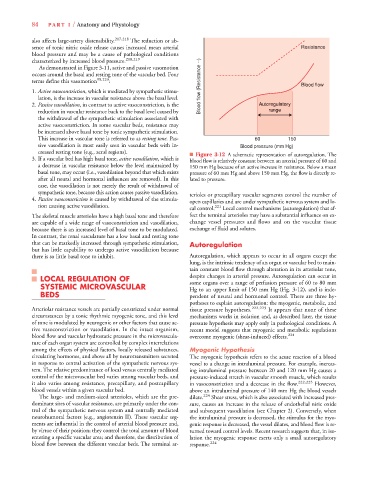
                    creased resting tone (e.g., acral regions).       ■ Figure 3-12 A schematic representation of autoregulation. The
                  3. If a vascular bed has high basal tone, active vasodilation, which is  blood flow is relatively constant between an arterial pressure of 60 and
                    a decrease in vascular resistance below the level maintained by  150 mm Hg because of an active increase in resistance. Below a mean
                    basal tone, may occur (i.e., vasodilation beyond that which exists  pressure of 60 mm Hg and above 150 mm Hg, the flow is directly re-
                    after all neural and hormonal influences are removed). In this  lated to pressure.
                    case, the vasodilation is not merely the result of withdrawal of
                    sympathetic tone, because this action causes passive vasodilation.  terioles or precapillary vascular segments control the number of
                  4. Passive vasoconstriction is caused by withdrawal of the stimula-  open capillaries and are under sympathetic nervous system and lo-
                    tion causing active vasodilation.                         221
                                                                      cal control.  Local control mechanisms (autoregulation) that af-
                  The skeletal muscle arterioles have a high basal tone and therefore  fect the terminal arterioles may have a substantial influence on ex-
                  are capable of a wide range of vasoconstriction and vasodilation,  change vessel pressures and  flows and on the vascular tissue
                  because there is an increased level of basal tone to be modulated.  exchange of fluid and solutes.
                  In contrast, the renal vasculature has a low basal and resting tone
                  that can be markedly increased through sympathetic stimulation,  Autoregulation
                  but has little capability to undergo active vasodilation because
                  there is so little basal tone to inhibit.           Autoregulation, which appears to occur in all organs except the
                                                                      lung, is the intrinsic tendency of an organ or vascular bed to main-
                                                                      tain constant blood flow through alteration in its arteriolar tone,
                     LOCAL REGULATION OF                              despite changes in arterial pressure. Autoregulation can occur in
                     SYSTEMIC MICROVASCULAR                           some organs over a range of perfusion pressure of 60 to 80 mm
                                                                      Hg to an upper limit of 150 mm Hg (Fig. 3-12), and is inde-
                     BEDS                                             pendent of neural and hormonal control. There are three hy-
                                                                      potheses to explain autoregulation: the myogenic, metabolic, and
                  Arteriolar resistance vessels are partially constricted under normal  tissue pressure hypotheses. 222,223  It appears that none of these
                  circumstances by a tonic rhythmic myogenic tone, and this level  mechanisms works in isolation and, as described later, the tissue
                  of tone is modulated by neurogenic or other factors that cause ac-  pressure hypothesis may apply only in pathological conditions. A
                  tive vasoconstriction or vasodilation. In the intact organism,  recent model suggests that myogenic and metabolic regulations
                  blood flow and vascular hydrostatic pressure in the microvascula-  overcome myogenic (shear-induced) effects. 224
                  ture of each organ system are controlled by complex interrelations
                  among the effects of physical factors, locally released substances,  Myogenic Hypothesis
                  circulating hormones, and above all by neurotransmitters secreted  The myogenic hypothesis refers to the acute reaction of a blood
                  in response to central activation of the sympathetic nervous sys-  vessel to a change in intraluminal pressure. For example, increas-
                  tem. The relative predominance of local versus centrally mediated  ing intraluminal pressure between 20 and 120 mm Hg causes a
                  control of the microvascular bed varies among vascular beds, and  pressure-induced stretch in vascular smooth muscle, which results
                  it also varies among resistance, precapillary, and postcapillary  in vasoconstriction and a decrease in the flow. 222,225  However,
                  blood vessels within a given vascular bed.          above an intraluminal pressure of 140 mm Hg the blood vessels
                     The large- and medium-sized arterioles, which are the pre-  dilate. 224  Shear stress, which is also associated with increased pres-
                  dominant sites of vascular resistance, are primarily under the con-  sure, causes an increase in the release of endothelial niric oxide
                  trol of the sympathetic nervous system and centrally mediated  and subsequent vasodilation (see Chapter 2). Conversely, when
                  neurohumoral factors (e.g., angiotensin II). These vascular seg-  the intraluminal pressure is decreased, the stimulus for the myo-
                  ments are influential in the control of arterial blood pressure and,  genic response is decreased, the vessel dilates, and blood flow is re-
                  by virtue of their position; they control the total amount of blood  turned toward control levels. Recent research suggests that, in iso-
                  entering a specific vascular area; and therefore, the distribution of  lation the myogenic response exerts only a small autoregulatory
                  blood flow between the different vascular beds. The terminal ar-  response. 224

