


Page 111 - Cardiac Nursing
P. 111
9/0
                                                  e 8
                               0
                         96.
                           qxd
                                                 g
                                                         ra
                                                       pta
                                           1 A
                                               P
                                             M
                       9-0
            K34
               0-c
         LWBK340-c03_p069-096.qxd  09/09/2009  08:41 AM  Page 87 Aptara
         LWB K34 0-c 03_ p06 9-0 96. qxd  0 9/0 9/2 009  0 0 8:4 1 A M  P a a g e 8 7 A pta ra
         L L LWB
                 03_
                                                    7 A
                    p06
                                  9/2
                                        8:4
                                    009
                                                          C HAPTER  3 / Regulation of Cardiac Output and Blood Pressure  87
                                                                               Normal
                                                                                flow           C
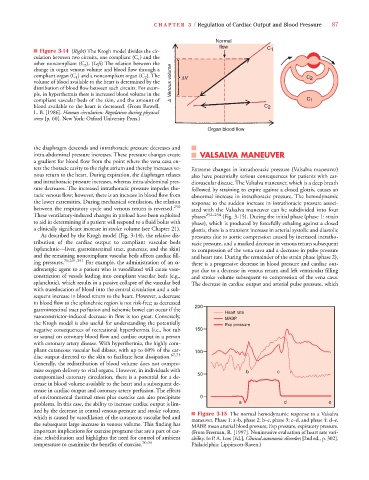
                   ■ Figure 3-14 (Right) The Krogh model divides the cir-t t                     1
                   culation between two circuits, one compliant (C 1 ) and the
                   other noncompliant (C 2 ). (Left) The relation between the
                                         t
                                         t
                   change in organ venous volume and blood flow through a
                   compliant organ (C 1 ) and a noncompliant organ (C 2 ). The  	V                          C 2
                   volume of blood available to the heart is determined by the  Venous volume
                   distribution of blood flow between such circuits. For exam-
                   ple, in hyperthermia there is increased blood volume in the
                   compliant vascular beds of the skin, and the amount of                                   C 1
                   blood available to the heart is decreased. (From Rowell,                   C 2
                   L. B. [1986]. Human circulation: Regulation during physical
                   stress [p. 60]. New York: Oxford University Press.)
                                                                            Organ blood flow
                   the diaphragm descends and intrathoracic pressure decreases and
                   intra-abdominal pressure increases. These pressure changes create  VALSALVA MANEUVER
                   a gradient for blood flow from the point where the vena cava en-
                   ters the thoracic cavity to the right atrium and thereby increases ve-  Extreme changes in intrathoracic pressure (Valsalva maneuver)
                   nous return to the heart. During expiration, the diaphragm relaxes  also have potentially serious consequences for patients with car-
                   and intrathoracic pressure increases, whereas intra-abdominal pres-  diovascular disease. The Valsalva maneuver, which is a deep breath
                   sure decreases. The increased intrathoracic pressure impedes tho-  followed by straining to expire against a closed glottis, causes an
                   racic venous flow; however, there is an increase in blood flow from  abnormal increase in intrathoracic pressure. The hemodynamic
                   the lower extremities. During mechanical ventilation, the relation  response to the sudden increase in intrathoracic pressure associ-
                   between the respiratory cycle and venous return is reversed. 250  ated with the Valsalva maneuver can be subdivided into four
                   These ventilatory-induced changes in preload have been exploited  phases 252–254  (Fig. 3-15). During the initial phase (phase 1: strain
                   to aid in determining if a patient will respond to a fluid bolus with  phase), which is produced by forcefully exhaling against a closed
                   a clinically significant increase in stroke volume (see Chapter 21).  glottis, there is a transient increase in arterial systolic and diastolic
                     As described by the Krogh model (Fig. 3-14), the relative dis-  pressures due to aortic compression caused by increased intratho-
                   tribution of the cardiac output to compliant vascular  beds  racic pressure, and a marked decrease in venous return subsequent
                   (splanchnic—liver, gastrointestinal tract, pancreas, and the skin)  to compression of the vena cava and a decrease in pulse pressure
                   and the remaining noncompliant vascular beds affects cardiac fill-  and heart rate. During the remainder of the strain phase (phase 2),
                   ing pressures. 70,231,251  For example, the administration of an  -  there is a progressive decrease in blood pressure and cardiac out-
                   adrenergic agent to a patient who is vasodilated will cause vaso-  put due to a decrease in venous return and left ventricular filling
                   constriction of vessels leading into compliant vascular beds (e.g.,  and stroke volume subsequent to compression of the vena cava.
                   splanchnic), which results in a passive collapse of the vascular bed  The decrease in cardiac output and arterial pulse pressure, which
                   with translocation of blood into the central circulation and a sub-
                   sequent increase in blood return to the heart. However, a decrease
                   in blood flow to the splanchnic region is not risk-free; as decreased
                   gastrointestinal tract perfusion and ischemic bowel can occur if the  200
                                                                                  Heart rate
                   vasoconstrictor-induced decrease in flow is too great. Conversely,
                                                                                  MABP
                   the Krogh model is also useful for understanding the potentially  Exp pressure
                   negative consequences of recreational hyperthermia (i.e., hot tub  150
                   or sauna) on coronary blood flow and cardiac output in a person
                   with coronary artery disease. With hyperthermia, the highly com-
                   pliant cutaneous vascular bed dilates, with up to 60% of the car-  100
                   diac output directed to the skin to facilitate heat dissipation. 67,73
                   Generally, the redistribution of blood volume does not compro-
                   mise oxygen delivery to vital organs. However, in individuals with   b          c
                   compromised coronary circulation, there is a potential for a de-  50
                   crease in blood volume available to the heart and a subsequent de-
                   crease in cardiac output and coronary artery perfusion. The effects
                   of environmental thermal stress plus exercise can also precipitate  0
                   problems. In this case, the ability to increase cardiac output is lim-  a         d             e
                   ited by the decrease in central venous pressure and stroke volume,  ■ Figure 3-15 The normal hemodynamic response to a Valsalva
                   which is caused by vasodilation of the cutaneous vascular bed and  maneuver. Phase 1: a–b, phase 2: b–c, phase 3: c–d, and phase 4: d–e.
                   the subsequent large increase in venous volume. This finding has  MABP, mean arterial blood pressure; Exp pressure, expiratory pressure.
                   important implications for exercise programs that are a part of car-  (From Freeman, R. [1997]. Noninvasive evaluation of heart rate vari-
                   diac rehabilitation and highlights the need for control of ambient  ability. In P. A. Low [Ed.], Clinical autonomic disorders [2nd ed., p. 302].
                   temperature to maximize the benefits of exercise. 70,99  Philadelphia: Lippincott-Raven.)

