


Page 112 - Cardiac Nursing
P. 112
8:4
                                9/0
                                    009
                                           1 A
                                                         ra
                         96.
                    p06
                       9-0
                                  9/2
                                                       pta
                                                    8 A
                           qxd
                               0
                                               P
                                             M
                                                  e 8
                                                 g
            K34
               0-c
                 03_
         LWB K34 0-c 03_ p06 9-0 96. qxd  0 9/0 9/2 009  0 0 8:4 1 A M  P a a g e 8 8 A pta ra
         LWBK340-c03_p069-096.qxd  09/09/2009  08:41 AM  Page 88 Aptara
         L L LWB
                  88    PA R T  I / Anatomy and Physiology
                  increases baroreflex-mediated sympathetic activity, is manifested  Tilt up              Tilt down
                  as a compensatory increase in heart rate and peripheral resistance.
                  On release of the strain (phase 3), there is an abrupt decrease in  85         85
                  arterial pressure (release of aortic compression) and a rapid rise in
                  venous return (decreased caval compression with restoration of  MAP (mmHg)  80  80
                  the inferior vena cava to right atrial pressure gradient) without a  75        75
                  change in heart rate. Finally, during phase 4 (overshoot), when the
                  increased venous return reaches the left ventricle, there is a
                  progressive increase in left ventricular stroke volume, blood pres-           110
                  sure, and pulse pressure above baseline caused by an increase in  SV (ml) 110  100
                                                                          100
                  cardiac output, secondary to the increased venous return into the
                  vasoconstricted systemic vasculature. The overshoot of blood pres-  90         90
                  sure, pulse pressure, and cardiac output stimulates vagal activity,
                  leading to reflex bradycardia. 255,256
                     In the clinical setting, the effects of the Valsalva maneuver may  72       72
                  be observed when a patient strains during defecation or vomit-  70             70
                  ing. 257  It is the reflex bradycardia and the sequelae of the Valsalva  HR (beats•min)  68  68
                  maneuver (cardiac arrhythmias, sudden cardiac arrest, cerebral and
                  subarachnoid hemorrhage, rupture of a dissecting aortic aneurysm)  66          66
                  that are observed clinically. 258  Patients who may be at increased risk
                  for an adverse response to the Valsalva maneuver include those with
                  cardiac disease (e.g., heart failure) and older individuals. 254,259  In-  6.2  6.2
                  terventions to protect this high-risk group from the sequelae of the  5.8     5.8
                  Valsalva maneuver (e.g., positioning, and avoiding straining during  CO (l•min)  5.4  5.4
                  a bowel movement or vomiting) should be performed.      5.0                   5.0
                                                                          4.6                   4.6
                     OVERALL CONTROL                                      100                   100
                  Baroreflex Control of Blood Pressure                  TPC  (ml•mmHg•min)  90    90
                                                                           80
                                                                                                 80
                  The arterial baroreflex is the primary mechanism of control for  70             70
                  the short-term or rapid control of arterial blood pressure. 260–263
                                                                            20   30  40   50  60  20   30  40   50  60
                  Neurohumoral factors (predominantly the control of sodium ex-
                  cretion) are primarily responsible for long-term or slower blood  Time (s)              Time (s)
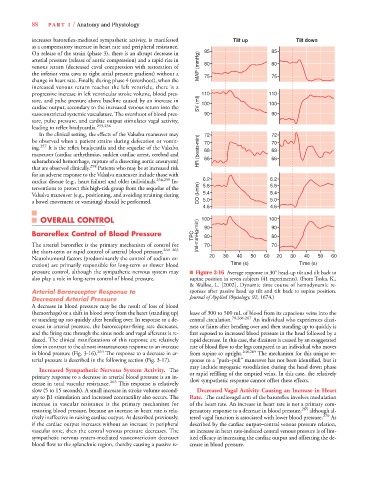
                  pressure control, although the sympathetic nervous system may  ■ Figure 3-16 Average response to 30  head-up tilt and tilt back to
                  also play a role in long-term control of blood pressure.  supine position in seven subjects (41 experiments). (From Toska, K.,
                                                                      & Walløe, L. [2002]. Dynamic time course of hemodynamic re-
                  Arterial Baroreceptor Response to                   sponses after passive head up tilt and tilt back to supine position.
                  Decreased Arterial Pressure                         Journal of Applied Physiology, 92, 1674.)
                  A decrease in blood pressure may be the result of loss of blood
                  (hemorrhage) or a shift in blood away from the heart (standing up)  lease of 300 to 500 mL of blood from its capacious veins into the
                  or standing up too quickly after bending over. In response to a de-  central circulation. 70,266,267  An individual who experiences dizzi-
                  crease in arterial pressure, the baroreceptor-firing rate decreases,  ness or faints after bending over and then standing up to quickly is
                  and the firing rate through the sinus node and vagal afferents is re-  first exposed to increased blood pressure in the head followed by a
                  duced. The clinical manifestations of this response are relatively  rapid decrease. In this case, the dizziness is caused by an exaggerated
                  slow in contrast to the almost instantaneous response to an increase  rate of blood flow to the legs compared to an individual who moves
                  in blood pressure (Fig. 3-16). 264  The response to a decrease in ar-  from supine to upright. 268,269  The mechanism for this unique re-
                  terial pressure is described in the following section (Fig. 3-17).  sponse to a “push–pull” maneuver has not been identified, but it
                                                                      may include myogenic vasodilation during the head down phase
                     Increased Sympathetic Nervous System Activity. The  or rapid refilling of the emptied veins. In this case, the relatively
                  primary response to a decrease in arterial blood pressure is an in-  slow sympathetic response cannot offset these effects.
                  crease in total vascular resistance. 265  This response is relatively
                  slow (5 to 15 seconds). A small increase in stroke volume second-  Decreased Vagal Activity Causing an Increase in Heart
                  ary to  1 stimulation and increased contractility also occurs. The  Rate. The cardiovagal arm of the baroreflex involves modulation
                  increase in vascular resistance is the primary mechanism  for  of the heart rate. An increase in heart rate is not a primary com-
                  restoring blood pressure, because an increase in heart rate is rela-  pensatory response to a decrease in blood pressure, 265  although al-
                  tively ineffective in raising cardiac output. As described previously,  tered vagal function is associated with lower blood pressure. 270  As
                  if the cardiac output increases without an increase in peripheral  described by the cardiac output–central venous pressure relation,
                  vascular tone, then the central venous pressure decreases. The  an increase in heart rate-induced central venous pressure is of lim-
                  sympathetic nervous system-mediated vasoconstriction decreases  ited efficacy in increasing the cardiac output and offsetting the de-
                  blood flow to the splanchnic region, thereby causing a passive re-  crease in blood pressure.

