


Page 113 - Cardiac Nursing
P. 113
qxd
                         96.
                                        8:4
                                           1 A
                    p06
                               0
                                             M
                       9-0
                                    009
                                                 g
                                                  e 8
                                9/0
                                               P
                                                         ra
                                  9/2
                                                    9 A
                                                       pta
            K34
               0-c
                 03_
         LWBK340-c03_p069-096.qxd  09/09/2009  08:41 AM  Page 89 Aptara
         LWB K34 0-c 03_ p06 9-0 96. qxd  0 9/0 9/2 009  0 0 8:4 1 A M  P a a g e 8 9 A pta ra
         LWB
                                                          C HAPTER  3 / Regulation of Cardiac Output and Blood Pressure  89


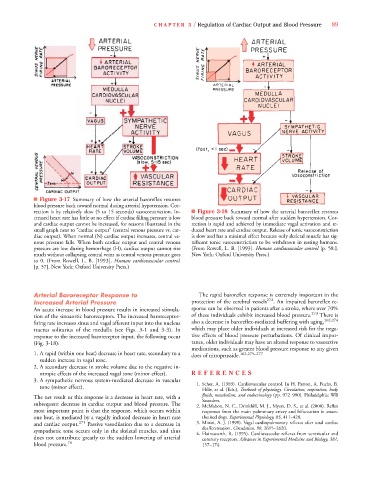
                   ■ Figure 3-17 Summary of how the arterial baroreflex restores
                   blood pressure back toward normal during arterial hypotension. Cor-
                   rection is by relatively slow (5 to 15 seconds) vasoconstriction. In-  ■ Figure 3-18 Summary of how the arterial baroreflex restores
                   creased heart rate has little or no effect if cardiac filling pressure is low  blood pressure back toward normal after sudden hypertension. Cor-
                   and cardiac output cannot be increased, for reasons illustrated in the  rection is rapid and achieved by immediate vagal activation and re-
                   small graph next to “cardiac output” (central venous pressure vs. car-  duced heart rate and cardiac output. Release of tonic vasoconstriction
                   diac output). When normal (N) cardiac output increases, central ve-  is slow and has a minimal effect because only skeletal muscle has sig-
                   nous pressure falls. When both cardiac output and central venous  nificant tonic vasoconstriction to be withdrawn in resting humans.
                   pressure are low during hemorrhage (H), cardiac output cannot rise  (From Rowell, L. B. [1993]. Human cardiovascular control [p. 58.].
                   much without collapsing central veins as central venous pressure goes  New York: Oxford University Press.)
                   to 0. (From Rowell, L. B. [1993]. Human cardiovascular control
                   [p. 57]. New York: Oxford University Press.)


                   Arterial Baroreceptor Response to                     The rapid baroreflex response is extremely important in the
                   Increased Arterial Pressure                         protection of the cerebral vessels 272 . An impaired baroreflex re-
                   An acute increase in blood pressure results in increased stimula-  sponse can be observed in patients after a stroke, where over 70%
                   tion of the sinoaortic baroreceptors. The increased baroreceptor-  of these individuals exhibit increased blood pressure. 273  There is
                   firing rate increases sinus and vagal afferent input into the nucleus  also a decrease in baroreflex-mediated buffering with aging, 162,274
                   tractus solitarius of the medulla (see Figs. 3-1 and 3-3). In  which may place older individuals at increased risk for the nega-
                   response to the increased baroreceptor input, the following occur  tive effects of blood pressure perturbations. Of clinical impor-
                   (Fig. 3-18):                                        tance, older individuals may have an altered response to vasoactive
                                                                       medications, such as greater blood pressure response to any given
                   1. A rapid (within one beat) decrease in heart rate, secondary to a  162,275–277
                                                                       does of nitroprusside.
                     sudden increase in vagal tone.
                   2. A secondary decrease in stroke volume due to the negative in-
                     otropic effects of the increased vagal tone (minor effect).  REFE R E NC ES
                   3. A sympathetic nervous system-mediated decrease in vascular
                                                                        1.Scher, A. (1989). Cardiovascular control. In H. Patton, A. Fuchs, B.
                     tone (minor effect).
                                                                          Hille, et al. (Eds.), Textbook of physiology. Circulation, respiration, body
                   The net result or this response is a decrease in heart rate, with a  fluids, metabolism, and endocrinology (pp. 972–990). Philadelphia: WB
                                                                          Saunders.
                   subsequent decrease in cardiac output and blood pressure. The  2.McMahon, N. C., Drinkhill, M. J., Myers, D. S., et al. (2000). Reflex
                   most important point is that the response, which occurs within  responses from the main pulmonary artery and bifurcation in anaes-
                   one beat, is mediated by a vagally induced decrease in heart rate  thetised dogs. Experimental Physiology, 85, 411–420.
                   and cardiac output. 271  Passive vasodilation due to a decrease in  3. Minisi, A. J. (1998). Vagal cardiopulmonary reflexes after total cardiac
                                                                          deafferentation. Circulation, 98, 2615–2620.
                   sympathetic tone occurs only in the skeletal muscles, and thus  4. Hainsworth, R. (1995). Cardiovascular reflexes from ventricular and
                   does not contribute greatly to the sudden lowering of arterial  coronary receptors. Advances in Experimental Medicine and Biology, 381,
                   blood pressure. 70                                     157–174.

