


Page 163 - Cardiac Nursing
P. 163
LWBK340-c06_p132-152.qxd  09/09/2009  08:25 AM  Page 139 Aptara


                                                               C HAP TE R  6 / Hematopoiesis, Coagulation, and Bleeding  139

                   may also be linked to inflammation because angiotensin II not  each case, bleeding is the primary manifestation. The bleeding may
                   only may be a vasoconstrictor but also may cause intimal inflam-  be minor, such as petechiae and easy bruising of the skin, or ma-
                   mation by stimulating the smooth muscle and endothelial cells to  jor, with massive hemorrhage.
                   express proinflammatory cytokines such as IL-6 and monocyte  The focus of cardiac interventions today emphasizes main-
                                       3
                   chemoattractant protein-1. Hyperglycemia associated with dia-  taining blood flow with percutaneous interventions (vascular in-
                   betes can lead to the formation of advance glycation end products  jury) and anticoagulation to prevent thrombus formation. This
                   that may augment the secretion of proinflammatory cytokines. 3  intentional disruption of the coagulation system can potentially
                   Even chronic extravascular infections such as gingivitis, prostati-  lead to bleeding disorders or even shock with excessive blood loss
                   tis, bronchitis, etc., can augment extravascular production of in-  from percutaneous interventions and/or thrombolysis. Shock can
                   flammatory cytokines, which can accelerate the evolution of ath-  lead to hypoperfusion and decreased oxygen delivery, which can
                                 3
                   erosclerotic lesions. This new scientific insight into the role of  trigger the intrinsic and extrinsic pathways simultaneously. Dis-
                   inflammation in the development of atherosclerosis has led to us-  seminated intravascular coagulation (DIC) is a complication of
                   ing new markers to determine the degree of inflammation. Find-  shock. Although DIC is actually a disorder of coagulation, it is
                   ings of a relationship between increased C-reactive protein levels  discussed as a bleeding disorder because its major manifestation
                   and unfavorable cardiovascular outcomes have led to new thera-  is bleeding.
                   peutic considerations for acute coronary syndrome. 3

                                                                       Disseminated Intravascular
                      BLEEDING DISORDERS
                                                                       Coagulation
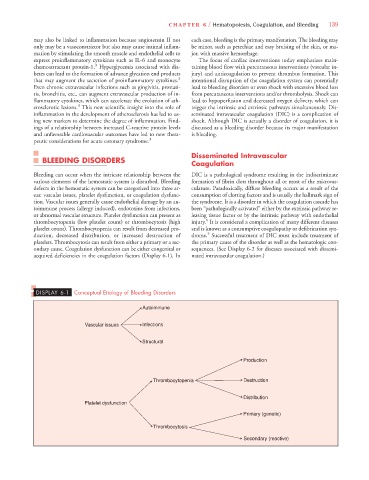
                   Bleeding can occur when the intricate relationship between the  DIC is a pathological syndrome resulting in the indiscriminate
                   various elements of the hemostatic system is disturbed. Bleeding  formation of fibrin clots throughout all or most of the microvas-
                   defects in the hemostatic system can be categorized into three ar-  culature. Paradoxically, diffuse bleeding occurs as a result of the
                   eas: vascular issues, platelet dysfunction, or coagulation dysfunc-  consumption of clotting factors and is usually the hallmark sign of
                   tion. Vascular issues generally cause endothelial damage by an au-  the syndrome. It is a disorder in which the coagulation cascade has
                   toimmune process (allergy induced), endotoxins from infections,  been “pathologically activated” either by the extrinsic pathway re-
                   or abnormal vascular structure. Platelet dysfunction can present as  leasing tissue factor or by the intrinsic pathway with endothelial
                                                                           1
                   thrombocytopenia (low platelet count) or thrombocytosis (high  injury. It is considered a complication of many different diseases
                   platelet count). Thrombocytopenia can result from decreased pro-  and is known as a consumptive coagulopathy or defibrination syn-
                                                                            5
                   duction,  decreased  distribution, or increased  destruction of  drome. Successful treatment of DIC must include treatment of
                   platelets. Thrombocytosis can result from either a primary or a sec-  the primary cause of the disorder as well as the hematologic con-
                   ondary cause. Coagulation dysfunction can be either congenital or  sequences. (See Display 6-2 for diseases associated with dissemi-
                   acquired deficiencies in the coagulation factors (Display 6-1). In  nated intravascular coagulation.)


                    DISPLAY 6-1 Conceptual Etiology of Bleeding Disorders

                                                       Autoimmune

                                    Vascular issues    Infections


                                                       Structural

                                                                                        Production


                                                          Thrombocytopenia              Destruction

                                                                                        Distribution
                                    Platelet dysfunction
                                                                                        Primary (genetic)

                                                          Thrombocytosis
                                                                                        Secondary (reactive)

