


Page 43 - Cardiac Nursing
P. 43
92806_c01.qxd  11/21/11  10:30 AM  Page 19


                                                                          CHAPTER 1 / Cardiac Anatomy and Physiology   19


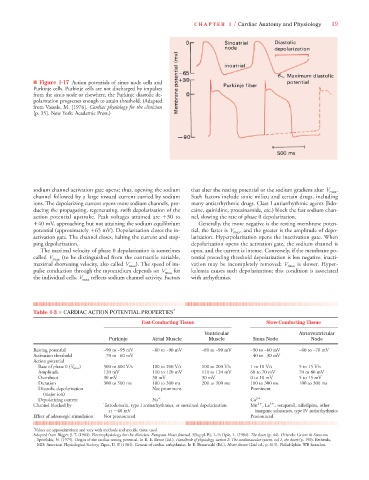
                     ■ Figure 1-17 Action potentials of sinus node cells and
                     Purkinje cells. Purkinje cells are not discharged by impulses
                     from the sinus node or elsewhere, the Purkinje diastolic de-
                     polarization progresses enough to attain threshold. (Adapted
                     from Vassale, M. [1976]. Cardiac physiology for the clinician
                     [p. 35]. New York: Academic Press.)


                     sodium channel activation gate opens; thus, opening the sodium  that alter the resting potential or the sodium gradient alter V max .
                     channel followed by a large inward current carried by sodium  Such factors include ionic milieu and certain drugs, including
                     ions. The depolarizing current opens more sodium channels, pro-  many antiarrhythmic drugs. Class I antiarrhythmic agents (lido-
                     ducing the propagating, regenerating, swift depolarization of the  caine, quinidine, procainamide, etc.) block the fast sodium chan-
                     action potential upstroke. Peak voltages attained are  30 to   nel, slowing the rate of phase 0 depolarization.
                      40 mV, approaching but not attaining the sodium equilibrium  Generally, the more negative is the resting membrane poten-
                     potential (approximately  65 mV). Depolarization closes the in-  tial, the faster is V max , and the greater is the amplitude of depo-
                     activation gate. The channel closes, halting the current and stop-  larization. Hyperpolarization opens the inactivation gate. When
                     ping depolarization.                                depolarization opens the activation gate, the sodium channel is
                        The maximal velocity of phase 0 depolarization is sometimes  open, and the current is intense. Conversely, if the membrane po-
                     called V max (to be distinguished from the contractile variable,  tential preceding threshold depolarization is less negative, inacti-
                     maximal shortening velocity, also called V max ). The speed of im-  vation may be incompletely removed; V max is slower. Hyper-
                     pulse conduction through the myocardium depends on V max for  kalemia causes such depolarization; this condition is associated
                     the individual cells. V max reflects sodium channel activity. Factors  with arrhythmias.


                     Table 1-3 ■ CARDIAC ACTION POTENTIAL PROPERTIES *
                                                        Fast-Conducting Tissue                   Slow-Conducting Tissue
                                                                             Ventricular                    Atrioventricular
                                              Purkinje      Atrial Muscle      Muscle        Sinus Node         Node

                     Resting potential      –90 to –95 mV   –80 to –90 mV   –80 to –90 mV   –50 to –60 mV   –60 to –70 mV
                     Activation threshold   –70 to –60 mV                                   –40 to –30 mV
                     Action potential
                       Rate of phase 0 (V max )  500 to 800 V/s  100 to 200 V/s  100 to 200 V/s  1 to 10 V/s  5 to 15 V/s
                       Amplitude            120 mV          110 to 120 mV   110 to 120 mV   60 to 70 mV     70 to 80 mV
                       Overshoot            30 mV           30 mV           30 mV           0 to 10 mV      5 to 15 mV
                       Duration             300 to 500 ms   100 to 300 ms   200 to 300 ms   100 to 300 ms   100 to 300 ms
                       Diastolic depolarization             Not prominent                   Prominent
                        (major ion)
                       Depolarizing current                 Na                              Ca 2
                                                                                              2
                                                                                                  3
                     Channel blocked by     Tetrodotoxin, type I antiarrhythmics, or sustained depolarization   Mn , La , verapamil, nifedipine, other
                                              at  40 mV                                       inorganic substances, type IV antiarrhythmics
                     Effect of adrenergic stimulation  Not pronounced                       Pronounced
                     * Values are approximations and vary with methods and specific tissue used.
                     Adapted from Bigger, J. T. (1984). Electrophysiology for the clinician. European Heart Journal, 5(Suppl. B), 1–9; Opie, L. (1984). The heart (p. 44). Orlando: Grune & Stratton;
                      Sperelakis, N. (1979). Origin of the cardiac resting potential. In R. E. Berne (Ed.), Handbook of physiology, section 2: The cardiovascular system, vol 1, the heart (p. 190). Bethesda,
                      MD: American Physiological Society; Zipes, D. P. (1984). Genesis of cardiac arrhythmias. In E. Braunwald (Ed.), Heart disease (2nd ed., p. 615). Philadelphia: WB Saunders.

