


Page 46 - Cardiac Nursing
P. 46
92806_c01.qxd  11/21/11  10:30 AM  Page 22


                     22   PA R T  I / Anatomy and Physiology


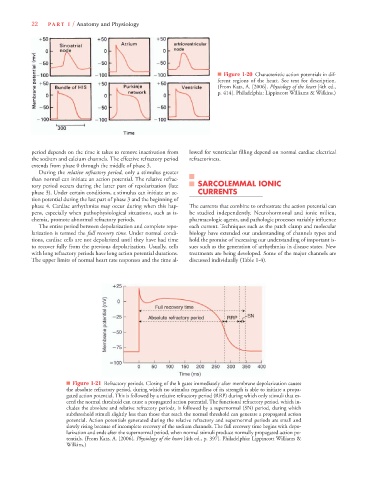
                                                                                 ■ Figure 1-20 Characteristic action potentials in dif-
                                                                                 ferent regions of the heart. See text for description.
                                                                                 (From Katz, A. [2006]. Physiology of the heart [4th ed.,
                                                                                 p. 414]. Philadelphia: Lippincott Williams & Wilkins.)


                     period depends on the time it takes to remove inactivation from  lowed for ventricular filling depend on normal cardiac electrical
                     the sodium and calcium channels. The effective refractory period  refractoriness.
                     extends from phase 0 through the middle of phase 3.
                       During the relative refractory period, only a stimulus greater
                     than normal can initiate an action potential. The relative refrac-
                     tory period occurs during the latter part of repolarization (late  SARCOLEMMAL IONIC
                     phase 3). Under certain conditions, a stimulus can initiate an ac-  CURRENTS
                     tion potential during the last part of phase 3 and the beginning of
                     phase 4. Cardiac arrhythmias may occur during when this hap-  The currents that combine to orchestrate the action potential can
                     pens, especially when pathophysiological situations, such as is-  be studied independently. Neurohormonal and ionic milieu,
                     chemia, promote abnormal refractory periods.       pharmacologic agents, and pathologic processes variably influence
                       The entire period between depolarization and complete repo-  each current. Techniques such as the patch clamp and molecular
                     larization is termed the full recovery time. Under normal condi-  biology have extended our understanding of channels types and
                     tions, cardiac cells are not depolarized until they have had time  hold the promise of increasing our understanding of important is-
                     to recover fully from the previous depolarization. Usually, cells  sues such as the generation of arrhythmias in disease states. New
                     with long refractory periods have long action potential durations.  treatments are being developed. Some of the major channels are
                     The upper limits of normal heart rate responses and the time al-  discussed individually (Table 1-4).


                                ■ Figure 1-21 Refractory periods. Closing of the h gates immediately after membrane depolarization causes
                                the absolute refractory period, during which no stimulus regardless of its strength is able to initiate a propa-
                                gated action potential. This is followed by a relative refractory period (RRP) during which only stimuli that ex-
                                ceed the normal threshold can cause a propagated action potential. The functional refractory period, which in-
                                cludes the absolute and relative refractory periods, is followed by a supernormal (SN) period, during which
                                subthreshold stimuli slightly less than those that reach the normal threshold can generate a propagated action
                                potential. Action potentials generated during the relative refractory and supernormal periods are small and
                                slowly rising because of incomplete recovery of the sodium channels. The full recovery time begins with depo-
                                larization and ends after the supernormal period, when normal stimuli produce normally propagated action po-
                                tentials. (From Katz, A. [2006]. Physiology of the heart [4th ed., p. 397]. Philadelphia: Lippincott Williams &
                                Wilkins.)

