


Page 47 - Cardiac Nursing
P. 47
92806_c01.qxd  11/21/11  10:30 AM  Page 23


                                                                          CHAPTER 1 / Cardiac Anatomy and Physiology   23


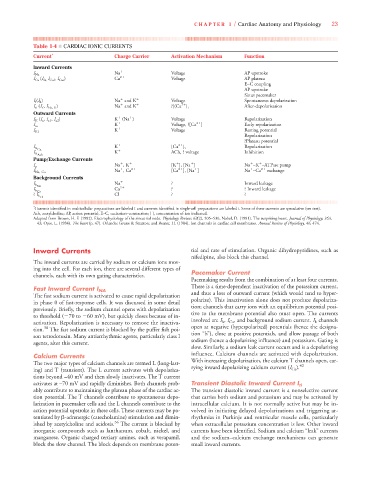
                     Table 1-4 ■ CARDIAC IONIC CURRENTS
                     Current *                  Charge Carrier    Activation Mechanism    Function
                     Inward Currents
                                                Na                Voltage                 AP upstroke
                     I Na
                     I Ca  (I Si,  I Caf , I Cas )  Ca 2          Voltage                 AP plateau
                                                                                          E–C coupling
                                                                                          AP upstroke
                                                                                          Sinus pacemaker

                     I f (I h )                 Na and K          Voltage                 Spontaneous depolarization
                                                                     2

                     I ti (I t’ , I Na, K )     Na and K          ?[(Ca ] i               After-depolarization
                     Outward Currents


                     I K (I x , I x1 , I x2 )   K (Na )           Voltage                 Repolarization
                                                                          2
                                                K                 Voltage, ?[Ca ]         Early repolarization
                     I to
                                                K                 Voltage                 Resting potential
                     I K1
                                                                                          Repolarization
                                                                                          ?Plateau potential
                                                K                   2                     Repolarization
                     I K Ca                                       [Ca ] i
                                                K                 ACh, ? voltage          Inhibition
                     I K Ach
                     Pump/Exchange Currents


                                                Na , K            [K ], [Na ]             Na –K –ATPase pump
                     I p


                                                                    2
                                                Na , Ca 2         [Ca ], [Na ]            Na –Ca 2   exchange
                     I Na, Ca
                     Background Currents
                                                Na                ?                       Inward leakage
                     I b Na
                                                Ca 2              ?                       ? Inward leakage
                     I b Ca
                                                Cl –              ?                       ?
                     ? I b Cl
                     *
                      Currents identified in multicellular preparations are labeled I and currents identified in single-cell preparations are labeled i. Some of these currents are speculative (see text).
                     Ach, acetylcholine; AP, action potential; E–C, excitation–contraction; [ ], concentration of ion indicated.
                     Adapted from Brown, H. F. (1982). Electrophysiology of the sinoatrial node. Physiology Review, 62(2), 505–530; Nobel, D. (1981). The surprising heart. Journal of Physiology, 353,
                      43; Opie, L. (1984). The heart (p. 47). Orlando: Grune & Stratton; and Reuter, H. (1984). Ion channels in cardiac cell membranes. Annual Review of Physiology, 46, 474.
                     Inward Currents                                     tial and rate of stimulation. Organic dihydropyridines, such as
                                                                         nifedipine, also block this channel.
                     The inward currents are carried by sodium or calcium ions mov-
                     ing into the cell. For each ion, there are several different types of  Pacemaker Current
                     channels, each with its own gating characteristics.
                                                                         Pacemaking results from the combination of at least four currents.
                                                                         There is a time-dependent inactivation of the potassium current,
                     Fast Inward Current I NA
                                                                         and thus a loss of outward current (which would tend to hyper-
                     The fast sodium current is activated to cause rapid depolarization
                                                                         polarize). This inactivation alone does not produce depolariza-
                     in phase 0 of fast-response cells. It was discussed in some detail
                                                                         tion; channels that carry ions with an equilibrium potential posi-
                     previously. Briefly, the sodium channel opens with depolarization
                                                                         tive to the membrane potential also must open. The currents
                     to threshold ( 70 to  60 mV), but quickly closes because of in-
                                                                         involved are I h , I Ca , and background sodium current. I h channels
                     activation. Repolarization is necessary to remove the inactiva-
                         38
                     tion. The fast sodium current is blocked by the puffer fish poi-  open at negative (hyperpolarized) potentials (hence the designa-
                                                                         tion “h”), close at positive potentials, and allow passage of both
                     son tetrodotoxin. Many antiarrhythmic agents, particularly class I
                                                                         sodium (hence a depolarizing influence) and potassium. Gating is
                     agents, alter this current.
                                                                         slow. Similarly, a sodium leak current occurs and is a depolarizing
                     Calcium Currents                                    influence. Calcium channels are activated with depolarization.
                                                                         With increasing depolarization, the calcium T channels open, car-
                     The two major types of calcium channels are termed L (long-last-
                                                                         rying inward depolarizing calcium current (I Ca ). 42
                     ing) and T (transient). The L current activates with depolariza-
                     tions beyond –40 mV and then slowly inactivates. The T current
                     activates at –70 mV and rapidly diminishes. Both channels prob-  Transient Diastolic Inward Current I ti
                     ably contribute to maintaining the plateau phase of the cardiac ac-  The transient diastolic inward current is a nonselective current
                     tion potential. The T channels contribute to spontaneous depo-  that carries both sodium and potassium and may be activated by
                     larization in pacemaker cells and the L channels contribute to the  intracellular calcium. It is not normally active but may be in-
                     action potential upstroke in these cells. These currents may be po-  volved in initiating delayed depolarizations and triggering ar-
                     tentiated by  -adrenergic (catecholamine) stimulation and dimin-  rhythmias in Purkinje and ventricular muscle cells, particularly
                     ished by acetylcholine and acidosis. 36  The current is blocked by  when extracellular potassium concentration is low. Other inward
                     inorganic compounds such as lanthanum, cobalt, nickel, and  currents have been identified. Sodium and calcium “leak” currents
                     manganese. Organic charged tertiary amines, such as verapamil,  and the sodium–calcium exchange mechanisms can generate
                     block the slow channel. The block depends on membrane poten-  small inward currents.

