


Page 39 - Cardiac Nursing
P. 39
92806_c01.qxd  11/21/11  10:30 AM  Page 15


                                                                          CHAPTER 1 / Cardiac Anatomy and Physiology   15


                     Table 1-2 ■ APPROXIMATE INTRACELLULAR AND EXTRACELLULAR ION CONCENTRATIONS AND ACTIVITIES IN
                     CARDIAC MUSCLE *
                                                                   Ratio of Extracellular to
                                Extracellular     Intracellular         Intracellular
                     Ion †     Concentration ‡  Concentration §11      Concentration          E 1       Intracellular Activity #

                     Na           145 mM             15 mM                 9.7               60 mV            7.0 mM
                     K             4 mM             150 mM                 0.027             94 mV            125 mM
                     Cl           120 mM              5 mM                  24               83 mV            15 mM
                     Ca 2          2 mM            10  4  M               2    10 4          129 mV         8   10  6  mM

                     * Values given are approximations and vary according to the cardiac tissue, species, and method used for measurement.
                                                2
                     † Na , sodium; K , potassium; Cl , chloride; Ca , calcium.


                                        –
                     ‡ mM, millimolar.
                     §11 Most of the intracellular calcium is bound to proteins or sequestered in intracellular organelles; thus, total intracellular calcium content approximates 1 to 2 mm. During contrac-
                      tion, measurable intracellular calcium concentration approximates 10 –5  mm.
                     ¶ E 1 , equilibrium potential; mV, millivolt.
                     # Median values from summarized data; these values should be considered as subject to revision. Concentrations and equilibrium potentials from Sperelakis, N. (1979). Origin of the
                      cardiac resting potential. In R. M. Berne (Ed.), Handbook of physiology, section 2: The cardiovascular system, vol 1, the heart (p. 193). Bethesda: American Physiological Society. Activi-
                      ties are approximations from Lee, C. O. (1981). Ionic activities in cardiac muscle cells and application of ion-sensitive microelectrodes, American Journal of Physiology, 10, H461,
                      H464 and Fozzard, H. A., & Wasserstrom, J. A. (1985). Voltage dependence of intracellular sodium and control of contraction. In P. P. Zipes, & J. Jalife. Cardiac electrophysiology
                      and arrhythmias (p. 52.). Orlando: Grune & Tratton.
                       For each ion, concentration differences across the sarcolemma  layer or span its full thickness. Some of the proteins contain a water-
                     are determined by the sarcolemma’s permeability to that ion and  filled pore that spans the membrane, connecting the intracellular
                     the balance of forces moving the ion from one to the other side of  and extracellular spaces and forming a channel through which ions
                     the membrane. Electrical and concentration differences are main-  can pass. Membrane channels open and close in response to a stim-
                     tained by a number of active and passive processes. Typical con-  ulus (electrical, mechanical, or chemical), allowing passage of specific
                     centration differences are outlined in Table 1-2.   ions when open. The opening and closing properties of a channel are
                       The sarcolemma is composed of phospholipid molecules. Each  called its gating characteristics. The ability of a channel to selectively
                     molecule consists of a charged hydrophilic (water-attracting) glob-  allow passage of certain ions while restricting other ions is called its
                     ular head and a noncharged hydrophobic (water-repelling) tail.  selectivity property. Many ion channels are named after the ion for
                     The molecules organize into thin sheets, with the heads oriented in  which they have selectivity. Some common types are sodium chan-
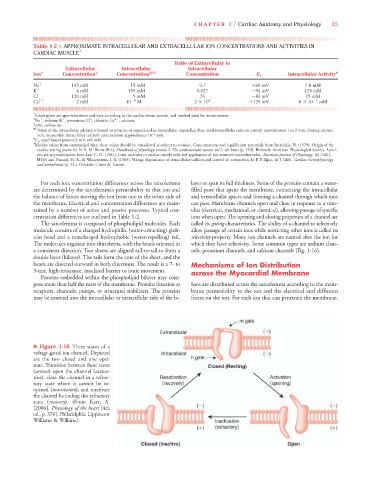
                     a consistent direction. Two sheets are aligned tail-to-tail to form a  nels, potassium channels, and calcium channels (Fig. 1-16).
                     double layer (bilayer). The tails form the core of the sheet, and the
                     heads are directed outward in both directions. The result is a 7- to  Mechanisms of Ion Distribution
                     9-nm, high-resistance, insulated barrier to ionic movement.  across the Myocardial Membrane
                       Proteins embedded within the phospholipid bilayer may com-
                     pose more than half the mass of the membrane. Proteins function as  Ions are distributed across the sarcolemma according to the mem-
                     receptors, channels, pumps, or structural stabilizers. The proteins  brane permeability to the ion and the electrical and diffusion
                     may be inserted into the intracellular or extracellular side of the bi-  forces on the ion. For each ion that can penetrate the membrane,


                     ■ Figure 1-16 Three states of a
                     voltage-gated ion channel. Depicted
                     are the two closed and one open
                     state. Transition between these states
                     (arrows) open the channel (activa-
                     tion), close the channel in a refrac-
                     tory state where it cannot be re-
                     opened (inactivation), and reactivate
                     the channel by ending this refractory
                     state (recovery). (From Katz, A.
                     [2006]. Physiology of the heart [4th
                     ed., p. 376]. Philadelphia: Lippincott
                     Williams & Wilkins.)

