


Page 451 - Cardiac Nursing
P. 451
8:2
                                    009
                    p42
                                           7 A
                                               P
                                               P
                                             M
                         38.
                         38.
                       0-4
                           qxd
                                  9/2
                                9/0
                               0
            K34
               0-c
                 19_
            K34
         LWB K34 0-c 19_ p42 0-4 38. qxd  0 9/0 9/2 009  0 0 8:2 7 A M  P a a g e 4 27  Apt ara
         L L LWB
         LWBK340-c19_19_p420-438.qxd  09/09/2009  08:27 AM  Page 427 Aptara
                                                    27
                                                  e 4
                                                 g
                                                    27
                                                         ara
                                                       Apt
                                                                                   C HAPTER 1 9 / Exercise Testing  427
                    DISPLAY 19-2  Example of an Automated Exercise Test Summary Report with Diagnostic and Prognostic Probabilities
                                  Generated from A Computer Program (continued)
                    Angiographic CAD Prediction
                    The patient has no recorded history of coronary disease. Pretest probabilities for any significant coronary disease are 50%
                      (CASS, 1981 [chest pain, age, gender]), 71% (Morise, 1992), and 51% (Do/Froelicher, 1997,1998). Pretest probabilities for severe
                      coronary disease are 22% (Pryor, 1993), 52% (Morise, 1992), and 17% (Do/Froelicher, 1997,1998).
                    The posttest probabilities for any clinically significant CAD are 99% (Detrano, 1992), 98% (Morise, 1992), and 94%
                      (Do/Froelicher, 1997,1998) due to age, diabetes mellitus, symptoms, and abnormal ST depression.
                    The probabilities of having severe CAD are 75% (Detrano, 1992) due to abnormal ST depression, 91% (Morise, 1992) due to
                      age abnormal ST depression, and 74% (Do/Froelicher, 1997,1998) due to abnormal ST depression.
                    Operative Mortality Prediction
                    If the patient would be selected for nonemergent bypass surgery and no renal dysfunction was present, the estimated
                      operative morality rates are 9% (Parsonnet, 1989), 2% (NY State Department of Health, 1992), and 3% (VA, 1993). This is
                      partially based on an estimated EF of 45%, so compare with measured EF.
                    Disclaimer: This report was computer generated and the results are dependent on rules and correct data entry. It must be
                      overread by a physician.
                   EF, ejection fraction; ECG, electrocardiographic; METs, metabolic equivalents; SBP, systolic blood pressure.
                   From Froelicher, V. F. (1996). Exercise test reporting aid (EXTRA) software. St. Louis, MO: Mosby-Year Book.
                   Morise, A. P., Detrano, R., Bobbio, M., et al. (1993). Development and validation of a logistic regression-derived algorithm for estimating the incremental probability of coronary
                    artery disease before and after exercise testing. Journal of the American College of Cardiology 22(1), 340–341.
                   Do, D., West, J. A., Morise, A., et al. (1997). An agreement approach to predict severe angiographic coronary artery disease with clinical and exercise test data. American Heart Jour-
                    nal 134(4),672–679.
                   Do, D., Marcus, R., Froelicher, V., et al. (1998). Predicting severe angiographic coronary artery disease using computerization of clinical and exercise test data. Chest 114(5),1437–1445.
                   Pryor, D. B., Shaw, L., McCants, C.B., et al. (1993). Value of the history and physical in identifying patients at increased risk for coronary artery disease. Annals of Internal Medicine
                    118(2),81–90.
                   Detrano, R., Janosi, A., Steinbrunn, W., et al. (1991). Algorithm to predict triple-vessel/left main coronary artery disease in patients without myocardial infarction. An international
                    cross validation. Circulation 83(5 Suppl),III89–96.
                   Parsonnet, V., Dean, D., Bernstein A. D. (1989). A method of uniform stratification of risk for evaluating the results of surgery in acquired adult heart disease. Circulation 79(6 Pt 2),I3–I12.
                   exchange techniques, but this requires specialized equipment and  an MET value can be ascribed to any speed and grade on a tread-
                   is not available in many clinical laboratories. Exercise capacity is  mill or workload achieved on a cycle ergometer; therefore, exercise
                   therefore usually expressed as exercise duration, watts achieved  capacity can be compared uniformly between protocols.
                   (on a bicycle ergometer), maximal exercise stage, or METs. In the  As mentioned previously in the discussion on protocols, there
                   absence of gas exchange techniques, it is preferable to express ex-  can be a great deal of uncertainty in predicting a person’s energy cost
                   ercise capacity in METs rather than exercise time. This is because  from the treadmill or cycle ergometer workload. How accurately an
                                                                       MET level predicts a person’s true oxygen uptake depends on several
                                                                       factors. For most patients with cardiovascular or pulmonary disease,
                       250                                             there is a substantial overprediction of the MET level. 8,25,29,60  The
                                                                       error associated with this prediction is accentuated when rapidly
                       220                                             incremented protocols are used, when patients are unaccustomed to
                                                                       walking on a treadmill or pedaling a cycle ergometer, and when
                                                                                                      8,29,60
                                                                       patients are allowed to use handrail support.
                      Maximal heart rate  160                          and as a relative percentage of normal reference values for age and
                       190
                                                                         Exercise capacity should be expressed as both an absolute value
                                                                       gender. The latter can be important because exercise capacity de-
                                                                       clines with increasing age and higher values are observed in men.
                                                                       Thus, when measuring or estimating oxygen uptake or MET levels,
                       130
                                                                       it is useful to have reference values for comparison. Normal refer-
                                                                       ence values can facilitate communication with patients and between
                       100
                                                                       physicians regarding levels of exercise capacity in relation to a given
                                                                       patient’s peers. Figures 19-4 and 19-5 are illustrations of nomo-
                        70                                             grams for male patients referred for exercise testing. Expressing rel-
                           20       40        60       80       100    ative exercise capacity using a nomogram is advantageous because it
                                                                       offers a simple visual method of classifying a patient’s response,
                                             Age
                                                                       without having to make cumbersome calculations from a particular
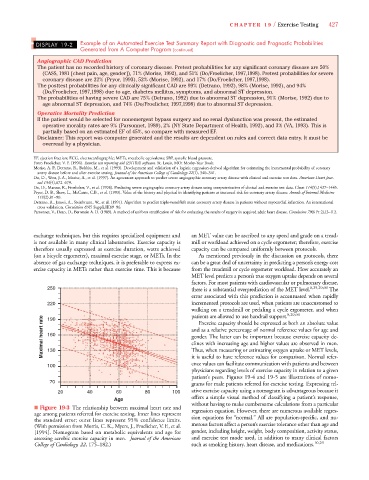
                   ■ Figure 19-3 The relationship between maximal heart rate and  regression equation. However, there are numerous available regres-
                   age among patients referred for exercise testing. Inner lines represent
                   the standard error; outer lines represent 95% confidence limits.  sion equations for “normal.” All are population-specific, and nu-
                   (With permission from Morris, C. K., Myers, J., Froelicher, V. F., et al.  merous factors affect a person’s exercise tolerance other than age and
                   [1994]. Nomogram based on metabolic equivalents and age for  gender, including height, weight, body composition, activity status,
                   assessing aerobic exercise capacity in men.  Journal of the American  and exercise test mode used, in addition to many clinical factors
                   College of Cardiology, 22, 175–182.)                such as smoking history, heart disease, and medications. 10,29

