


Page 465 - Cardiac Nursing
P. 465
LWBK340-c20_p439-459.qxd  6/29/09  11:29 PM  Page 441 Aptara Inc.


                                                                             C HAP TE R 2 0 / Cardiac Catheterization  441


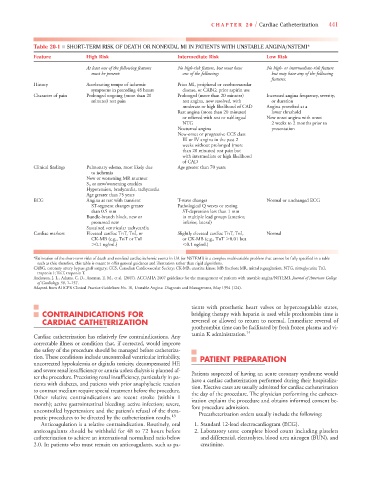
                   Table 20-1 ■ SHORT-TERM RISK OF DEATH OR NONFATAL MI IN PATIENTS WITH UNSTABLE ANGINA/NSTEMI*
                   Feature          High Risk                     Intermediate Risk            Low Risk
                                    At least one of the following features  No high-risk feature, but must have  No  high- or intermediate-risk feature
                                      must be present:              one of the following:        but may have any of the following
                                                                                                 features:
                   History          Accelerating tempo of ischemic   Prior MI, peripheral or cerebrovascular
                                      symptoms in preceding 48 hours  disease, or CABG; prior aspirin use
                   Character of pain  Prolonged ongoing (more than 20   Prolonged (more than 20 minutes)   Increased angina frequency, severity,
                                      minutes) rest pain            rest angina, now resolved, with  or duration
                                                                    moderate or high likelihood of CAD  Angina provoked at a
                                                                  Rest angina (more than 20 minutes)   lower threshold
                                                                    or relieved with rest or sublingual  New onset angina with onset
                                                                    NTG                          2 weeks to 2 months prior to
                                                                  Nocturnal angina               presentation
                                                                  New-onset or progressive CCS class
                                                                    III or IV angina in the past 2
                                                                    weeks without prolonged (more
                                                                    than 20 minutes) rest pain but
                                                                    with intermediate or high likelihood
                                                                    of CAD
                   Clinical findings  Pulmonary edema, most likely due  Age greater than 70 years
                                      to ischemia
                                    New or worsening MR murmur
                                    S 3 or new/worsening crackles
                                    Hypotension, bradycardia, tachycardia
                                    Age greater than 75 years
                   ECG              Angina at rest with transient   T-wave changes             Normal or unchanged ECG
                                      ST-segment changes greater   Pathological Q waves or resting
                                      than 0.5 mm                   ST-depression less than 1 mm
                                    Bundle-branch block, new or     in multiple lead groups (anterior,
                                      presumed new                  inferior, lateral)
                                    Sustained ventricular tachycardia
                   Cardiac markers  Elevated cardiac TnT, TnI, or   Slightly elevated cardiac TnT, TnI,   Normal
                                      CK-MB (e.g., TnT or TnI       or CK-MB (e.g., TnT  0.01 but
                                       0.1 ng/mL)                    0.1 ng/mL)

                   *Estimation of the short-term risks of death and nonfatal cardiac ischemic events in UA (or NSTEMI) is a complex multivariable problem that cannot be fully specified in a table
                    such as this; therefore, this table is meant to offer general guidance and illustration rather than rigid algorithms.
                   CABG, coronary artery bypass graft surgery; CCS, Canadian Cardiovascular Society; CK-MB, creatine kinase MB fraction; MR, mitral regurgitation; NTG, nitroglycerin; TnI,
                    troponin I; TnT, troponin T.
                   Anderson, J. L., Adams, C. D., Antman, E. M., et al. (2007). ACC/AHA 2007 guidelines for the management of patients with unstable angina/NSTEMI. Journal of American College
                    of Cardiology, 50, 1–157.
                   Adapted from AHCPR Clinical Practice Guidelines No. 10, Unstable Angina: Diagnosis and Management, May 1994 (124).

                                                                       tients with prosthetic heart valves or hypercoagulable states,
                      CONTRAINDICATIONS FOR                            bridging therapy with heparin is used while prothrombin time is
                      CARDIAC CATHETERIZATION                          reversed or allowed to return to normal. Immediate reversal of
                                                                       prothrombin time can be facilitated by fresh frozen plasma and vi-
                                                                       tamin K administration. 14
                   Cardiac catheterization has relatively few contraindications. Any
                   correctable illness or condition that, if corrected, would improve
                   the safety of the procedure should be managed before catheteriza-
                   tion. These conditions include uncontrolled ventricular irritability,  PATIENT PREPARATION
                   uncorrected hypokalemia or digitalis toxicity, decompensated HF,
                   and severe renal insufficiency or anuria unless dialysis is planned af-  Patients suspected of having an acute coronary syndrome would
                   ter the procedure. Preexisting renal insufficiency, particularly in pa-  have a cardiac catheterization performed during their hospitaliza-
                   tients with diabetes, and patients with prior anaphylactic reaction  tion. Elective cases are usually admitted for cardiac catheterization
                   to contrast medium require special treatment before the procedure.  the day of the procedure. The physician performing the catheter-
                   Other relative contraindications are recent stroke (within 1  ization explains the procedure and obtains informed consent be-
                   month); active gastrointestinal bleeding; active infection; severe,  fore procedure admission.
                   uncontrolled hypertension; and the patient’s refusal of the thera-  Precatheterization orders usually include the following:
                   peutic procedures to be directed by the catheterization results. 13
                     Anticoagulation is a relative contraindication. Routinely, oral  1. Standard 12-lead electrocardiogram (ECG).
                   anticoagulants should be withheld for 48 to 72 hours before  2. Laboratory tests: complete blood count including platelets
                   catheterization to achieve an international normalized ratio below  and differential, electrolytes, blood urea nitrogen (BUN), and
                   2.0. In patients who must remain on anticoagulants, such as pa-  creatinine.

