


Page 467 - Cardiac Nursing
P. 467
9 P
                                     9 P
                                        M
                                        M
                   p
                    43
                                   1:2
                   p
                    43
                                          Pa
                                              43
                                            e 4
                                                A
                                              43
                                            e 4
                                           g
                                          Pa
                                           g
                                           g
                           xd
                              6
                          q
                           xd
                             6
                              /29
                                /09
                             6
                              /29
                          q
                      9-4
                      9-4
                                   1:2
                                   1
                                   1
                        59.
                          q
                                /09
                        59.
                                                A
                                                    In
                                                      c.
                                                    In
                                                   a
         LWB K34 0-c 20_ pp439-459.qxd  6/29/09  11:29 PM  Page 443 Aptara Inc.
                                                      c.
               0-c
                 20_
            K34
         LWB
         LWBK340-c20_
                                                  t
                                                  t
                                                  ara
                                                 p
                                                 p
                                                 p
                                                   a
                                                   a
                                                   a
                                                  ara
                                                  ara
                                                                             C HAPTER 2 0 / Cardiac Catheterization  443
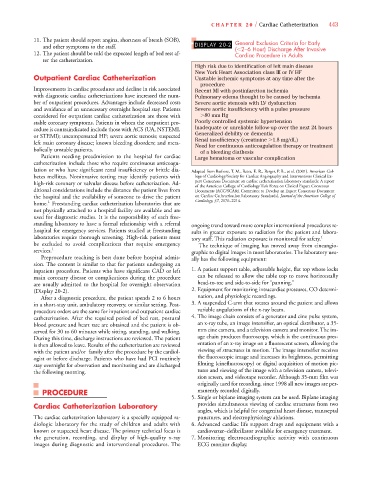
                   11. The patient should report angina, shortness of breath (SOB),  General Exclusion Criteria for Early
                      and other symptoms to the staff.                  DISPLAY 20-2  ( 2–6 Hour) Discharge After Invasive
                   12. The patient should be told the expected length of bed rest af-  Cardiac Procedure in Adults
                      ter the catheterization.
                                                                        High risk due to identification of left main disease
                                                                        New York Heart Association class III or IV HF
                   Outpatient Cardiac Catheterization                   Unstable ischemic symptoms at any time after the
                                                                         procedure
                   Improvements in cardiac procedures and decline in risk associated  Recent MI with postinfarction ischemia
                   with diagnostic cardiac catheterizations have increased the num-  Pulmonary edema thought to be caused by ischemia
                   ber of outpatient procedures. Advantages include decreased costs  Severe aortic stenosis with LV dysfunction
                   and avoidance of an unnecessary overnight hospital stay. Patients  Severe aortic insufficiency with a pulse pressure
                   considered for outpatient cardiac catheterization are those with   80 mm Hg
                   stable coronary symptoms. Patients in whom the outpatient pro-  Poorly controlled systemic hypertension
                   cedure is contraindicated include those with ACS (UA, NSTEMI,  Inadequate or unreliable follow-up over the next 24 hours
                   or STEMI); uncompensated HF; severe aortic stenosis; suspected  Generalized debility or dementia
                   left main coronary disease; known bleeding disorders; and meta-  Renal insufficiency (creatinine  1.8 mg/dL)
                                                                        Need for continuous anticoagulation therapy or treatment
                   bolically unstable patients.                          of a bleeding diathesis
                     Patients needing preadmission to the hospital for cardiac  Large hematoma or vascular complication
                   catheterization include those who require continuous anticoagu-
                   lation or who have significant renal insufficiency or brittle dia-  Adapted from Bashore, T. M., Bates, E. R., Berger, P. B., et al. (2001). American Col-
                   betes mellitus. Noninvasive testing may identify patients with  lege of Cardiology/Society for Cardiac Angiography and Interventions Clinical Ex-
                   high-risk coronary or valvular disease before catheterization. Ad-  pert Consensus Document on cardiac catheterization laboratory standards: A report
                                                                        of the American College of Cardiology Task Force on Clinical Expert Consensus
                   ditional considerations include the distance the patient lives from  Documents (ACC/SCA&I Committee to Develop an Expert Consensus Document
                   the hospital and the availability of someone to drive the patient  on Cardiac Catheterization Laboratory Standards). Journal of the American College of
                                                                               7
                                                                               7
                        1
                   home. Freestanding cardiac catheterization laboratories that are  Cardiology, 37, 2170–2214.
                   not physically attached to a hospital facility are available and are
                   used for diagnostic studies. It is the responsibility of each free-
                   standing laboratory to have a formal relationship with a referral  ongoing trend toward more complex interventional procedures re-
                   hospital for emergency services. Patients studied at freestanding  sults in greater exposure to radiation for the patient and labora-
                   laboratories require thorough screening. High-risk patients must  tory staff. This radiation exposure is monitored for safety. 1
                   be excluded to avoid complications that require emergency  The technique of imaging has moved away from cineangio-
                   services. 1                                         graphic to digital images in most laboratories. The laboratory usu-
                     Preprocedure teaching is best done before hospital admis-  ally has the following equipment:
                   sion. The content is similar to that for patients undergoing an
                   inpatient procedure. Patients who have significant CAD or left  1. A patient support table, adjustable height, flat top whose locks
                   main coronary disease or complications during the procedure  can be released to allow the table top to move horizontally
                   are usually admitted to the hospital for overnight observation  head-to-toe and side-to-side for “panning.”
                   (Display 20-2).                                     2. Equipment for monitoring intracardiac pressures, CO determi-
                     After a diagnostic procedure, the patient spends 2 to 6 hours  nation, and physiologic recordings.
                   in a short-stay unit, ambulatory recovery, or similar setting. Post-  3. A suspended C-arm that rotates around the patient and allows
                   procedure orders are the same for inpatient and outpatient cardiac  variable angulations of the x-ray beam.
                   catheterization. After the required period of bed rest, postural  4. The image chain consists of a generator and cine pulse system,
                   blood pressure and heart rate are obtained and the patient is ob-  an x-ray tube, an image intensifier, an optical distributor, a 35-
                   served for 30 to 60 minutes while sitting, standing, and walking.  mm cine camera, and a television camera and monitor. The im-
                   During this time, discharge instructions are reviewed. The patient  age chain produces fluoroscopy, which is the continuous pres-
                   is then allowed to leave. Results of the catheterization are reviewed  entation of an x-ray image on a fluorescent screen, allowing the
                   with the patient and/or  family after the procedure by the cardiol-  viewing of structures in motion. The image intensifier receives
                   ogist or before discharge. Patients who have had PCI routinely  the fluoroscopic image and increases its brightness, permitting
                   stay overnight for observation and monitoring and are discharged  filming (cinefluoroscopy) or digital acquisition of motion pic-
                   the following morning.                                tures and viewing of the image with a television camera, televi-
                                                                         sion screen, and videotape recorder. Although 35-mm film was
                                                                         originally used for recording, since 1998 all new images are per-
                      PROCEDURE                                          manently recorded digitally.
                                                                       5. Single or biplane imaging system can be used. Biplane imaging
                   Cardiac Catheterization Laboratory                    provides simultaneous viewing of cardiac structures from two
                                                                         angles, which is helpful for congenital heart disease, transseptal
                   The cardiac catheterization laboratory is a specially equipped ra-  punctures, and electrophysiology ablations.
                   diologic laboratory for the study of children and adults with  6. Advanced cardiac life support drugs and equipment with a
                   known or suspected heart disease. The primary technical focus is  cardioverter–defibrillator available for emergency treatment.
                   the generation, recording, and  display of  high-quality x-ray   7. Monitoring electrocardiographic activity with continuous
                   images during diagnostic and interventional procedures. The   ECG monitor display.

