


Page 468 - Cardiac Nursing
P. 468
1:2
                                     9 P
                                   1:2
                                   1
                                   1
                                     9 P
                                          Pa
                                          Pa
                                          Pa
                                        M
                                        M
                                    1
                           xd
                             6
                           xd
                          q
                          q
                             6
                                /09
                                /09
                                /09
                              /29
                              /29
                                           g
                                                   a
                                                   a
                                                  ara
                                                  t
                                                  ara
                                                   a
                                                      c.
                                                      c.
                                                    In
                                                   a
                                                    In
                                                  t
                                            e 4
                                              44
                                            e 4
                                           g
                                           g
                                              44
                                                 p
                                                 p
                                                 p
                                                A
                                                A
         LWB K34 0-c 20_ p p pp439-459.qxd  6/29/09  11:29 PM  Page 444 Aptara Inc.
         LWB
                    43
                    43
         LWBK340-c20_
                 20_
                 20_
            K34
               0-c
                        59.
                      9-4
                      9-4
                          q
                        59.
                        59.
                  444    P A R T  III / Assessment of Heart Disease
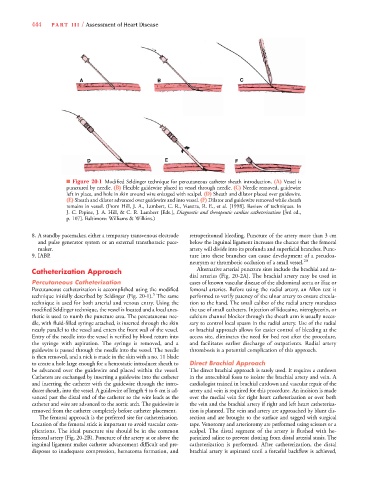
                                  A                        B                          C
                                    D                         E                      F
                              ■ Figure 20-1 Modified Seldinger technique for percutaneous catheter sheath introduction. (A) Vessel is
                              punctured by needle. (B) Flexible guidewire placed in vessel through needle. (C) Needle removed, guidewire
                              left in place, and hole in skin around wire enlarged with scalpel. (D) Sheath and dilator placed over guidewire.
                              (E) Sheath and dilator advanced over guidewire and into vessel. (F) Dilator and guidewire removed while sheath
                              remains in vessel. (From Hill, J. A., Lambert, C. R., Vuestra, R. E., et al. [1998]. Review of techniques. In
                              J. C. Pepine, J. A. Hill, & C. R. Lambert [Eds.], Diagnostic and therapeutic cardiac catheterization [3rd ed.,
                              p. 107]. Baltimore: Williams & Wilkins.)
                  8. A standby pacemaker, either a temporary transvenous electrode  retroperitoneal bleeding. Puncture of the artery more than 3 cm
                    and pulse generator system or an external transthoracic pace-  below the inguinal ligament increases the chance that the femoral
                    maker.                                            artery will divide into its profunda and superficial branches. Punc-
                  9. IABP.                                            ture into these branches can cause development of a pseudoa-
                                                                      neurysm or thrombotic occlusion of a small vessel. 20
                  Catheterization Approach                              Alternative arterial puncture sites include the brachial and ra-
                                                                      dial arteries (Fig. 20-2A). The brachial artery may be used in
                  Percutaneous Catheterization                        cases of known vascular disease of the abdominal aorta or iliac or
                  Percutaneous catheterization is accomplished using the modified  femoral arteries. Before using the radial artery, an Allen test is
                                                          5
                  technique initially described by Seldinger (Fig. 20-1). The same  performed to verify patency of the ulnar artery to ensure circula-
                  technique is used for both arterial and venous entry. Using the  tion to the hand. The small caliber of the radial artery mandates
                  modified Seldinger technique, the vessel is located and a local anes-  the use of small catheters. Injection of lidocaine, nitroglycerin, or
                  thetic is used to numb the puncture area. The percutaneous nee-  calcium channel blocker through the sheath arm is usually neces-
                  dle, with fluid-filled syringe attached, is inserted through the skin  sary to control local spasm in the radial artery. Use of the radial
                  nearly parallel to the vessel and enters the front wall of the vessel.  or brachial approach allows for easier control of bleeding at the
                  Entry of the needle into the vessel is verified by blood return into  access site, eliminates the need for bed rest after the procedure,
                  the syringe with aspiration.  The syringe is removed, and a  and facilitates earlier discharge of outpatients. Radial artery
                  guidewire is passed through the needle into the vessel. The needle  thrombosis is a potential complication of this approach.
                  is then removed, and a nick is made in the skin with a no. 11 blade
                  to create a hole large enough for a hemostatic introducer sheath to  Direct Brachial Approach
                  be advanced over the guidewire and placed within the vessel.  The direct brachial approach is rarely used. It requires a cutdown
                  Catheters are exchanged by inserting a guidewire into the catheter  in the antecubital fossa to isolate the brachial artery and vein. A
                  and inserting the catheter with the guidewire through the intro-  cardiologist trained in brachial cutdown and vascular repair of the
                  ducer sheath, into the vessel. A guidewire of length 4 to 6 cm is ad-  artery and vein is required for this procedure. An incision is made
                  vanced past the distal end of the catheter so the wire leads as the  over the medial vein for right heart catheterization or over both
                  catheter and wire are advanced to the aortic arch. The guidewire is  the vein and the brachial artery if right and left heart catheteriza-
                  removed from the catheter completely before catheter placement.  tion is planned. The vein and artery are approached by blunt dis-
                     The femoral approach is the preferred site for catheterization.  section and are brought to the surface and tagged with surgical
                  Location of the femoral stick is important to avoid vascular com-  tape. Venotomy and arteriotomy are performed using scissors or a
                  plications. The ideal puncture site should be in the common  scalpel. The  distal segment of the artery is  flushed with  he-
                  femoral artery (Fig. 20-2B). Puncture of the artery at or above the  parinized saline to prevent clotting from distal arterial stasis. The
                  inguinal ligament makes catheter advancement difficult and pre-  catheterization is  performed. After catheterization, the  distal
                  disposes to inadequate compression, hematoma formation, and  brachial artery is aspirated until a forceful backflow is achieved,

