


Page 479 - Cardiac Nursing
P. 479
6
                              6
                      9-4
                             6
                          q
                          q
                           xd
                           xd
                                                      c.
                                                    In
                                            e 4
                                                      c.
                                                   a
                      9-4
                                                    In
                                                   a
                                                  ara
                                                  ara
                                                   a
                                                  ara
                        59.
                                        M
                                                  t
                        59.
                                           g
                                           g
                          q
                                            e 4
                                          Pa
                                                   a
                                           g
                                          Pa
                                                A
                                                 p
                                                 p
                    43
                                     9 P
                                        M
                    43
                                                 p
         LWBK340-c20_
         LWB
         LWB K34 0-c 20_ p p pp439-459.qxd  6/29/09  11:29 PM  Page 455 Aptara Inc.
            K34
                                                  t
                 20_
               0-c
                                /09
                                /09
                                   1
                                   1
                                              55
                                              55
                              /29
                              /29
                                   1:2
                                                A
                                   1:2
                                     9 P
                                                                             C HAPTER 2 0 / Cardiac Catheterization  455
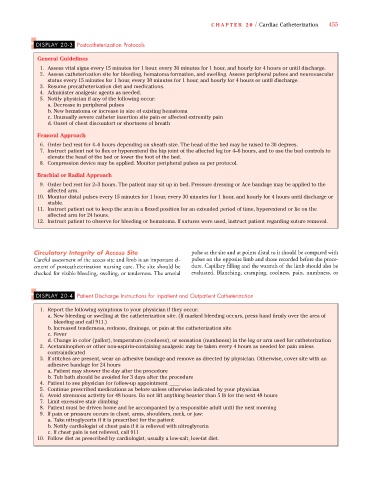
                    DISPLAY 20-3 Postcatheterization Protocols
                    General Guidelines
                     1. Assess vital signs every 15 minutes for 1 hour, every 30 minutes for 1 hour, and hourly for 4 hours or until discharge.
                     2. Assess catheterization site for bleeding, hematoma formation, and swelling. Assess peripheral pulses and neurovascular
                        status every 15 minutes for 1 hour, every 30 minutes for 1 hour, and hourly for 4 hours or until discharge.
                     3. Resume precatheterization diet and medications.
                     4. Administer analgesic agents as needed.
                     5. Notify physician if any of the following occur:
                        a. Decrease in peripheral pulses
                        b. New hematoma or increase in size of existing hematoma
                        c. Unusually severe catheter insertion site pain or affected extremity pain
                        d. Onset of chest discomfort or shortness of breath
                    Femoral Approach
                     6. Order bed rest for 4–6 hours depending on sheath size. The head of the bed may be raised to 30 degrees.
                     7. Instruct patient not to flex or hyperextend the hip joint of the affected leg for 4–6 hours, and to use the bed controls to
                        elevate the head of the bed or lower the foot of the bed.
                     8. Compression device may be applied. Monitor peripheral pulses as per protocol.
                    Brachial or Radial Approach
                     9. Order bed rest for 2–3 hours. The patient may sit up in bed. Pressure dressing or Ace bandage may be applied to the
                        affected arm.
                    10. Monitor distal pulses every 15 minutes for 1 hour, every 30 minutes for 1 hour, and hourly for 4 hours until discharge or
                        stable.
                    11. Instruct patient not to keep the arm in a flexed position for an extended period of time, hyperextend or lie on the
                        affected arm for 24 hours.
                    12. Instruct patient to observe for bleeding or hematoma. If sutures were used, instruct patient regarding suture removal.
                   Circulatory Integrity of Access Site                pulse at the site and at points distal to it should be compared with
                   Careful assessment of the access site and limb is an important el-  pulses on the opposite limb and those recorded before the proce-
                   ement of postcatheterization nursing care. The site should be  dure. Capillary filling and the warmth of the limb should also be
                   checked for visible bleeding, swelling, or tenderness. The arterial  evaluated. Blanching, cramping, coolness, pain, numbness, or
                    DISPLAY 20-4 Patient Discharge Instructions for Inpatient and Outpatient Catheterization
                     1. Report the following symptoms to your physician if they occur:
                        a. New bleeding or swelling at the catheterization site. (If marked bleeding occurs, press hand firmly over the area of
                          bleeding and call 911.)
                        b. Increased tenderness, redness, drainage, or pain at the catheterization site
                        c. Fever
                        d. Change in color (pallor), temperature (coolness), or sensation (numbness) in the leg or arm used for catheterization
                     2. Acetaminophen or other non-aspirin-containing analgesic may be taken every 4 hours as needed for pain unless
                        contraindicated
                     3. If stitches are present, wear an adhesive bandage and remove as directed by physician. Otherwise, cover site with an
                        adhesive bandage for 24 hours
                        a. Patient may shower the day after the procedure
                        b. Tub bath should be avoided for 3 days after the procedure
                     4. Patient to see physician for follow-up appointment ____
                     5. Continue prescribed medications as before unless otherwise indicated by your physician
                     6. Avoid strenuous activity for 48 hours. Do not lift anything heavier than 5 lb for the next 48 hours
                     7. Limit excessive stair climbing
                     8. Patient must be driven home and be accompanied by a responsible adult until the next morning
                     9. If pain or pressure occurs in chest, arms, shoulders, neck, or jaw:
                        a. Take nitroglycerin if it is prescribed for the patient
                        b. Notify cardiologist of chest pain if it is relieved with nitroglycerin
                        c. If chest pain is not relieved, call 911
                    10. Follow diet as prescribed by cardiologist, usually a low-salt, low-fat diet.

