


Page 481 - Cardiac Nursing
P. 481
9 P
                                     9 P
                                   1:2
                                   1
                                   1:2
                                        M
                                          Pa
                                           g
                                          Pa
                                        M
                                          Pa
                             6
                              /29
                             6
                           xd
                           xd
                              /29
                                    1
                                   1
                                /09
                                /09
                                /09
                                           g
                                                   a
                                                   a
                                                  ara
                                                  t
                                                  ara
                                                   a
                                                      c.
                                                      c.
                                                    In
                                                   a
                                                    In
                                              57
                                              57
                                            e 4
                                           g
                                            e 4
                                                A
                                                 p
                                                  t
                                                 p
                                                A
                                                 p
         LWB K34 0-c 20_ p p pp439-459.qxd  6/29/09  11:29 PM  Page 457 Aptara Inc.
         LWB
                    43
                      9-4
                    43
                 20_
                 20_
               0-c
         LWBK340-c20_
            K34
                      9-4
                        59.
                        59.
                        59.
                          q
                          q
                          q
                                                                             C HAPTER 2 0 / Cardiac Catheterization  457
                   Other Possible Problems                             tion due to systolic constriction from encircling muscle bands or
                   MI, stroke, and HF are very rare complications after cardiac  to coronary artery spasm is also observed, and its degree, distri-
                   catheterization. However, the nurse caring for patients after car-  bution, and pattern are evaluated. If bypass grafts have been in-
                   diac catheterization should be aware of the signs and symptoms of  jected, they are evaluated in the same manner for patency, flow
                   these complications.                                indices, and the condition of the perfused artery. Figures 20-12
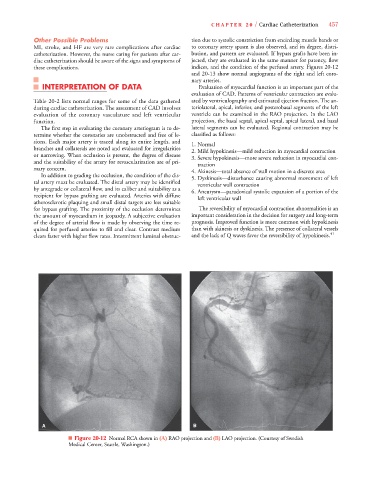
                                                                       and 20-13 show normal angiograms of the right and left coro-
                                                                       nary arteries.
                      INTERPRETATION OF DATA                             Evaluation of myocardial function is an important part of the
                                                                       evaluation of CAD. Patterns of ventricular contraction are evalu-
                   Table 20-2 lists normal ranges for some of the data gathered  ated by ventriculography and estimated ejection fraction. The an-
                   during cardiac catheterization. The assessment of CAD involves  teriolateral, apical, inferior, and posterobasal segments of the left
                   evaluation of the coronary vasculature and  left ventricular  ventricle can be examined in the RAO projection. In the LAO
                   function.                                           projection, the basal septal, apical septal, apical lateral, and basal
                     The first step in evaluating the coronary arteriogram is to de-  lateral segments can be evaluated. Regional contraction may be
                   termine whether the coronaries are unobstructed and free of le-  classified as follows:
                   sions. Each major artery is traced along its entire length, and  1. Normal
                   branches and collaterals are noted and evaluated for irregularities  2.Mild hypokinesis—mild reduction in myocardial contraction
                   or narrowing. When occlusion is present, the degree of disease  3. Severe hypokinesis—more severe reduction in myocardial con-
                   and the suitability of the artery for revascularization are of pri-  traction
                   mary concern.                                       4. Akinesis—total absence of wall motion in a discrete area
                     In addition to grading the occlusion, the condition of the dis-  5. Dyskinesis—disturbance causing abnormal movement of left
                   tal artery must be evaluated. The distal artery may be identified  ventricular wall contraction
                   by antegrade or collateral flow, and its caliber and suitability as a  6. Aneurysm—paradoxical systolic expansion of a portion of the
                   recipient for bypass grafting are evaluated. Arteries with diffuse  left ventricular wall
                   atherosclerotic plaquing and small distal targets are less suitable
                   for bypass grafting. The proximity of the occlusion determines  The reversibility of myocardial contraction abnormalities is an
                   the amount of myocardium in jeopardy. A subjective evaluation  important consideration in the decision for surgery and long-term
                   of the degree of arterial flow is made by observing the time re-  prognosis. Improved function is more common with hypokinesis
                   quired for perfused arteries to fill and clear. Contrast medium  than with akinesis or dyskinesis. The presence of collateral vessels
                   clears faster with higher flow rates. Intermittent luminal obstruc-  and the lack of Q waves favor the reversibility of hypokinesis. 41
                      A                                                B
                              ■ Figure 20-12 Normal RCA shown in (A) RAO projection and (B) LAO projection. (Courtesy of Swedish
                              Medical Center, Seattle, Washington.)

