


Page 474 - Cardiac Nursing
P. 474
1
                                   1:2
                                   1:2
                                /09
                                    1
                                   1
                                        M
                                          Pa
                                          Pa
                                     9 P
                                     9 P
                                        M
                                /09
                          q
                          q
                           xd
                        59.
                        59.
                          q
                              /29
                              /29
                                /09
                           xd
                             6
                             6
                                                  ara
                                                   a
                                                   a
                                                  t
                                                  t
                                                  ara
                                                    In
                                                      c.
                                                      c.
                                                   a
                                                   a
                                                    In
                                                 p
                                           g
                                            e 4
                                            e 4
                                          Pa
                                           g
                                           g
                                                A
                                                 p
                                                 p
                                              50
                                              50
                                                A
            K34
               0-c
                 20_
         LWB K34 0-c 20_ p p pp439-459.qxd  6/29/09  11:29 PM  Page 450 Aptara Inc.
         LWBK340-c20_
         LWB
                 20_
                      9-4
                      9-4
                        59.
                    43
                    43
                  450    P A R T  III / Assessment of Heart Disease
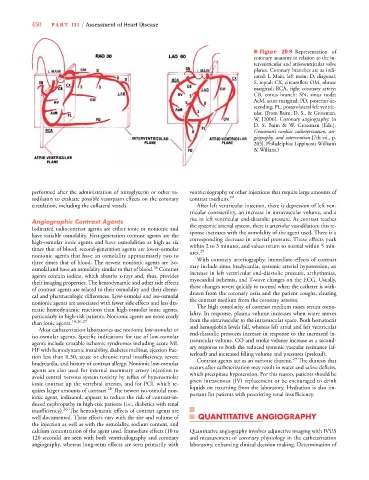
                                                                                           ■ Figure 20-9 Representation of
                                                                                           coronary anatomy in relation to the in-
                                                                                           terventricular and atrioventricular valve
                                                                                           planes. Coronary branches are as indi-
                                                                                           cated: L Main, left main; D, diagonal;
                                                                                           S, septal; CX, circumflex; OM, obtuse
                                                                                           marginal; RCA, right coronary artery;
                                                                                           CB, conus branch; SN, sinus node;
                                                                                           AcM, acute marginal; PD, posterior de-
                                                                                           scending; PL, posterolateral left ventric-
                                                                                           ular. (From Baim, D. S., & Grossman,
                                                                                           W. [2006]. Coronary angiography. In
                                                                                           D. S. Baim &  W. Grossman  [Eds.],
                                                                                           Grossman’s cardiac catheterization, an-
                                                                                           giography, and intervention [7th ed., p.
                                                                                           203]. Philadelphia: Lippincott Williams
                                                                                           & Wilkins.)
                  performed after the administration of nitroglycerin or other va-  ventriculography or other injections that require large amounts of
                  sodilators to evaluate possible vasospasm effects on the coronary  contrast medium. 29
                  circulation, including the collateral vessels.        After left ventricular injection, there is depression of left ven-
                                                                      tricular contractility, an increase in intravascular volume, and a
                                                                      rise in left ventricular end-diastolic pressure. As contrast reaches
                  Angiographic Contrast Agents
                  Iodinated radiocontrast agents are either ionic or nonionic and  the systemic arterial system, there is arteriolar vasodilation; this re-
                  have variable osmolality. First-generation contrast agents are the  sponse increases with the osmolality of the agent used. There is a
                  high-osmolar ionic agents and have osmolalities as high as six  corresponding decrease in arterial pressure. These effects peak
                  times that of blood; second-generation agents are lower-osmolar  within 2 to 3 minutes, and values return to normal within 5 min-
                                                                         29
                  nonionic agents that have an osmolality approximately two to  utes.
                  three times that of blood. The newest nonionic agents are iso-  With coronary arteriography, immediate effects of contrast
                                                          26
                  osmolal and have an osmolality similar to that of blood. Contrast  may include sinus bradycardia, systemic arterial hypotension, an
                  agents contain iodine, which absorbs x-rays and, thus, provides  increase in left ventricular end-diastolic pressure, arrhythmias,
                  their imaging properties. The hemodynamic and other side effects  myocardial ischemia, and T-wave changes on the ECG. Usually,
                  of contrast agents are related to their osmolality and their chemi-  these changes revert quickly to normal when the catheter is with-
                  cal and pharmacologic differences. Low-osmolal and iso-osmolal  drawn from the coronary ostia and the patient coughs, clearing
                  nonionic agents are associated with fewer side effects and less dra-  the contrast medium from the coronary arteries.
                  matic hemodynamic reactions than high-osmolar ionic agents,  The high osmolarity of contrast medium raises serum osmo-
                  particularly in high-risk patients. Nonionic agents are more costly  lality. In response, plasma volume increases when water moves
                  than ionic agents. 16,26,27                         from the extravascular to the intravascular space. Both hematocrit
                     Most catheterization laboratories use nonionic low-osmolar or  and hemoglobin levels fall, whereas left atrial and left ventricular
                  iso-osmolar agents. Specific indications for use of low-osmolar  end-diastolic pressures increase in response to the increased in-
                  agents include unstable ischemic syndromes including acute MI,  travascular volume. CO and stroke volume increase as a second-
                  HF with hemodynamic instability, diabetes mellitus, ejection frac-  ary response to both the reduced systemic vascular resistance (af-
                  tion less than 0.30, acute or chronic renal insufficiency, severe  terload) and increased filling volume and pressures (preload).
                                                                                                        29
                  bradycardia, and history of contrast allergy. Nonionic low-osmolar  Contrast agents act as an osmotic diuretic. The diuresis that
                  agents are also used for internal mammary artery injection to  occurs after catheterization may result in water and saline deficits,
                  avoid central nervous system toxicity by reflux of hyperosmolar  which precipitate hypotension. For this reason, patients should be
                  ionic contrast up the vertebral arteries, and for PCI, which re-  given intravenous (IV) replacement or be encouraged to drink
                                           28
                  quires larger amounts of contrast. The newest iso-osmolal non-  liquids on returning from the laboratory. Hydration is also im-
                  ionic agent, iodixanol, appears to reduce the risk of contrast-in-  portant for patients with preexisting renal insufficiency.
                  duced nephropathy in high-risk patients (i.e., diabetics with renal
                  insufficiency). 26  The hemodynamic effects of contrast agents are
                  well documented. These effects vary with the site and volume of  QUANTITATIVE ANGIOGRAPHY
                  the injection as well as with the osmolality, sodium content, and
                  calcium concentration of the agent used. Immediate effects (10 to  Quantitative angiography involves adjunctive imaging with IVUS
                  120 seconds) are seen with both ventriculography and coronary  and measurement of coronary physiology in the catheterization
                  angiography, whereas long-term effects are seen primarily with  laboratory, enhancing clinical decision making. Determination of

