


Page 486 - Cardiac Nursing
P. 486
g
                                               P
                                  9/2
                                                  e 4
                                                       Apt
                                                         ara
                                                    62
                                               P
                                9/0
                                                    62
                       0-5
                               0
                         10.
                         10.
                           qxd
         LWB K34 0-c 21_ p46 0-5 10. qxd  0 9/0 9/2 009  0 0 8:2 8 A M  P a a g e 4 62  Apt ara
            K34
                                             M
               0-c
                 21_
         L L LWB
                    p46
            K34
         LWBK340-c21_21_p460-510.qxd  09/09/2009  08:28 AM  Page 462 Aptara
                                        8:2
                                           8 A
                                    009
                  462    P A R T  III / Assessment of Heart Disease
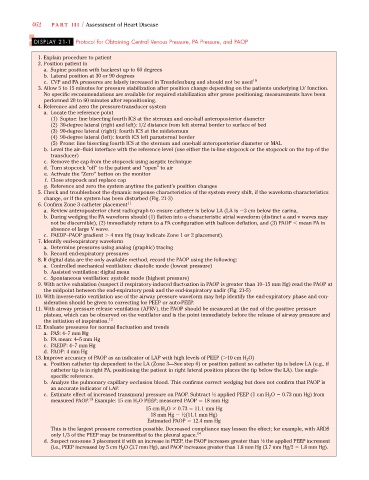
                   DISPLAY 21-1 Protocol for Obtaining Central Venous Pressure, PA Pressure, and PAOP
                    1. Explain procedure to patient
                    2. Position patient in
                      a. Supine position with backrest up to 60 degrees
                      b. Lateral position at 30 or 90 degrees
                      c. CVP and PA pressures are falsely increased in Trendelenburg and should not be used 10
                    3. Allow 5 to 15 minutes for pressure stabilization after position change depending on the patients underlying LV function.
                      No specific recommendations are available for required stabilization after prone positioning; measurements have been
                      performed 20 to 60 minutes after repositioning.
                    4. Reference and zero the pressure-transducer system
                      a. Locate the reference point
                         (1)Supine: line bisecting fourth ICS at the sternum and one-half anteroposterior diameter
                         (2) 30-degree lateral (right and left): 1/2 distance from left sternal border to surface of bed
                         (3) 90-degree lateral (right): fourth ICS at the midsternum
                         (4) 90-degree lateral (left): fourth ICS left parasternal border
                         (5) Prone: line bisecting fourth ICS at the sternum and one-half anteroposterior diameter or MAL
                      b. Level the air–fluid interface with the reference level (use either the in-line stopcock or the stopcock on the top of the
                         transducer)
                      c. Remove the cap from the stopcock using aseptic technique
                      d. Turn stopcock “off” to the patient and “open” to air
                      e. Activate the “Zero” button on the monitor
                       f. Close stopcock and replace cap
                      g. Reference and zero the system anytime the patient’s position changes
                    5. Check and troubleshoot the dynamic response characteristics of the system every shift, if the waveform characteristics
                      change, or if the system has been disturbed (Fig. 21-3)
                    6. Confirm Zone 3 catheter placement 11
                      a. Review anteroposterior chest radiograph to ensure catheter is below LA (LA is  3 cm below the carina.
                      b. During wedging the PA waveform should (1) flatten into a characteristic atrial waveform (distinct a and v waves may
                         not be discernible), (2) immediately return to a PA configuration with balloon deflation, and (3) PAOP   mean PA in
                         absence of large V wave.
                      c. PAEDP–PAOP gradient   4 mm Hg (may indicate Zone 1 or 2 placement).
                    7. Identify end-expiratory waveform
                      a. Determine pressures using analog (graphic) tracing
                      b. Record end-expiratory pressures
                    8. If digital data are the only available method, record the PAOP using the following:
                      a. Controlled mechanical ventilation: diastolic mode (lowest pressure)
                      b. Assisted ventilation: digital mean
                      c. Spontaneous ventilation: systolic mode (highest pressure)
                    9. With active exhalation (suspect if respiratory-induced fluctuation in PAOP is greater than 10–15 mm Hg) read the PAOP at
                      the midpoint between the end-expiratory peak and the end-inspiratory nadir (Fig. 21-5)
                    10. With inverse-ratio ventilation use of the airway pressure waveform may help identify the end-expiratory phase and con-
                      sideration should be given to correcting for PEEP or auto-PEEP.
                    11. With airway pressure release ventilation (APRV), the PAOP should be measured at the end of the positive pressure
                      plateau, which can be observed on the ventilator and is the point immediately before the release of airway pressure and
                      the initiation of inspiration. 12
                    12. Evaluate pressures for normal fluctuation and trends
                      a. PAS: 4–7 mm Hg
                      b. PA mean: 4–5 mm Hg
                      c. PAEDP: 4–7 mm Hg
                      d. PAOP: 4 mm Hg
                    13. Improve accuracy of PAOP as an indicator of LAP with high levels of PEEP ( 10 cm H 2 O)
                      a. Position catheter tip dependent to the LA (Zone 3—See step 6) or position patient so catheter tip is below LA (e.g., if
                         catheter tip is in right PA, positioning the patient in right lateral position places the tip below the LA). Use angle-
                         specific reference.
                      b. Analyze the pulmonary capillary occlusion blood. This confirms correct wedging but does not confirm that PAOP is
                         an accurate indicator of LAP.
                                                                              ⁄
                      c. Estimate effect of increased transmural pressure on PAOP. Subtract  ⁄2⁄ applied PEEP (1 cm H 2 O   0.73 mm Hg) from
                                                                             1 1
                         measured PAOP. 13  Example: 15 cm H 2 O PEEP; measured PAOP   18 mm Hg:
                                                        15 cm H 2 O   0.73   11.1 mm Hg
                                                                   1 1
                                                         18 mm Hg   ⁄2(11.1 mm Hg)
                                                                    ⁄
                                                                    ⁄
                                                        Estimated PAOP   12.4 mm Hg
                         This is the largest pressure correction possible. Decreased compliance may lessen the effect; for example, with ARDS
                         only 1/3 of the PEEP may be transmitted to the pleural space. 14
                                                                                             1 1
                                                                                              ⁄
                      d. Suspect non-zone 3 placement if with an increase in PEEP, the PAOP increases greater than  ⁄2 the applied PEEP increment
                                                                                              ⁄
                         (i.e., PEEP increased by 5 cm H 2 O (3.7 mm Hg), and PAOP increases greater than 1.8 mm Hg (3.7 mm Hg/2   1.8 mm Hg).

