


Page 485 - Cardiac Nursing
P. 485
009
                                  9/2
                                9/0
                         10.
                           qxd
                                        8:2
                                                 g
                                                         ara
                                                       Apt
                                                    61
                                                  e 4
                               0
                                                    61
                         10.
            K34
            K34
               0-c
         LWB K34 0-c 21_ p46 0-5 10. qxd  0 9/0 9/2 009  0 0 8:2 8 A M  P a a g e 4 61  Apt ara
         L L LWB
         LWBK340-c21_21_p460-510.qxd  09/09/2009  08:28 AM  Page 461 Aptara
                 21_
                                           8 A
                    p46
                       0-5
                                               P
                                               P
                                             M
                                                                           C HAPTER 2 1 / Hemodynamic Monitoring   461
                                                                            n
                                                                               ng
                                                                             di
                                                                         A Ascending
                                                                          s
                                                                           ce
                                                                         Aorta                               R. Pulmonary
                                                                                                             Artery y
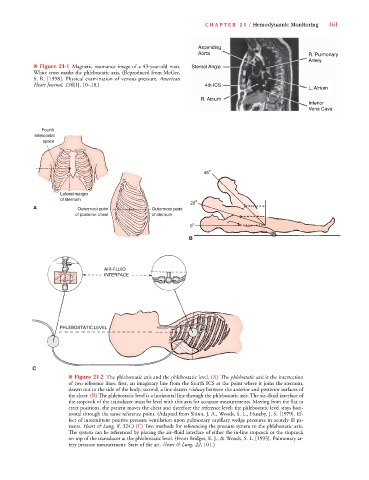
                   ■ Figure 21-1 Magnetic resonance image of a 43-year-old man.  Sternal Angle
                   White cross marks the phlebostatic axis. (Reproduced from McGee,
                   S. R. [1998]. Physical examination of venous pressure. American
                   Heart Journal, 136[1], 10–18.)                          4th ICS
                               6
                               6
                                                                                                             L. Atrium
                                                                          R .  At r i
                                                                          R A ium
                                                                                                             Inferior
                                                                                                             Vena Cava


                              ■ Figure 21-2 The phlebostatic axis and the phlebostatic level. (A) The phlebostatic axis is the intersection
                              of two reference lines: first, an imaginary line from the fourth ICS at the point where it joins the sternum,
                              drawn out to the side of the body; second, a line drawn midway between the anterior and posterior surfaces of
                              the chest. (B) The phlebostatic level is a horizontal line through the phlebostatic axis. The air–fluid interface of
                              the stopcock of the transducer must be level with this axis for accurate measurements. Moving from the flat to
                              erect positions, the patient moves the chest and therefore the reference level; the phlebostatic level stays hori-
                              zontal through the same reference point. (Adapted from Shinn, J. A., Woods, S. L., Huseby, J. S. [1979]. Ef-
                              fect of intermittent positive pressure ventilation upon pulmonary capillary wedge pressures in acutely ill pa-
                              tients. Heart & Lung, 8, 324.) (C) Two methods for referencing the pressure system to the phlebostatic axis.
                              The system can be referenced by placing the air–fluid interface of either the in-line stopcock or the stopcock
                              on top of the transducer at the phlebostatic level. (From Bridges, E. J., & Woods, S. L. [1993]. Pulmonary ar-
                              tery pressure measurement: State of the art. Heart & Lung, 22, 101.)

