


Page 487 - Cardiac Nursing
P. 487
p46
                                        0
                                        0
                                    009
                                    009
                    p46
                                        8:2
                                             M
                                             M
                                               P
                                        8:2
                                           8 A
                                           8 A
                           qxd
                           qxd
                               0
                         10.
                         10.
                         10.
                               0
                                9/0
                                  9/2
                                  9/2
                       0-5
                       0-5
                                9/0
         L L LWB
         LWB
            K34
         LWBK340-c21_21_p460-510.qxd  09/09/2009  08:28 AM  Page 463 Aptara
                                                       Apt
                                                       Apt
                                                         ara
               0-c
            K34
               0-c
                 21_
            K34
                                                         ara
                 21_
                                                 g
                                                 g
                                                  e 4
                                                  e 4
                                               P
                                               P
                                                a
                                                a
                                                    63
                                                    63
                                                    63
                                                                           C HAPTER 2 1 / Hemodynamic Monitoring   463
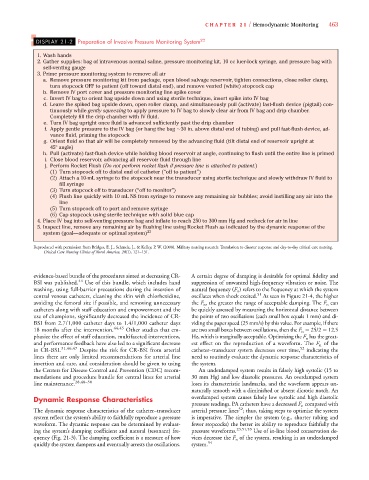
                    DISPLAY 21-2 Preparation of Invasive Pressure Monitoring System 22
                    1. Wash hands
                    2. Gather supplies: bag of intravenous normal saline, pressure monitoring kit, 10 cc luer-lock syringe, and pressure bag with
                      self-venting gauge
                    3. Prime pressure monitoring system to remove all air
                      a. Remove pressure monitoring kit from package, open blood salvage reservoir, tighten connections, close roller clamp,
                        turn stopcock OFF to patient (off toward distal end), and remove vented (white) stopcock cap
                      b. Remove IV port cover and pressure monitoring line spike cover
                      c. Invert IV bag to orient bag upside down and using sterile technique, insert spike into IV bag
                      d. Leave the spiked bag upside down, open roller clamp, and simultaneously pull (activate) fast-flush device (pigtail) con-
                        tinuously while gently squeezing to apply pressure to IV bag to slowly clear air from IV bag and drip chamber.
                        Completely fill the drip chamber with IV fluid.
                      e. Turn IV bag upright once fluid is advanced sufficiently past the drip chamber
                       f. Apply gentle pressure to the IV bag (or hang the bag  30 in. above distal end of tubing) and pull fast-flush device, ad-
                        vance fluid, priming the stopcock
                      g. Orient fluid so that air will be completely removed by the advancing fluid (tilt distal end of reservoir upright at
                        45  angle)
                      h. Pull (activate) fast-flush device while holding blood reservoir at angle, continuing to flush until the entire line is primed
                       i. Close blood reservoir, advancing all reservoir fluid through line
                                          (
                                          (
                       j. Perform Rocket Flush (Do not perform rocket flush if pressure line is attached to patient.)
                        (1) Turn stopcock off to distal end of catheter (“off to patient”)
                        (2) Attach a 10-mL syringe to the stopcock near the transducer using sterile technique and slowly withdraw IV fluid to
                           fill syringe
                        (3) Turn stopcock off to transducer (“off to monitor”)
                        (4) Flush line quickly with 10 mL NS from syringe to remove any remaining air bubbles; avoid instilling any air into the
                           line
                        (5) Turn stopcock off to port and remove syringe
                        (6) Cap stopcock using sterile technique with solid blue cap
                    4. Place IV bag into self-venting pressure bag and inflate to reach 250 to 300 mm Hg and recheck for air in line
                    5. Inspect line, remove any remaining air by flushing line using Rocket Flush as indicated by the dynamic response of the
                      system (goal—adequate or optimal system) 23
                   Reproduced with permission from Bridges, E. J., Schmelz, J., & Kelley, P. W. (2008). Military nursing research: Translation to disaster response and day-to-day critical care nursing.
                      Critical Care Nursing Clinics of North America, 20(1), 121–131.
                   evidence-based bundle of the procedures aimed at decreasing CR-  A certain degree of damping is desirable for optimal fidelity and
                   BSI was published. 44  Use of this bundle, which includes hand  suppression of unwanted high-frequency vibration or noise. The
                                                                                     F
                   washing, using full-barrier precautions during the insertion of  natural frequency (F n F ) refers to the frequency at which the system
                                                                                            51
                   central venous catheters, cleaning the skin with chlorhexidine,  oscillates when shock excited. As seen in Figure 21-4, the higher
                   avoiding the femoral site if possible, and removing unnecessary  the F n F , the greater the range of acceptable damping. The F n F can
                                                                                                                  F
                                                                          F
                   catheters along with staff education and empowerment and the  be quickly assessed by measuring the horizontal distance between
                   use of champions, significantly decreased the incidence of CR-  the points of two oscillations (each small box equals 1 mm) and di-
                   BSI from 2.7/1,000 catheter days to 1.4/1,000 catheter days  viding the paper speed (25 mm/s) by this value. For example, if there
                   18 months after the intervention. 44,45  Other studies that em-  are two small boxes between oscillations, then the F n F   25/2   12.5
                                                                                                          F
                                                                                                           F
                   phasize the effect of staff education, multifaceted interventions,  Hz, which is marginally acceptable. Optimizing the F n F has the great-
                                                                                                               F
                   and performance feedback have also led to a significant decrease  est effect on the reproduction of a waveform. The F n F of the
                   in CR-BSI. 31,46,47  Despite the risk for CR-BSI from arterial  catheter–transducer system decreases over time, 52  indicating the
                   lines there are only limited recommendations for arterial line  need to routinely evaluate the dynamic response characteristics of
                   insertion and care, and consideration should be given to using  the system.
                   the Centers for Disease Control and Prevention (CDC) recom-  An underdamped system results in falsely high systolic (15 to
                   mendations and procedure bundle for central lines for arterial  30 mm Hg) and low diastolic pressures. An overdamped system
                   line maintenance. 28,48–50                          loses its characteristic landmarks, and the waveform appears un-
                                                                       naturally smooth with a diminished or absent dicrotic notch. An
                   Dynamic Response Characteristics                    overdamped system causes falsely low systolic and high diastolic
                                                                                                         F
                                                                       pressure readings. PA catheters have a decreased F n F compared with
                                                                                      52
                   The dynamic response characteristics of the catheter–transducer  arterial pressure lines ; thus, taking steps to optimize the system
                   system reflect the system’s ability to faithfully reproduce a pressure  is imperative. The simpler the system (e.g., shorter tubing and
                   waveform. The dynamic response can be determined by evaluat-  fewer stopcocks) the better its ability to reproduce faithfully the
                   ing the system’s damping coefficient and natural (resonant) fre-  pressure waveforms. 23,51,53  Use of in-line blood conservation de-
                   quency (Fig. 21-3). The damping coefficient is a measure of how  vices decrease the F n F of the system, resulting in an underdamped
                                                                                    F
                   quickly the system dampens and eventually arrests the oscillations.  system. 54

