


Page 490 - Cardiac Nursing
P. 490
66
                         10.
                                                       Apt
                         10.
                                                         ara
                           qxd
                                  9/2
                               0
                       0-5
                                9/0
                                             M
                                                    66
                                           8 A
                                    009
                                        8:2
                                               P
                    p46
                                               P
                                                  e 4
                                                 g
            K34
               0-c
                 21_
            K34
         L L LWB K34 0-c 21_ p46 0-5 10. qxd  0 9/0 9/2 009  0 0 8:2 8 A M  P a a g e 4 66  Apt ara
         LWB
         LWBK340-c21_21_p460-510.qxd  09/09/2009  08:28 AM  Page 466 Aptara
                  466    P A R T  III / Assessment of Heart Disease
                  for infection, and adequate collateral circulation. 65  The most
                  common insertion site is the radial artery due to the presence of  Table 21-2 ■ RISK FACTORS AND ACTIONS TO PREVENT
                  collateral circulation, which decreases the risk of vascular compli-  COMPLICATIONS ASSOCIATED WITH ARTERIAL
                  cations. The radial and ulnar artery/superficial palmar arteries  CATHETERIZATION
                  provide a dual blood supply to the hand. Although the Allen test  Risk Factors  Preventive Actions
                  has traditionally been used to evaluate collateral circulation, rec-
                  ommendations in the  literature regarding its use are equivo-  • Catheter  20 gauge  • Use of heparinized flush solution to
                  cal. 66,67  In addition, the implications of a positive Allen test are  • Catheter in place  3 days  maintain patency is equivocal.
                  equivocal. The positive findings may not be consistent with con-  • Female  Consideration should also be given
                                                                                            to risk of heparin-induced
                                                                      • Low CO/hypotension
                  current Doppler ultrasonography evaluation nor does the pres-  • Peripheral vascular disease  thrombocytopenia. 72 77
                  ence of an abnormal Allen test reliably predict that the patient will  • Vasopressor agents  • Aspirate clot or discontinue line if
                  develop hand ischemia after radial artery cannulation. Given this  • Anticoagulation (T risk)  thrombosis is suspected
                  limited diagnostic accuracy, newer technologies including digit  • Femoral (T risk)  • Perform routine monitoring of distal
                  pressure measurement and plethysmography and Doppler ultra-  • Systemic antithrombotics or   perfusion (skin color, temperature and
                                                                                            capillary refill) and after line
                                                                       anticoagulants (T risk)
                  sonography should be considered, particularly for patients who  • Insertion site (femoral or   manipulation
                  are at increased risk for complications from the catheterization  axillary)  • No beneficial effect from repeated flushes
                  (e.g., peripheral vascular disease or diabetes, previous extremity  • Insertion site preparation  • No effect from method of blood  78
                                                                                            sampling (waste versus nonwaste)
                  surgery or trauma, current anticoagulation or vasopressor therapy,  • Catheter in place  5 7 days  • Catheter length sheaths/arterial lines
                                                                      • Insertion site
                  and hypotension). 68                                                      (T risk)
                     The femoral artery is often an alternative to the radial artery.      • Maintain system integrity
                  However, there is an increased risk of infection with the femoral        • Monitor waveform for damping (may in-
                  site. The brachial artery is used less frequently because it does not     dicate loose connections) See Table 21-1
                  have good collateral circulation, which in theory increases the
                  risk for diffuse distal ischemia. The axillary artery is a less com-
                  mon insertion site, with complication rates similar to radial and
                  femoral insertions. The dorsalis pedis artery is another option.  flow just before aortic valve closure. Pressure in the aorta continues
                  Complication rates associated with the dorsalis pedis artery are  to decrease and is reflected on the arterial pressure waveform as a
                                              69
                  comparable to radial artery insertion. The dorsalis pedis should  gradual downslope until the next ventricular systole. The interval
                  not be used if the patient has peripheral vascular disease or an ab-  after the incisura when the aortic pressure continues to decrease is
                  sent posterior tibial pulse. In addition, the dorsalis pedis artery  referred to as the diastolic run-off period, and the slope of this
                  pressures are higher than radial pressures, even in the supine po-  period is affected by arterial stiffness and the rate at which the
                  sition. 70                                                                                79
                                                                      blood flows into the periphery (vascular resistance).
                                                                        The arterial pressure waveform changes its contour when
                  Complications Related to Arterial                   recorded at different sites along the arterial circuit 80  (Fig. 21-6).
                  Catheterization                                     The pulse pressure and the systolic pressure increase, and the as-
                                                                      cending limb of the waveform becomes steeper. In addition, the
                  The most common complication from arterial cannulation is  incisura is gradually replaced by a later diastolic wave (dicrotic
                  temporary occlusion of the artery (radial 19.7%; femoral 1.5%),  notch). The change in amplitude and contour of the arterial wave-
                  although permanent arterial occlusion is rare (0.09% and  form is primarily caused by peripheral pulse wave reflection. 81
                  0.18%, respectively). 65  Given the risk and potentially severe
                  outcomes from arterial occlusion, distal perfusion (skin color,
                  temperature, and capillary refill) should be routinely assessed
                  postinsertion and any time the system is manipulated. 68,71
                  Bleeding is a rare complication for all insertion sites (0.6% to
                  1.6%), with increased incidence in femoral and axillary lines. 65     Systole  Diastole
                  A summary of risk factors and actions to prevent complications
                  is presented in Table 21-2.
                  Arterial Pressure Wave
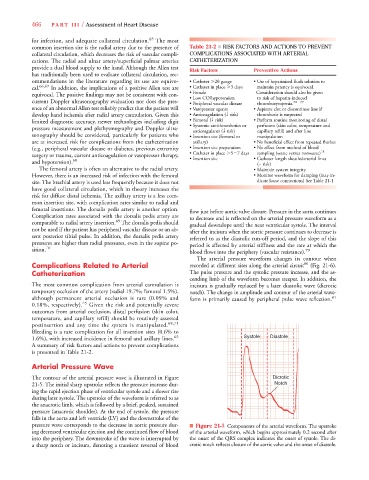
                  The contour of the arterial pressure wave is illustrated in Figure             Dicrotic
                  21-5. The initial sharp upstroke reflects the pressure increase dur-             Notch
                  ing the rapid ejection phase of ventricular systole and a slower rise
                  during later systole. The upstroke of the waveform is referred to as
                  the anacrotic limb, which is followed by a brief, peaked, sustained
                  pressure (anacrotic shoulder). At the end of systole, the pressure
                  falls in the aorta and left ventricle (LV) and the downstroke of the
                  pressure wave corresponds to the decrease in aortic pressure dur-  ■ Figure 21-5 Components of the arterial waveform. The upstroke
                  ing decreased ventricular ejection and the continued flow of blood  of the arterial waveform, which begins approximately 0.2 second after
                  into the periphery. The downstroke of the wave is interrupted by  the onset of the QRS complex indicates the onset of systole. The di-
                  a sharp notch or incisura, denoting a transient reversal of blood  crotic notch reflects closure of the aortic valve and the onset of diastole.

