


Page 491 - Cardiac Nursing
P. 491
8:2
                                    009
                                  9/2
                                               P
                                             M
                                           8 A
                                9/0
                         10.
                       0-5
                    p46
                               0
                           qxd
                         10.
                                               P
            K34
            K34
               0-c
         LWB K34 0-c 21_ p46 0-5 10. qxd  0 9/0 9/2 009  0 0 8:2 8 A M  P a a g e 4 67  Apt ara
         L L LWB
         LWBK340-c21_21_p460-510.qxd  09/09/2009  08:28 AM  Page 467 Aptara
                 21_
                                                    67
                                                  e 4
                                                 g
                                                         ara
                                                       Apt
                                                    67
                                                                           C HAPTER 2 1 / Hemodynamic Monitoring   467
                                                                       Interpretation of Arterial
                                                                       Pressure Data
                                                                       The mean arterial pressure (MAP), which represents the average
                                                                       pressure through a cardiac cycle, is affected by the CO and sys-
                                                                       temic vascular resistance (SVR) as described by the following
                                                                       equation:
                                                                                       MAP   CO   SVR
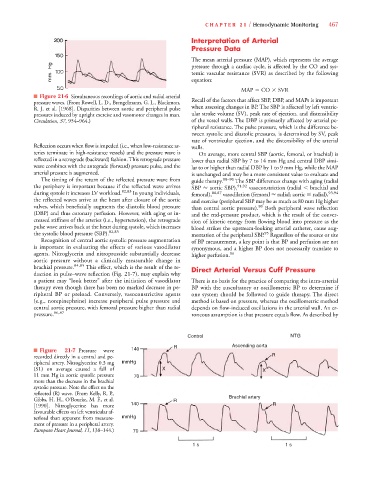
                   ■ Figure 21-6 Simultaneous recordings of aortic and radial arterial
                   pressure waves. (From Rowell, L. D., Brengelmann, G. L., Blackmon,  Recall of the factors that affect SBP, DBP, and MAPs is important
                   R. J. et al. [1968]. Disparities between aortic and peripheral pulse  when assessing changes in BP. The SBP is affected by left ventric-
                   pressures induced by upright exercise and vasomotor changes in man.  ular stroke volume (SV), peak rate of ejection, and distensibility
                            7
                            7
                   Circulation, 37, 954–964.)                          of the vessel walls. The DBP is primarily affected by arterial pe-
                                                                       ripheral resistance. The pulse pressure, which is the difference be-
                                                                       tween systolic and diastolic pressures, is determined by SV, peak
                                                                       rate of ventricular ejection, and the distensibility of the arterial
                   Reflection occurs when flow is impeded (i.e., when low-resistance ar-  walls.
                   teries terminate in high-resistance vessels) and the pressure wave is  On average, more central SBP (aortic, femoral, or brachial) is
                   reflected in a retrograde (backward) fashion. This retrograde pressure  lower than radial SBP by 7 to 14 mm Hg and central DBP simi-
                   wave combines with the antegrade (forward) pressure pulse, and the  lar to or higher than radial DBP by 1 to 9 mm Hg, while the MAP
                   arterial pressure is augmented.                     is unchanged and may be a more consistent value to evaluate and
                     The timing of the return of the reflected pressure wave from  guide therapy. 88–90  The SBP differences change with aging (radial
                   the periphery is important because if the reflected wave arrives  SBP   aortic SBP), 91,92  vasoconstriction (radial   brachial and
                   during systole it increases LV workload. 82,83  In young individuals,  femoral), 86,87  vasodilation (femoral   radial; aortic   radial), 93,94
                   the reflected waves arrive at the heart after closure of the aortic  and exercise (peripheral SBP may be as much as 80 mm Hg higher
                   valves, which beneficially augments the diastolic blood pressure  than central aortic pressure).  80  Both peripheral wave reflection
                   (DBP) and thus coronary perfusion. However, with aging or in-  and the end-pressure product, which is the result of the conver-
                   creased stiffness of the arteries (i.e., hypertension), the retrograde  sion of kinetic energy from flowing blood into pressure as the
                   pulse wave arrives back at the heart during systole, which increases  blood strikes the upstream-looking arterial catheter, cause aug-
                   the systolic blood pressure (SBP). 82,83            mentation of the peripheral SBP. Regardless of the source or site
                                                                                              95
                     Recognition of central aortic systolic pressure augmentation  of BP measurement, a key point is that BP and perfusion are not
                   is important in evaluating the effects of various vasodilator  synonymous, and a higher BP does not necessarily translate to
                   agents. Nitroglycerin and nitroprusside substantially decrease  higher perfusion. 96
                   aortic pressure without a clinically measurable change in
                   brachial pressure. 84,85  This effect, which is the result of the re-  Direct Arterial Versus Cuff Pressure
                   duction in pulse–wave reflection (Fig. 21-7), may explain why
                   a patient may “look better” after the initiation of vasodilator  There is no basis for the practice of comparing the intra-arterial
                   therapy even though there has been no marked decrease in pe-  BP with the auscultatory or oscillometric BP to determine if
                   ripheral BP or preload. Conversely, vasoconstrictive agents  one system should be followed to guide therapy. The direct
                   (e.g., norepinephrine) increase peripheral pulse pressure and  method is based on pressure, whereas the oscillometric method
                   central aortic pressure, with femoral pressure higher than radial  depends on flow-induced oscillations in the arterial wall. An er-
                   pressure. 86,87                                     roneous assumption is that pressure equals flow. As described by
                                                                                                       NTG
                                                                     Control                           NTG
                   ■ Figure  21-7 Pressure wave    140           R R                Ascending aorta
                   recorded directly in a central and pe-                                        R
                   ripheral artery. Nitroglycerine 0.3 mg  m mmHg
                   (SL) on average caused a fall of          X                                X
                   11 mm Hg in aortic systolic pressure  70
                   more than the decrease in the brachial
                   systolic pressure. Note the effect on the
                   reflected (R) wave. (From Kelly, R. P.,                          Brachial artery
                   Gibbs, H. H., O’Rourke, M. F., et al.         R
                   [1990]. Nitroglycerine has more  140                                          R R
                   favourable effects on left ventricular af-
                   terload than apparent from measure-  m mmHg
                   ment of pressure in a peripheral artery.
                   European Heart Journal, 11, 138–144.)  70

                                                                       1 s                           1 s

