


Page 511 - Cardiac Nursing
P. 511
9/0
                               0
                                  9/2
                                        8:2
                                    009
                       0-5
                    p46
                         10.
                           qxd
                         10.
                                                    87
                                                  e 4
                                                    87
                                                         ara
                                                       Apt
                                             M
                                           8 A
                                               P
                                                 g
                                               P
                 21_
               0-c
         LWB K34 0-c 21_ p46 0-5 10. qxd  0 9/0 9/2 009  0 0 8:2 8 A M  P a a g e 4 87  Apt ara
         L L LWB
            K34
            K34
         LWBK340-c21_21_p460-510.qxd  09/09/2009  08:28 AM  Page 487 Aptara
                                                                           C HAPTER 2 1 / Hemodynamic Monitoring   487
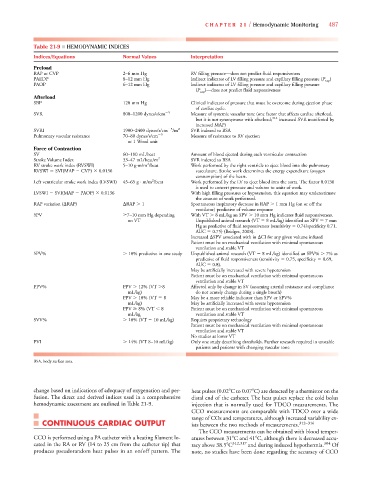
                   Table 21-9 ■ HEMODYNAMIC INDICES
                   Indices/Equations            Normal Values         Interpretation
                   Preload
                   RAP or CVP                   2–6 mm Hg             RV filling pressure—does not predict fluid responsiveness
                   PAEDP                        8–12 mm Hg            Indirect indicator of LV filling pressure and capillary filling pressure (P cap )
                                                                                                                 P P
                   PAOP                         6–12 mm Hg            Indirect indicator of LV filling pressure and capillary filling pressure
                                                                        (P cap )—does not predict fluid responsiveness
                                                                         P P
                   Afterload
                   SBP                          120 mm Hg             Clinical indicator of pressure that must be overcome during ejection phase
                                                                        of cardiac cycle.
                   SVR                          800–1200 dynes/s/cm  5  Measure of systemic vascular tone (one factor that affects cardiac afterload,
                                                                        but it is not synonymous with afterload; 311  increased SVR manifested by
                                                                        increased MAP)
                   SVRI                         1900–2400 dynes/s/cm  5 /m 2  SVR indexed to BSA
                   Pulmonary vascular resistance  70–80 dynes/s/cm  5  Measure of resistance to RV ejection
                                                  or 1 Wood unit
                   Force of Contraction
                   SV                           60–180 mL/beat        Amount of blood ejected during each ventricular contraction
                   Stroke Volume Index          33–47 mL/beat/m 2     SVR indexed to BSA
                                                        2
                   RV stroke work index (RVSWI)  5–10 g-m/m /beat     Work performed by the right ventricle to eject blood into the pulmonary
                   RVSWI   SVI(MAP   CVP)   0.0136                      vasculature. Stroke work determines the energy expenditure (oxygen
                                                                        consumption) of the heart.
                                                          2
                   Left ventricular stroke work index (LVSWI)  45–65 g ⋅ m/m /beat  Work performed by the LV to eject blood into the aorta. The factor 0.0136
                                                                        is used to convert pressure and volume to units of work.
                   LVSWI   SVI(MAP   PAOP)   0.0136                   With high filling pressures or hypotension, this equation may underestimate
                                                                        the amount of work performed.
                   RAP variation (	RAP)         	RAP   1              Spontaneous inspiratory decrease in RAP   1 mm Hg (on or off the
                                                                        ventilator) predictive of volume response
                   SPV                           7–10 mm Hg depending   With VT   8 mL/kg an SPV   10 mm Hg indicates fluid responsiveness.
                                                  on VT                 Unpublished animal research (VT   8 mL/kg) identified an SPV   7 mm
                                                                        Hg as predictive of fluid responsiveness (sensitivity   0.74/specificity 0.71,
                                                                        AUC   0.75) (Bridges, 2008).
                                                                      Increased 	SPV associated with in 	CI for any given volume infused
                                                                      Patient must be on mechanical ventilation with minimal spontaneous
                                                                        ventilation and stable VT
                   SPV%                           10% predictive in one study  Unpublished animal research (VT   8 mL/kg) identified an SPV%   7% as
                                                                        predictive of fluid responsiveness (sensitivity   0.75, specificity   0.69,
                                                                        AUC   0.8).
                                                                      May be artificially increased with severe hypotension
                                                                      Patient must be on mechanical ventilation with minimal spontaneous
                                                                        ventilation and stable VT
                   PPV%                         PPV   12% (VT  8      Affected only by change in SV (assuming arterial resistance and compliance
                                                  mL/kg)                do not acutely change during a single breath)
                                                PPV   10% (VT   8     May be a more reliable indicator than SPV or SPV%
                                                  mL/kg)              May be artificially increased with severe hypotension
                                                PPV   8% (VT   8      Patient must be on mechanical ventilation with minimal spontaneous
                                                  mL/kg                 ventilation and stable VT
                   SVV%                           10% (VT   10 mL/kg)  Requires proprietary technology
                                                                      Patient must be on mechanical ventilation with minimal spontaneous
                                                                        ventilation and stable VT
                                                                      No studies at lower VT
                   PVI                            14% (VT 8–10 mL/kg)  Only one study describing thresholds. Further research required in unstable
                                                                        patients and patients with changing vascular tone
                   BSA, body surface area.
                   change based on indications of adequacy of oxygenation and per-  heat pulses (0.02 C to 0.07 C) are detected by a thermistor on the
                   fusion. The direct and derived indices used in a comprehensive  distal end of the catheter. The heat pulses replace the cold bolus
                   hemodynamic assessment are outlined in Table 21-9.  injection that is normally used for TDCO measurements. The
                                                                       CCO measurements are comparable with TDCO over a wide
                                                                       range of COs and temperatures, although increased variability ex-
                      CONTINUOUS CARDIAC OUTPUT                        ists between the two methods of measurements. 312–316
                                                                         The CCO measurements can be obtained with blood temper-
                   CCO is performed using a PA catheter with a heating filament lo-  atures between 31 C and 41 C, although there is decreased accu-
                   cated in the RA or RV (14 to 25 cm from the catheter tip) that  racy above 38.5 C 312,317  and during induced hypothermia. 304  Of
                   produces pseudorandom heat pulses in an on/off pattern. The  note, no studies have been done regarding the accuracy of CCO

