


Page 507 - Cardiac Nursing
P. 507
LWBK340-c21_p460-510.qxd  09/09/2009  08:28 AM  Page 483 Aptara


                                                                           C HAP TE R 2 1 / Hemodynamic Monitoring  483


                                 110.0  SBP                                         PP
                                 100.0     max            SBP min                     max
                                                       Ps                                     PP
                                  90.0                                                          min
                                                       ∇
                                  80.0
                                  70.0
                                                       DBP
                                  60.0
                                  50.0
                                A
                                  130.0
                                  120.0
                                  110.0
                                  100.0
                                   90.0
                                B
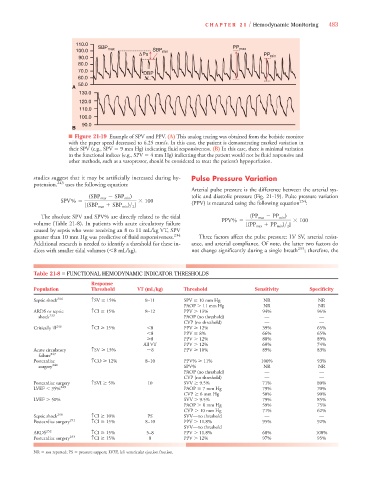
                              ■ Figure 21-19 Example of SPV and PPV. (A) This analog tracing was obtained from the bedside monitor
                              with the paper speed decreased to 6.25 mm/s. In this case, the patient is demonstrating marked variation in
                              their SPV (e.g., SPV   9 mm Hg) indicating fluid responsiveness. (B) In this case, there is minimal variation
                              in the functional indices (e.g., SPV   4 mm Hg) indicating that the patient would not be fluid responsive and
                              other methods, such as a vasopressor, should be considered to treat the patient’s hypoperfusion.

                   studies suggest that it may be artificially increased during hy-  Pulse Pressure Variation
                   potension, 245  uses the following equation:
                                                                       Arterial pulse pressure is the difference between the arterial sys-
                                     (SBP max   SBP min )              tolic and diastolic pressure (Fig. 21-19). Pulse pressure variation
                            SPV%                       100                                                254
                                    [(SBP max
 SBP min )> 2 ]         (PPV) is measured using the following equation  :
                     The absolute SPV and SPV% are directly related to the tidal          (PP max   PP min )
                                                                                PPV%                      100
                   volume (Table 21-8). In patients with acute circulatory failure      [(PP max
 PP min )> 2 ]
                   caused by sepsis who were receiving an 8 to 11 mL/kg VT, SPV
                   greater than 10 mm Hg was predictive of fluid responsiveness. 234  Three factors affect the pulse pressure: LV SV, arterial resist-
                   Additional research is needed to identify a threshold for these in-  ance, and arterial compliance. Of note, the latter two factors do
                   dices with smaller tidal volumes ( 8 mL/kg).        not change significantly during a single breath 255 ; therefore, the


                   Table 21-8 ■ FUNCTIONAL HEMODYNAMIC INDICATOR THRESHOLDS
                                      Response
                   Population         Threshold      VT (mL/kg)     Threshold              Sensitivity       Specificity
                   Septic shock 234   ↑SV   15%        8–11         SPV   10 mm Hg            NR                NR
                                                                    PAOP   11 mm Hg           NR                NR
                   ARDS or septic     ↑CI   15%        8–12         PPV   13%                 94%               96%
                     shock 233                                      PAOP (no threshold)       —                 —
                                                                    CVP (no threshold)        —                 —
                   Critically ill 246  ↑CI   15%         8          PPV   12%                 39%               65%
                                                         8          PPV   8%                  66%               65%
                                                         8          PPV   12%                 88%               89%
                                                       All VT       PPV   12%                 60%               74%
                   Acute circulatory   ↑SV   15%         8          PPV   10%                 89%               83%
                     failure 247
                   Postcardiac        ↑CO   12%        8–10         PPV%   11%               100%               93%
                     surgery y 248                                  SPV%                      NR                NR
                                                                    PAOP (no threshold)       —                 —
                                                                    CVP (no threshold)        —                 —
                   Postcardiac surgery  ↑SVI   5%       10          SVV   9.5%                71%               80%
                   LVEF   35% 249                                   PAOP   7 mm Hg            79%               70%
                                                                    CVP   6 mm Hg             50%               90%
                   LVEF   50%                                       SVV   9.5%                79%               85%
                                                                    PAOP   8 mm Hg            59%               75%
                                                                    CVP   10 mm Hg            71%               62%
                   Septic shock 250   ↑CI   10%         PS          SVV—no threshold          —                 —
                   Postcardiac surgeryy 251  ↑CI   15%  8–10        PPV   11.8%               95%               92%
                                                                    SVV—no threshold
                   ARDS 252           ↑CI   15%         5–8         PPV   11.8%               68%              100%
                   Postcardiac surgeryy 253  ↑CI   15%   8          PPV   12%                 97%               95%

                   NR   not reported; PS   pressure support; LVEF, left ventricular ejection fraction.

