


Page 510 - Cardiac Nursing
P. 510
9/0
                               0
                                  9/2
                                        8:2
                                    009
                       0-5
                    p46
                         10.
                           qxd
                         10.
                                                    86
                                                  e 4
                                                    86
                                                         ara
                                                       Apt
                                             M
                                           8 A
                                               P
                                                 g
                                               P
            K34
               0-c
                 21_
            K34
         L L LWB K34 0-c 21_ p46 0-5 10. qxd  0 9/0 9/2 009  0 0 8:2 8 A M  P a a g e 4 86  Apt ara
         LWBK340-c21_21_p460-510.qxd  09/09/2009  08:28 AM  Page 486 Aptara
         LWB
                  486    P A R T  III / Assessment of Heart Disease
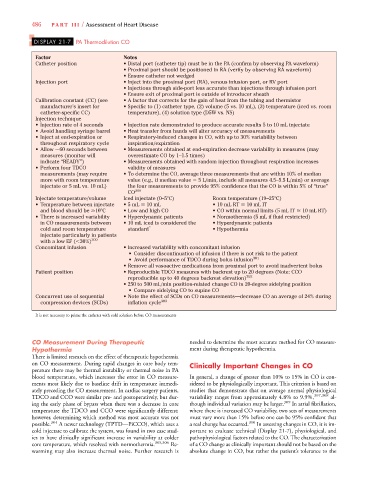
                   DISPLAY 21-7 PA Thermodilution CO
                    Factor                      Notes
                    Catheter position           • Distal port (catheter tip) must be in the PA (confirm by observing PA waveform)
                                                • Proximal port should be positioned in RA (verify by observing RA waveform)
                                                • Ensure catheter not wedged
                    Injection port              • Inject into the proximal port (RA), venous infusion port, or RV port
                                                • Injections through side-port less accurate than injections through infusion port
                                                • Ensure exit of proximal port is outside of introducer sheath
                    Calibration constant (CC) (see   • A factor that corrects for the gain of heat from the tubing and thermistor
                     manufacturer’s insert for   • Specific to (1) catheter type, (2) volume (5 vs. 10 mL), (3) temperature (iced vs. room
                     catheter-specific CC)         temperature), (4) solution type (D5W vs. NS)
                    Injection technique
                    • Injection rate of 4 seconds  • Injection rate demonstrated to produce accurate results 5 to 10 mL injectate
                    • Avoid handling syringe barrel  • Heat transfer from hands will alter accuracy of measurements
                    •Inject at end-expiration or   • Respiratory-induced changes in CO, with up to 30% variability between
                     throughout respiratory cycle  inspiration/expiration
                    • Allow  60 seconds between  • Measurements obtained at end-expiration decrease variability in measures (may
                     measures (monitor will       overestimate CO by 1–1.5 times)
                     indicate “READY”)          • Measurements obtained with random injection throughout respiration increases
                    • Perform four TDCO           validity of measures
                     measurements (may require  • To determine the CO, average three measurements that are within 10% of median
                     more with room temperature    value (e.g., if median value   5 L/min, include all measures 4.5–5.5 L/min) or average
                     injectate or 5 mL vs. 10 mL)  the four measurements to provide 95% confidence that the CO is within 5% of “true”
                                                  CO 299
                    Injectate temperature/volume  Iced injectate (0–5 C)      Room temperature (19–25 C)
                    • Temperature between injectate  • 5 mL   10 mL           • 10 mL RT   10 mL IT
                     and blood should be  10 C  • Low and high CO             • CO within normal limits (5 mL IT   10 mL RT)
                    • There is increased variability   • Hyperdynamic patients  • Normothermia (5 mL if fluid restricted)
                     in CO measurements between   • 10 mL iced is considered the   • Hyperdynamic patients
                     cold and room temperature    standard *                  •Hypothermia
                     injectate particularly in patients
                     with a low EF ( 30%) 300
                    Concomitant infusion        • Increased variability with concomitant infusion
                                                  • Consider discontinuation of infusion if there is not risk to the patient
                                                  • Avoid performance of TDCO during bolus infusion 301
                                                • Remove all vasoactive medications from proximal port to avoid inadvertent bolus
                    Patient position            • Reproducible TDCO measures with backrest up to 20 degrees (Note: CCO
                                                  reproducible up to 40 degrees backrest elevation) 302
                                                • 250 to 500 mL/min position-related change CO in 20-degree sidelying position
                                                  • Compare sidelying CO to supine CO
                    Concurrent use of sequential   • Note the effect of SCDs on CO measurements—decrease CO an average of 24% during
                     compression devices (SCDs)   inflation cycle 303
                    It is not necessary to prime the catheter with cold solution before CO measurements

                  CO Measurement During Therapeutic                   needed to determine the most accurate method for CO measure-
                  Hypothermia                                         ment during therapeutic hypothermia.
                  There is limited research on the effect of therapeutic hypothermia
                  on CO measurement. During rapid changes in core body tem-  Clinically Important Changes in CO
                  perature there may be thermal instability or thermal noise in PA
                  blood temperature, which increases the error in CO measure-  In general, a change of greater than 10% to 15% in CO is con-
                  ments most likely due to baseline drift in temperature immedi-  sidered to be physiologically important. This criterion is based on
                  ately preceding the CO measurement. In cardiac surgery patients,  studies that demonstrate that on average normal physiological
                  TDCO and CCO were similar pre- and postoperatively, but dur-  variability ranges from approximately 4.8% to 9.9%, 307,308  al-
                  ing the early phase of bypass when there was a decrease in core  though individual variation may be larger. 309  In atrial fibrillation,
                  temperature the TDCO and CCO were significantly different;  where there is increased CO variability, two sets of measurements
                  however, determining which method was most accurate was not  must vary more than 15% before one can be 95% confident that
                  possible. 304  A newer technology (TPTD—PiCCO), which uses a  a real change has occurred. 310  In assessing changes in CO, it is im-
                  cold injectate to calibrate the system, was found in two case stud-  portant to evaluate technical (Display 21-7), physiological, and
                  ies to have clinically significant increase in variability at colder  pathophysiological factors related to the CO. The characterization
                  core temperature, which resolved with normothermia. 305,306  Re-  of a CO change as clinically important should not be based on the
                  warming may also increase thermal noise. Further research is  absolute change in CO, but rather the patient’s tolerance to the

