


Page 506 - Cardiac Nursing
P. 506
p46
                                                 g
                                               P
                       0-5
                                               P
                                                       Apt
                                                         ara
                                                    82
                                                  e 4
                                                    82
                                9/0
                               0
                                        8:2
                                    009
                                  9/2
                                           8 A
                                             M
                         10.
                           qxd
                         10.
         LWBK340-c21_21_p460-510.qxd  09/09/2009  08:28 AM  Page 482 Aptara
         LWB
         L L LWB K34 0-c 21_ p46 0-5 10. qxd  0 9/0 9/2 009  0 0 8:2 8 A M  P a a g e 4 82  Apt ara
            K34
               0-c
                 21_
            K34
                  482    P A R T  III / Assessment of Heart Disease
                                                                      fluid responsiveness (i.e., a patient who will respond to volume
                                        Ventilator Breath
                                                                      loading with an increase in SV), whereas a smaller SV change in-
                                                                      dicates preload independence (fluid nonresponder). Patients who
                                                                      are preload independent will not increase their SV in response to
                                       ↑ Pleural Pressure
                                                                      volume loading and may be compromised by the excess fluid.
                                                                      Variations in these hemodynamic indices may help predict fluid
                     INSPIRATION`      ↓ Vena Cava Flow               have been evaluated.
                                                                      responsiveness. A number of functional hemodynamic indices
                                                                      Respiratory Variation in CVP
                                         ↓ RV Preload
                                                                      Although, the patient is more likely to respond to a fluid bolus if
                                                                      they have a lower CVP, in general the absolute CVP is not pre-
                                       ↓ RV Stroke Volume             dictive of a patient’s fluid responsiveness and over time a patient
                                                                      may respond differently to fluids despite a similar CVP. 141,175,231
                                               Pulmonary Transit Time
                                                                      For example, in cardiac surgery patients, 25% of patients with a
                                         ↓ LV Preload                 CVP between 0 and 5 mm Hg did not respond to a fluid bolus;
                                                                      although, if their CVP was greater than 13 mm Hg, the likelihood
                                                                                                   2
                     EXPIRATION        ↓ LV Stroke Volume             lus was low. 141  Consideration of the limitations of the absolute
                                                                      of increasing the CI   300 mL/min/m in response to a fluid bo-
                                                                      CVP is important as sepsis guidelines direct that in the presence
                                                                      of continued hypoperfusion, volume resuscitation should be un-
                                  ↓ SBP           ↓ Pulse Pressure    dertaken to achieve a CVP   8 mm Hg. 132,240  It is possible that
                                (expiration)        (expiration)      despite a low CVP some of these patients may not respond to flu-
                                                                      ids, which may exacerbate their condition. An alternate way to
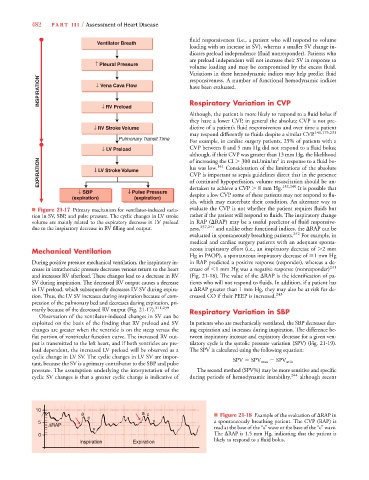
                  ■ Figure 21-17 Primary mechanism for ventilator-induced varia-  evaluate the CVP is not whether the patient requires fluids but
                  tion in SV, SBP, and pulse pressure. The cyclic changes in LV stroke  rather if the patient will respond to fluids. The inspiratory change
                  volume are mainly related to the expiratory decrease in LV preload  in RAP (	RAP) may be a useful predictor of fluid responsive-
                  due to the inspiratory decrease in RV filling and output.  ness, 237,241  and unlike other functional indices, the 	RAP can be
                                                                      evaluated in spontaneously breathing patients. 242  For example, in
                                                                      medical and cardiac surgery patients with an adequate sponta-
                  Mechanical Ventilation                              neous inspiratory effort (i.e., an inspiratory decrease of  2 mm
                                                                      Hg in PAOP), a spontaneous inspiratory decrease of  1 mm Hg
                  During positive pressure mechanical ventilation, the inspiratory in-  in RAP predicted a positive response (responder), whereas a de-
                  crease in intrathoracic pressure decreases venous return to the heart  crease of  1 mm Hg was a negative response (nonresponder) 241
                  and increases RV afterload. These changes lead to a decrease in RV  (Fig. 21-18). The value of the 	RAP is the identification of pa-
                  SV during inspiration. The decreased RV output causes a decrease  tients who will not respond to fluids. In addition, if a patient has
                  in LV preload, which subsequently decreases LV SV during expira-  a 	RAP greater than 1 mm Hg, they may also be at risk for de-
                  tion. Thus, the LV SV increases during inspiration because of com-  creased CO if their PEEP is increased. 243
                  pression of the pulmonary bed and decreases during expiration, pri-
                  marily because of the decreased RV output (Fig. 21-17). 211,239  Respiratory Variation in SBP
                     Observation of the ventilator-induced changes in SV can be
                  exploited on the basis of the finding that RV preload and SV  In patients who are mechanically ventilated, the SBP decreases dur-
                  changes are greater when the ventricle is on the steep versus the  ing expiration and increases during inspiration. The difference be-
                  flat portion of ventricular function curve. The increased RV out-  tween inspiratory increase and expiratory decrease for a given ven-
                  put is transmitted to the left heart, and if both ventricles are pre-  tilatory cycle is the systolic pressure variation (SPV) (Fig. 21-19).
                  load dependent, the increased LV preload will be observed as a  The SPV is calculated using the following equation:
                  cyclic change in LV SV. The cyclic changes in LV SV are impor-            V       V
                  tant, because the SV is a primary contributor to the SBP and pulse  SPV   SPV max   SPV min
                  pressure. The assumption underlying the interpretation of the  The second method (SPV%) may be more sensitive and specific
                  cyclic SV changes is that a greater cyclic change is indicative of  during periods of hemodynamic instability, 244  although recent


                    10
                                   a                  a a  c                  ■ Figure 21-18 Example of the evaluation of 	RAP in
                                     c
                     5                                    v v v               a spontaneously breathing patient. The CVP (RAP) is
                         R
                         RAP
                        Δ ΔRAP
                                      v                                       read at the base of the “a” wave or the base of the “c” wave.
                     0                                                        The 	RAP is 1.5 mm Hg, indicating that the patient is
                                                                              likely to respond to a fluid bolus.
                                                       a
                                   s
                                  Inspirationation  Expirationation

