


Page 543 - Cardiac Nursing
P. 543
LWBK340-c22_p511-536.qxd  30/06/2009  11:00 AM  Page 519 Aptara


                                                                          C HAP TE R 22 / Acute Coronary Syndromes  519


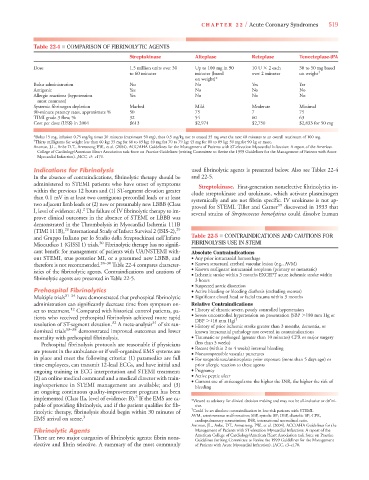
                   Table 22-4 ■ COMPARISON OF FIBRINOLYTIC AGENTS
                                                  Streptokinase         Alteplase         Reteplase       Tenecteplase-tPA
                   Dose                           1.5 million units over 30   Up to 100 mg in 90   10 U   2 each   30 to 50 mg based
                                                  to 60 minutes         minutes (based    over 2 minutes  on weight †
                                                                        on weight)*
                   Bolus administration           No                    No                Yes             Yes
                   Antigenic                      Yes                   No                No              No
                   Allergic reactions (hypotension   Yes                No                No              No
                    most common)
                   Systemic fibrinogen depletion   Marked                Mild              Moderate        Minimal
                   90-minute patency rates, approximate %  50           75                7               75
                   TIMI grade 3 flow, %            32                    54                60              63
                   Cost per dose (US$) in 2004    $613                  $2,974            $2,750          $2,833 for 50 mg

                   *Bolus 15 mg, infusion 0.75 mg/kg times 30 minutes (maximum 50 mg), then 0.5 mg/kg not to exceed 35 mg over the next 60 minutes to an overall maximum of 100 mg.
                   † Thirty milligrams for weight less than 60 kg; 35 mg for 60 to 69 kg; 40 mg for 70 to 79 kg; 45 mg for 80 to 89 kg; 50 mg for 90 kg or more.
                   Antman, J.L., Anbe D.T., Armstrong P.W., et al. (2004). ACC/AHA Guidelines for the Management of Patients with ST-elevation Myocardial Infarction: A report of the American
                    College of Cardiology/American Heart Association task force on Practice Guidelines (writing Committee to Revise the 1999 Guidelines for the Management of Patients with Acute
                    Myocardial Infarction). JACC, e3–e170.
                   Indications for Fibrinolysis                        used fibrinolytic agents is presented below. Also see Tables 22-4
                   In the absence of contraindications, fibrinolytic therapy should be  and 22-5.
                   administered to STEMI patients who have onset of symptoms  Streptokinase. First-generation nonselective fibrinolytics in-
                   within the previous 12 hours and (1) ST-segment elevation greater  clude streptokinase and urokinase, which activate plasminogen
                   than 0.1 mV in at least two contiguous precordial leads or at least  systemically and are not fibrin specific. IV urokinase is not ap-
                   two adjacent limb leads or (2) new or presumably new LBBB (Class  proved for STEMI. Tillet and Garner 39  discovered in 1933 that
                                   2
                   I, level of evidence: A). The failure of IV fibrinolytic therapy to im-  several strains of Streptococcus hemolyticus could dissolve human
                   prove clinical outcomes in the absence of STEMI or LBBB was
                   demonstrated in the Thrombolysis in Myocardial Ischemia 111B
                             28
                   (TIMI 111B), International Study of Infarct Survival 2 (ISIS-2), 29
                   and Gruppo Italiano per lo Studio della Streptochinasi nell’Infarto  Table 22-5 ■ CONTRAINDICATIONS AND CAUTIONS FOR
                                        30
                   Miocardico 1 (GISSI 1) trials. Fibrinolytic therapy has no signifi-  FIBRINOLYSIS USE IN STEMI
                   cant benefit for management of patients with UA/NSTEMI with-  Absolute Contraindications
                   out STEMI, true posterior MI, or a presumed new LBBB, and  • Any prior intracranial hemorrhage
                   therefore is not recommended. 28–30 Table 22-4 compares character-  • Known structural cerebral vascular lesion (e.g., AVM)
                   istics of the fibrinolytic agents. Contraindications and cautions of  • Known malignant intracranial neoplasm (primary or metastatic)
                                                                       • Ischemic stroke within 3 months EXCEPT acute ischemic stroke within
                   fibrinolytic agents are presented in Table 22-5.      3 hours
                                                                       • Suspected aortic dissection
                   Prehospital Fibrinolytics                           • Active bleeding or bleeding diathesis (excluding menses)
                   Multiple trials 31–34  have demonstrated that prehospital fibrinolytic  • Significant closed head or facial trauma within 3 months
                   administration can significantly decrease time from symptom on-  Relative Contraindications
                   set to treatment. 12  Compared with historical control patients, pa-  • History of chronic severe, poorly controlled hypertension
                   tients who received prehospital fibrinolysis achieved more rapid  • Severe uncontrolled hypertension on presentation (SBP  180 mm Hg or
                                                                                     †
                                                                        DBP  110 mm Hg)
                                             32
                                                          31
                   resolution of ST-segment elevation. A meta-analysis of six ran-  • History of prior ischemic stroke greater than 3 months, dementia, or
                   domized trials 33–38  demonstrated improved outcomes and lower  known intracranial pathology not covered in contraindications
                   mortality with prehospital fibrinolysis.             • Traumatic or prolonged (greater than 10 minutes) CPR or major surgery
                     Prehospital fibrinolysis protocols are reasonable if physicians  (less than 3 weeks)
                   are present in the ambulance or if well-organized EMS systems are  • Recent (within 2 to 4 weeks) internal bleeding
                                                                       • Noncompressible vascular punctures
                   in place and meet the following criteria: (1) paramedics are full  • For streptokinase/anistreplase: prior exposure (more than 5 days ago) or
                   time employees, can transmit 12-lead ECGs, and have initial and  prior allergic reaction to these agents
                   ongoing training in ECG interpretation and STEMI treatment;  • Pregnancy
                   (2) an online medical command and a medical director with train-  • Active peptic ulcer
                                                                       • Current use of anticoagulants: the higher the INR, the higher the risk of
                   ing/experience in STEMI management are available; and (3)  bleeding
                   an ongoing continuous quality-improvement program has been
                                                    2
                   implemented (Class IIa, level of evidence: B). If the EMS are ca-
                                                                       *Viewed as advisory for clinical decision making and may not be all-inclusive or defini-
                   pable of providing fibrinolysis, and if the patient qualifies for fib-  tive.
                                                                       † Could be an absolute contraindication in low-risk patients with STEMI.
                   rinolytic therapy, fibrinolysis should begin within 30 minutes of  AVM, arteriovenous malformation; SBP, systolic BP; DBP, diastolic BP; CPR,
                   EMS arrival on scene. 3                              cardiopulmonary resuscitation; INR, international normalized ratio.
                                                                       Antman, JL., Anbe, DT., Armstrong, PW., et al. (2004). ACC/AHA Guidelines for the
                   Fibrinolytic Agents                                  Management of Patients with ST-elevation Myocardial Infarction: A report of the
                                                                        American College of Cardiology/American Heart Association task force on Practice
                   There are two major categories of fibrinolytic agents: fibrin nons-
                                                                        Guidelines (writing Committee to Revise the 1999 Guidelines for the Management
                   elective and fibrin selective. A summary of the most commonly  of Patients with Acute Myocardial Infarction). JACC, e3–e170.

