


Page 541 - Cardiac Nursing
P. 541
xd
                                            Pa
                          q
                           xd
                             3
                             3
                              3
                          q
                        36.
                                              g
                      1-5
                        36.
                          q
                                            Pa
                                              g
                                  009
                                  009
                                        0 A
                                      1:0
                                      1:0
                                     1
                                     1
                                        0 A
                                6/2
                              0/0
                              0/0
                                6/2
                                          M
                                          M
                                6/2
                                                     ara
                                                     ara
         LWBK340-c22_
                                                    t
                                                    t
                                                     ara
            K34
                    51
                    51
                 22_
               0-c
               0-c
                 22_
         LWB
                                                17
                                                17
                                                17
                                               e 5
                      1-5
                                              g
                                               e 5
         LWB K34 0-c 22_ p p pp511-536.qxd  30/06/2009  11:00 AM  Page 517 Aptara
                                                   p
                                                   p
                                                   p
                                                  A
                                                  A
                                                                          C HAPTER 22 / Acute Coronary Syndromes   517
                                                     Chest discomfort suggestive of ischemia
                                          EMS assessment and care and hospital preparation:
                                          • Monitor, support ABCs. Be prepared to provide CPR and defibrillation
                                          • Administer oxygen, aspirin, nitroglycerin, and morphine if needed
                                          • If available, obtain 12-lead ECG; if ST- elevation:
                                             - Notify receiving hospital with transmission or interpretation
                                             - Begin fibrinolytic checklist
                                          • Notified hospital should mobilize hospital resources to respond to STEMI
                                 Immediate ED assessment (<10 minutes)  Immediate ED general treatment
                                 •   Check vital signs; evaluate oxygen saturation  • Start oxygen at 4 L/min; maintain O sat >90%
                                                                                               2
                                 •   Establish IV access             • Aspirin 160 to 325 mg (if not given by EMS)
                                 •   Obtain/review 12-lead ECG       • Nitroglycerin sublingual, spray, or IV
                                 •   Perform brief, targeted history, physical exam  • Morphine IV if pain not relieved by nitroglycerin
                                 •   Review/complete fibrinolytic checklist;
                                     check contraindications
                                 •   Obtain initial cardiac marker levels,
                                     initial electrolyte and coagulation studies
                                 •   Obtain portable chest x-ray (<30 minutes)
                                                           Review initial 12-lead ECG
                          ST elevation or new or           ST depression or dynamic             Normal or nondiagnostic
                          presumably new LBBB;             T-wave inversion; strongly          changes in ST segment or
                       strongly suspicious for injury       suspicious for ischemia                    T wave
                        ST-elevation MI (STEMI)          High-risk unstable angina/           Intermediate/Low-risk UA
                                                      Non-ST-elevation MI (UA/NSTEMI)
                     Start adjunctive treatments as     Start adjunctive treatments as             Develops high or
                     indicated. Do not delay reperfusion  indicated                    Yes      intermediate risk criteria
                     • β-Adrenergic receptor blockers   •   Nitroglycerin                               OR
                     • Clopidogrel                      •   β-Adrenergic receptor blockers        troponin-positive?
                     • Heparin (UFH or LMWH)            •   Clopidogrel
                                                        •   Heparin (UFH or LMWH)                          No
                                                        •   Glycoprotein llb/llla inhibitor     Consider admission to
                                                                                                ED chest pain unit or to
                                                                                                monitored bed in ED
                                                                                                Follow:
                           Time from onset of  >12 hours    Admit to monitored bed
                          symptoms ≤12 hours?                 Assess risk status                •   Serial cardiac markers
                                                                                                    (including troponin)
                                                                                                •   Repeat ECG/continuous
                                   ≤12 hours
                                                                                                    ST-segment monitoring
                                                      High-risk patient:
                     Reperfusion strategy:            • Refractory ischemic chest pain          •   Consider stress test
                     Therapy defined by patient and   • Recurrent/persistent ST deviation
                     center criteria                  • Ventricular tachycardia
                     • Be aware of reperfusion goals:  • Hemodynamic instability
                        - Door-to-balloon inflation (PCI)  • Signs of pump failure                 Develops high or
                           goal of 90 minutes         • Early invasive strategy, including  Yes  intermediate risk criteria
                        - Door-to-needle (fibrinolysis)    catheterization and revascularization        OR
                             goal of 30 minutes          for shock within 48 hours of an AMI      troponin-positive?
                     • Continue adjunctive therapies and :  Continue ASA, heparin, and other
                        - ACE inhibitors/angiotensin  therapies as indicated.                             No
                          receptor blocker (ARB) within  • ACE inhibitor/ARB
                          24 hours of symptom onset   • HMG CoA reductase inhibitor            If no evidence of ischemia
                        - HMG CoA reductase inhibitor    (statin therapy)                      or infarction, can discharge
                          (statin therapy)            Not at high risk: cardiology to risk-stratify  with follow-up
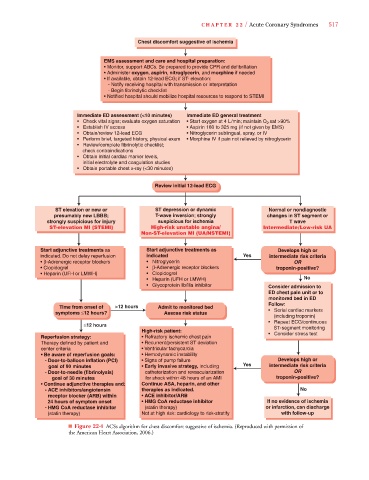
                              ■ Figure 22-4 ACSs algorithm for chest discomfort suggestive of ischemia. (Reproduced with permission of
                              the American Heart Association, 2006.)

