


Page 540 - Cardiac Nursing
P. 540
q
                                            Pa
                          q
                          q
                              3
                             3
                           xd
                           xd
                                              g
                                              g
                                              g
                                               e 5
                                               e 5
                        36.
                        36.
                      1-5
                      1-5
                                     1
                                     1
                                  009
                                  009
                                        0 A
                                        0 A
                                      1:0
                                      1:0
                                6/2
                              0/0
                              0/0
                             3
                                            Pa
                                          M
                                6/2
                                          M
                                          M
                                                     ara
         LWB
         LWBK340-c22_
                                                    t
                                                     ara
                                                     ara
            K34
                 22_
               0-c
                    51
                    51
                   p
                                                    t
                                                16
                                                16
                                                  A
                                                  A
                                                   p
                                                   p
                                                   p
         LWB K34 0-c 22_ p pp511-536.qxd  30/06/2009  11:00 AM  Page 516 Aptara
                  516    PA R T  I V / Pathophysiology and Management of Heart Disease
                                                                        A Symptoms suggestive of ACS
                    B1 Noncardiac diagnosis  B2 Chronic stable angina  B3  Possible ACS   B4  Definite ACS
                      Treatment as indicated   See ACC/AHA                    C2 No ST-elevation      C C3  ST-elevation
                   C1
                      by alternative diagnosis  guidelines for chronic
                                               stable angina
                                                                Nondiagnostic ECG      ST- and/or T-wave changes
                                                            D1  Normal initial serum   Ongoing pain
                                                                cardiac biomarkers  D2  Positive cardiac biomarkers
                                                                                       Hemodynamic abnormalities
                                                          Revhuyh
                                            E1
                                               12 hours or more from symptom onset
                                                                                                          Evaluate for
                                                                                                      D3   reperfusion
                                   No recurrent pain; negative       Recurrent ischemic pain or             therapy
                               F1
                                     follow-up studies          F2   positive follow-up studies
                                                                    Diagnosis of ACS confirmed
                                Stress study to provoke ischemia                                         See ACC/AHA
                               Consider evaluation of LV function if
                         G1                                                                               guidelines for
                            ischemia is present (tests may be performed                                   ST-elevation
                             either prior to discharge or as outpatient)
                                                                                                           myocardial
                                                                                                           infarction
                               Negative                Positive       H3          Admit to hospital
                          Potential diagnosis:       Diagnosis of
                     H1                         H2                         Manage via acute ischemia pathway
                         nonischemic discomfort;   ACS confirmed or
                             low-risk ACS            highly likely
                   I1 Arrangements for outpatient follow-up
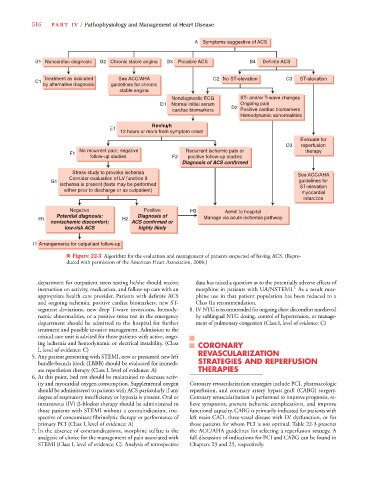
                              ■ Figure 22-3 Algorithm for the evaluation and management of patients suspected of having ACS. (Repro-
                              duced with permission of the American Heart Association, 2006.)
                    department for outpatient stress testing he/she should receive  data has raised a question as to the potentially adverse effects of
                                                                                                        1
                    instruction on activity, medication, and follow-up care with an  morphine in patients with UA/NSTEMI. As a result mor-
                    appropriate health care provider. Patients with definite ACS  phine use in that patient population has been reduced to a
                    and ongoing ischemia, positive cardiac biomarkers, new ST-  Class IIa recommendation.
                    segment deviations, new deep T-wave inversions, hemody-  8. IV NTG is recommended for ongoing chest discomfort unrelieved
                    namic abnormalities, or a positive stress test in the emergency  by sublingual NTG dosing, control of hypertension, or manage-
                    department should be admitted to the hospital for further  ment of pulmonary congestion (Class I, level of evidence: C)
                    treatment and possible invasive management. Admission to the
                    critical care unit is advised for those patients with active, ongo-
                    ing ischemia and hemodynamic or electrical instability. (Class  CORONARY
                    I, level of evidence: C)                             REVASCULARIZATION
                  5. Any patient presenting with STEMI, new or presumed new left
                    bundle-branch block (LBBB) should be evaluated for immedi-  STRATEGIES AND REPERFUSION
                    ate reperfusion therapy (Class I, level of evidence: A)  THERAPIES
                  6. At this point, bed rest should be maintained to decrease activ-
                    ity and myocardial oxygen consumption. Supplemental oxygen  Coronary revascularization strategies include PCI, pharmacologic
                    should be administered to patients with ACS particularly if any  reperfusion, and coronary artery bypass graft (CABG) surgery.
                    degree of respiratory insufficiency or hypoxia is present. Oral or  Coronary revascularization is performed to improve prognosis, re-
                    intravenous (IV)  -blocker therapy should be administered to  lieve symptoms, prevent ischemic complications, and improve
                    those patients with STEMI without a contraindication, irre-  functional capacity. CABG is primarily indicated for patients with
                    spective of concomitant fibrinolytic therapy or performance of  left main CAD, three-vessel disease with LV dysfunction, or for
                    primary PCI (Class I, level of evidence: A)       those patients for whom PCI is not optimal. Table 22-3 presents
                  7. In the absence of contraindications, morphine sulfate is the  the ACC/AHA guidelines for selecting a reperfusion strategy. A
                    analgesic of choice for the management of pain associated with  full discussion of indications for PCI and CABG can be found in
                    STEMI (Class I, level of evidence: C). Analysis of retrospective  Chapters 23 and 25, respectively.

