


Page 56 - Cardiac Nursing
P. 56
92806_c01.qxd  11/21/11  10:30 AM  Page 32


                     32   PA R T  I / Anatomy and Physiology

                     contraction). Left ventricular afterload is determined by the vol-  cardiac transplant patient, providing a mechanism to increase car-
                     ume and mass of blood ejected by the ventricle, the resistance to  diac output, particularly early in exercise.
                    blood flow (determined mainly by the cross-sectional area of the  Some treatment approaches take advantage of the length–
                    small arterioles, known as resistance vessels), aortic impedance  tension characteristics of the heart. Examples of this are leg rais-
                    (amount of pressure change for a given volume of blood ejected  ing and intravascular volume expansion in the patient with shock.
                    into the aorta; this depends on the elasticity of the aorta and  These therapies increase central blood volume and improve car-
                    branching arteries), and intrathoracic pressures. The arterial sys-  diac contractile force; they are easily and rapidly accessible. They
                    tolic pressure is a useful clinical indicator of the left ventricular  are, however, associated with an increase in myocardial oxygen
                    afterload; pulmonary systolic pressure suggests right ventricular  consumption and should be used carefully in the patient at risk
                    afterload. Total systemic vascular resistance and total pulmonary  for myocardial ischemia. These patients should be monitored for
                    vascular resistance are also used to suggest left and right ventricu-  ECG signs of myocardial ischemia and for symptoms such as
                    lar afterload, respectively.                        chest pain when interventions increase the preload.
                                                                           It is often clinically useful to monitor an indicator of cardiac vol-
                     Preload Role: Length–Tension Relationship          ume (such as jugular venous distension, pulmonary artery or cen-
                     Early in the twentieth century, Starling observed that within lim-  tral venous pressures, location of the point of maximum impulse)
                     its, an increase in left ventricular volume at the end of diastole re-  and a concurrently measured indicator of the tension generated
                     sulted in the generation of increased active pressure and increased  (such as cardiac output). The length–tension relationship charac-
                     volume pumped during the ensuing contraction. Beyond a cer-  terizes the mechanical functioning of the heart and can be helpful
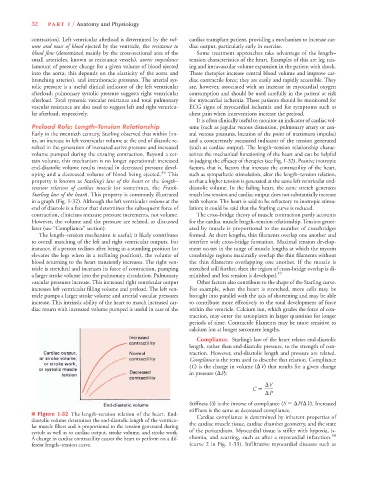
                     tain volume, this mechanism is no longer operational; increased  in judging the efficacy of therapies (see Fig. 1-32). Positive inotropic
                     end-diastolic volume results instead in decreased pressure devel-  factors, that is, factors that increase the contractility of the heart,
                     oping and a decreased volume of blood being ejected. 56  This  such as sympathetic stimulation, alter the length–tension relation,
                    property is known as Starling’s law of the heart or the length–  so that a higher tension is generated at the same left ventricular end-
                    tension relation of cardiac muscle (or sometimes, the  Frank-  diastolic volume. In the failing heart, the same stretch generates
                    Starling law of the heart). This property is commonly illustrated  much less tension and cardiac output does not substantially increase
                    in a graph (Fig. 1-32). Although the left ventricular volume at the  with volume. The heart is said to be refractory to inotropic stimu-
                    end of diastole is a factor that determines the subsequent force of  lation; it could be said that the Starling curve is reduced.
                    contraction, clinicians measure pressure increments, not volume.  The cross-bridge theory of muscle contraction partly accounts
                    However, the volume and the pressure are related, as discussed  for the cardiac muscle length–tension relationship. Tension gener-
                    later (see “Compliance” section).                   ated by muscle is proportional to the number of crossbridges
                       The length–tension mechanism is useful; it likely contributes  formed. At short lengths, thin filaments overlap one another and
                    to overall matching of the left and right ventricular outputs. For  interfere with cross-bridge formation. Maximal tension develop-
                    instance, if a person reclines after being in a standing position (or  ment occurs in the range of muscle lengths at which the myosin
                    elevates the legs when in a reclining position), the volume of  crossbridge regions maximally overlap the thin filaments without
                    blood returning to the heart transiently increases. The right ven-  the thin filaments overlapping one another. If the muscle is
                    tricle is stretched and increases its force of contraction, pumping  stretched still further, then the region of cross-bridge overlap is di-
                    a larger stroke volume into the pulmonary circulation. Pulmonary  minished and less tension is developed. 57
                    vascular pressures increase. This increased right ventricular output  Other factors also contribute to the shape of the Starling curve.
                    increases left ventricular filling volume and preload. The left ven-  For example, when the heart is stretched, more cells may be
                    tricle pumps a larger stroke volume and arterial vascular pressures  brought into parallel with the axis of shortening and may be able
                    increase. This intrinsic ability of the heart to match increased car-  to contribute more effectively to the total development of force
                    diac return with increased volume pumped is useful in case of the  within the ventricle. Calcium ion, which grades the force of con-
                                                                        traction, may enter the sarcoplasm in larger quantities for longer
                                                                        periods of time. Contractile filaments may be more sensitive to
                                                                        calcium ion at longer sarcomere lengths.
                                                                           Compliance. Starling’s law of the heart relates end-diastolic
                                                                        length, rather than end-diastolic pressure, to the strength of con-
                                                                        traction. However, end-diastolic length and pressure are related.
                                                                        Compliance is the term used to describe that relation. Compliance
                                                                        (C) is the change in volume ( V) that results for a given change
                                                                        in pressure ( P):
                                                                                                 ¢V
                                                                                             C
                                                                                                 ¢P
                                                                        Stiffness (S) is the inverse of compliance (S   P/ V). Increased
                                                                        stiffness is the same as decreased compliance.
                     ■ Figure 1-32 The length–tension relation of the heart. End-  Cardiac compliance is determined by inherent properties of
                     diastolic volume determines the end-diastolic length of the ventricu-
                     lar muscle fibers and is proportional to the tension generated during  the cardiac muscle tissue, cardiac chamber geometry, and the state
                     systole as well as to cardiac output, stroke volume, and stroke work.  of the pericardium. Myocardial tissue is stiffer with hypoxia, is-
                                                                                                                       58
                     A change in cardiac contractility causes the heart to perform on a dif-  chemia, and scarring, such as after a myocardial infarction.
                     ferent length–tension curve.                       (curve 2 in Fig. 1-33). Infiltrative myocardial diseases such as

