


Page 55 - Cardiac Nursing
P. 55
92806_c01.qxd  11/21/11  10:30 AM  Page 31


                                                                          CHAPTER 1 / Cardiac Anatomy and Physiology   31


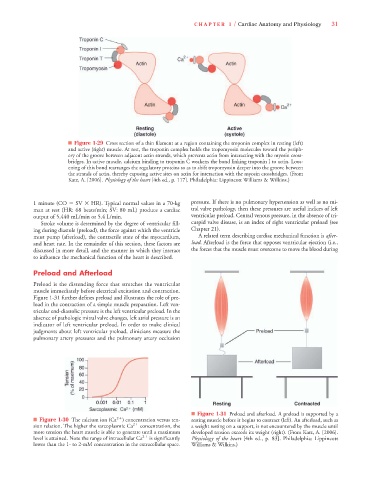
                                 ■ Figure 1-29 Cross section of a thin filament at a region containing the troponin complex in resting (left)
                                and active (right) muscle. At rest, the troponin complex holds the tropomyosin molecules toward the periph-
                                ery of the groove between adjacent actin strands, which prevents actin from interacting with the myosin cross-
                                bridges. In active muscle, calcium binding to troponin C weakens the bond linking troponin I to actin. Loos-
                                ening of this bond rearranges the regulatory proteins so as to shift tropomyosin deeper into the groove between
                                the strands of actin, thereby exposing active sites on actin for interaction with the myosin crossbridges. (From
                                Katz, A. [2006]. Physiology of the heart [4th ed., p. 117]. Philadelphia: Lippincott Williams & Wilkins.)


                     1 minute (CO   SV   HR). Typical normal values in a 70-kg  pressure. If there is no pulmonary hypertension as well as no mi-
                     man at rest (HR: 68 beats/min; SV: 80 mL) produce a cardiac  tral valve pathology, then these pressures are useful indices of left
                     output of 5,440 mL/min or 5.4 L/min.                ventricular preload. Central venous pressure, in the absence of tri-
                        Stroke volume is determined by the degree of ventricular fill-  cuspid valve disease, is an index of right ventricular preload (see
                     ing during diastole (preload), the force against which the ventricle  Chapter 21).
                     must pump (afterload), the contractile state of the myocardium,  A related term describing cardiac mechanical function is after-
                     and heart rate. In the remainder of this section, these factors are  load. Afterload is the force that opposes ventricular ejection (i.e.,
                     discussed in more detail, and the manner in which they interact  the forces that the muscle must overcome to move the blood during
                     to influence the mechanical function of the heart is described.

                     Preload and Afterload

                     Preload is the distending force that stretches the ventricular
                     muscle immediately before electrical excitation and contraction.
                     Figure 1-31 further defines preload and illustrates the role of pre-
                     load in the contraction of a simple muscle preparation. Left ven-
                     tricular end-diastolic pressure is the left ventricular preload. In the
                     absence of pathologic mitral valve changes, left atrial pressure is an
                     indicator of left ventricular preload. In order to make clinical
                     judgments about left ventricular preload, clinicians measure the
                     pulmonary artery pressures and the pulmonary artery occlusion


                                                                         ■ Figure 1-31 Preload and afterload. A preload is supported by a
                     ■ Figure 1-30 The calcium ion (Ca 2  ) concentration versus ten-  resting muscle before it begins to contract (left). An afterload, such as
                     sion relation. The higher the sarcoplasmic Ca 2   concentration, the  a weight resting on a support, is not encountered by the muscle until
                     more tension the heart muscle is able to generate until a maximum  developed tension exceeds its weight (right). (From Katz, A. [2006].
                     level is attained. Note the range of intracellular Ca 2   is significantly  Physiology of the heart [4th ed., p. 83]. Philadelphia: Lippincott
                     lower than the 1- to 2-mM concentration in the extracellular space.  Williams & Wilkins.)

