


Page 606 - Cardiac Nursing
P. 606
0
                                      1:4
                                  009
                                     0
                                      1:4
                                          M
                                          M
                                        3 P
                                        3 P
                             3
                             3
                           xd
                              3
                              0/0
                                6/2
                                  009
                              0/0
                                6/2
                                                   p
                                                   p
                                                  A
                                                  A
                                                   p
                                                     ara
                                                     ara
                                                    t
                                                    t
                                              g
                                              g
                                            Pa
                                            Pa
                                              g
                                                82
                                                82
                                              e 5
                                              e 5
                           xd
                    55
                    55
                      5-5
         LWBK340-c24_
                 24_
               0-c
            K34
         LWB
                          q
                        94.
                          q
                          q
         LWB K34 0-c 24_ p p pp555-594.qxd  30/06/2009  01:43 PM  Page 582 Aptara
                      5-5
                        94.
                  582    PA R T  I V / Pathophysiology and Management of Heart Disease
                  results in ventilatory failure. The increased volume begins to  sant factor has been identified in the serum of patients in the
                  pool in tissues secondary to profound venoconstriction and in-  early stages of septic shock. Its presence in other forms of shock
                  creased capillary permeability.                     remains controversial.
                     If the myocardial ischemia is severe and prolonged enough, my-
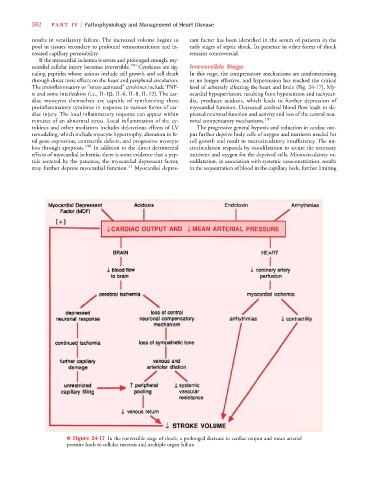
                  ocardial cellular injury becomes irreversible. 190  Cytokines are sig-  Irreversible Stage
                  naling peptides whose actions include cell growth and cell death  In this stage, the compensatory mechanisms are nonfunctioning
                  through direct toxic effects on the heart and peripheral circulation.  or no longer effective, and hypotension has reached the critical
                  The proinflammatory or “stress-activated” cytokines include TNF-  level of adversely affecting the heart and brain (Fig. 24-17). My-
                    and some interleukins (i.e., IL-1 , IL-6, IL-8, IL-12). The car-  ocardial hypoperfusion, resulting from hypotension and tachycar-
                  diac myocytes themselves are capable of synthesizing these  dia, produces acidosis, which  leads to  further  depression of
                  proinflammatory cytokines in response to various forms of car-  myocardial function. Decreased cerebral blood flow leads to de-
                  diac injury. The local inflammatory response can appear within  pressed neuronal function and activity and loss of the central neu-
                  minutes of an abnormal stress. Local inflammation of the cy-  ronal compensatory mechanisms. 197
                  tokines and other mediators includes deleterious effects of LV   The progressive general hypoxia and reduction in cardiac out-
                  remodeling, which include myocyte hypertrophy, alteration in fe-  put further deprive body cells of oxygen and nutrients needed for
                  tal gene expression, contractile defects, and progressive myocyte  cell growth and result in microcirculatory insufficiency. The mi-
                  loss through apoptosis. 198  In addition to the direct detrimental  crocirculation responds by vasodilatation to secure the necessary
                  effects of myocardial ischemia, there is some evidence that a pep-  nutrients and oxygen for the deprived cells. Microcirculatory va-
                  tide secreted by the pancreas, the myocardial depressant factor,  sodilatation, in association with systemic vasoconstriction, results
                  may further depress myocardial function. 11  Myocardial depres-  in the sequestration of blood in the capillary beds, further limiting


                              ■ Figure 24-17 In the irreversible stage of shock, a prolonged decrease in cardiac output and mean arterial
                              pressure leads to cellular necrosis and multiple organ failure.

