


Page 633 - Cardiac Nursing
P. 633
1
                                     1
                                  009
                                  009
                                      7:4
                                        5
                                         Pa
                                      7:4
                                        5
                                0/2
                           xd
                              0
                          q
                           xd
                             0
                              6/3
                                0/2
                             0
                              6/3
                                                 p
                                                 p
                                                A
                                                A
                                                 p
                                                  ara
                                                  ara
                                                 t
                                                 t
                                                A
                                           g
                                           g
                                         Pa
                                         Pa
                                           g
                                              09
                                              09
                                            e 6
                                            e 6
                          q
            K34
         LWBK340-c25_
         LWB
               0-c
                    59
                    59
                 25_
                        22.
                        22.
                          q
         LWB K34 0-c 25_ p p pp595-622.qxd  06/30/2009  17:45  Page 609 Aptara
                      5-6
                      5-6
                                                                                   C HAPTER 2 5 / Cardiac Surgery  609
                   (performed when recipients are accepted as transplantation candi-  An alternative technique is referred to as total orthotopic heart
                   dates) against standard pools of lymphocytes from multiple serum  transplantation or the bicaval and pulmonary venous anastomo-
                   donors. This result is reported in a percentage of panel reactive an-  sis. The basic features of the bicaval method are complete excision
                   tibody (% PRA). Patients with a known positive reaction, a positive  of the recipient atria and donor heart implantation with bicaval
                   PRA for example of 50%, will have additional HLA testing to iden-  end-to-end anastomosis. Proponents of this technique cite the po-
                   tify those specific circulating antibodies. These candidates are iden-  tential for more synchronous atrial contraction, and reduction of
                   tified as “sensitized” such that the candidates antibodies could react  pacemaker implantation and atrioventricular valve regurgita-
                   to certain donor cell antigens and result in antibody-mediated   tion. 65
                   rejection. Therapies are available to reduce these antibodies.
                     The original surgical technique for orthotopic heart transplan-  Medical Management
                   tation described by Shumway et al. 64  has remained the standard
                   procedure. After a median sternotomy and the initiation of CPB,  In the immediate postoperative period, postoperative care is sim-
                   the recipient’s heart is removed, leaving the posterior walls of the  ilar to that of any cardiac surgical patient. Transplant recipients
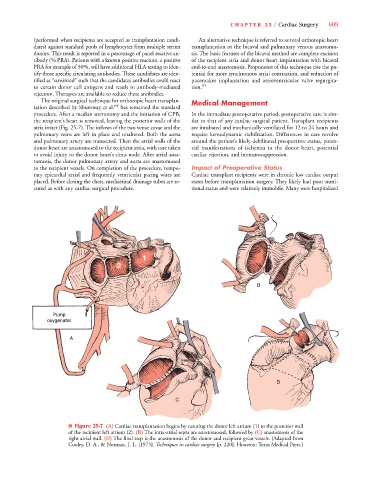
                   atria intact (Fig. 25-7). The inflows of the two venae cavae and the  are intubated and mechanically ventilated for 12 to 24 hours and
                   pulmonary veins are left in place and unaltered. Both the aorta  require hemodynamic stabilization. Differences in care revolve
                   and pulmonary artery are transected. Then the atrial walls of the  around the patient’s likely debilitated preoperative status, poten-
                   donor heart are anastomosed to the recipient atria, with care taken  tial manifestations of ischemia in the donor heart,  potential
                   to avoid injury to the donor heart’s sinus node. After atrial anas-  cardiac rejection, and immunosuppression.
                   tomosis, the donor pulmonary artery and aorta are anastomosed
                   to the recipient vessels. On completion of the procedure, tempo-  Impact of Preoperative Status
                   rary epicardial atrial and frequently ventricular pacing wires are  Cardiac transplant recipients were in chronic low cardiac output
                   placed. Before closing the chest, mediastinal drainage tubes are se-  states before transplantation surgery. They likely had poor nutri-
                   cured as with any cardiac surgical procedure.       tional status and were relatively immobile. Many were hospitalized
                                                       1
                                              2
                                                                                            B
                         Pump
                       oxygenator
                               A
                                                                                                  D

                                                                 C


                              ■ Figure 25-7 (A) Cardiac transplantation begins by suturing the donor left atrium (1) to the posterior wall
                              of the recipient left atrium (2). (B) The intra-atrial septa are anastomosed, followed by (C) anastomosis of the
                              right atrial wall. (D) The final step is the anastomosis of the donor and recipient great vessels. (Adapted from
                              Cooley, D. A., & Norman, J. L. [1975]. Techniques in cardiac surgery [p. 220]. Houston: Texas Medical Press.)

