


Page 630 - Cardiac Nursing
P. 630
009
                                  009
                                0/2
                              6/3
                                0/2
                                      7:4
                                        5
                                      7:4
                                     1
                                     1
                              6/3
                          q
                          q
                          q
                        22.
                        22.
                             0
                             0
                              0
                           xd
                           xd
                                                 p
                                                 p
                                                A
                                                A
                                                A
                                                  ara
                                                  ara
                                                 t
                                                 p
                                                 t
                                              06
                                         Pa
                                           g
                                         Pa
                                        5
                                         Pa
                                            e 6
                                              06
                                            e 6
                                           g
                                           g
            K34
            K34
         LWB
         LWB
                 25_
                 25_
               0-c
               0-c
         LWBK340-c25_ p p pp595-622.qxd  06/30/2009  17:45  Page 606 Aptara
                    59
                      5-6
                      5-6
                    59
                  606    PA R T  I V / Pathophysiology and Management of Heart Disease
                  self-injury and prolonged hospitalization. Haloperidol is often  Wound infection after CABG surgery occurs despite periopera-
                  used for sedation.                                  tive antibiotics and aseptic technique. Sternal wound infections
                                                                      typically present 4 to 14 days after surgery with fever, leukocyto-
                  Late Postoperative Complications                    sis, and inflammatory wound with purulent drainage. Sternal
                                                                      wounds are often associated with a sternal click and sternal insta-
                  After the fourth postoperative day, most cardiac surgery patients  bility. Staphylococci, both Staphylococcus aureus and coagulase-
                  have short, uncomplicated hospital stays and are discharged to  negative staphylococcus, are the most common causative organ-
                  home. However, postpericardiotomy syndrome, cardiac tampon-  ism.  49  Superficial chest wounds are treated with antibiotics and
                  ade, or incisional wound infection may occur during the last post-  local drainage. Deep sternal wounds and mediastinitis are treated
                  operative period.                                   with surgical débridement and closure or plastic surgical closure
                     Postpericardiotomy syndrome occurs when traumatized tissue in  with muscle flap. The incidence of deep sternal infections range
                  the pericardial cavity triggers an autoimmune response. Postperi-  from 0.25% to 4% and the superficial sternal wound infections
                  cardiotomy syndrome usually occurs weeks to months after sur-  are seen in 2% to 6% after cardiac surgery, both of which prolong
                                                                                       29
                  gery and results from inflammation of the pleura and pericardium  care and increase cost. Infections at the venectomy donor sites
                  causes aching pericardial pain and severe pleuritic pain. Pleural  may also occur and are usually treatable with oral antibiotics, but
                  and pericardial effusions may accompany the inflammation.  severe infections may require open drainage and intravenous an-
                  Treatment is with ibuprofen, indomethacin, or a brief course of  tibiotics.
                  prednisone. Large or symptomatic pleural effusions should be
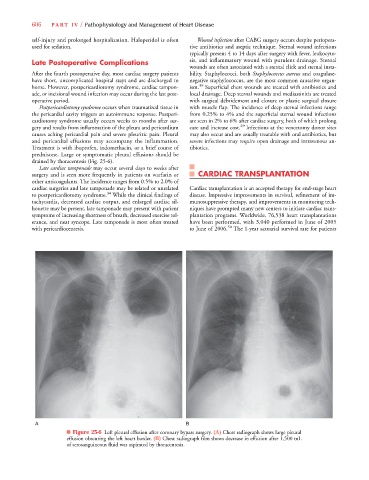
                  drained by thoracentesis (Fig. 25-6).
                     Late cardiac tamponade may occur several days to weeks after
                  surgery and is seen more frequently in patients on warfarin or  CARDIAC TRANSPLANTATION
                  other anticoagulants. The incidence ranges from 0.5% to 2.0% of
                  cardiac surgeries and late tamponade may be related or unrelated  Cardiac transplantation is an accepted therapy for end-stage heart
                                           34
                  to postpericardiotomy syndrome. While the clinical findings of  disease. Impressive improvements in survival, refinement of im-
                  tachycardia, decreased cardiac output, and enlarged cardiac sil-  munosuppressive therapy, and improvements in monitoring tech-
                  houette may be present, late tamponade may present with patient  niques have prompted many new centers to initiate cardiac trans-
                  symptoms of increasing shortness of breath, decreased exercise tol-  plantation programs. Worldwide, 76,538 heart transplantations
                  erance, and near syncope. Late tamponade is most often treated  have been performed, with 3,040 performed in June of 2005
                  with pericardiocentesis.                            to June of 2006. 50  The 1-year actuarial survival rate for patients

                    A                                                B
                              ■ Figure 25-6 Left pleural effusion after coronary bypass surgery. (A) Chest radiograph shows large pleural
                              effusion obscuring the left heart border. (B) Chest radiograph film shows decrease in effusion after 1,500 mL
                              of serosanguineous fluid was aspirated by thoracentesis.

