


Page 680 - Cardiac Nursing
P. 680
04.
                         04.
                       5-7
                                           P
                           qxd
                           qxd
                                                    tar
                                               656
                                                  Ap
                       5-7
                    p65
                    p65
                                            a
                                            a
                                             g
                                                    tar
                                              e
                                               656
                                 09
                                /1/
                                /1/
                                 09
                                    9:
                                     49
                                                  Ap
            K34
            K34
         L L LWB
         LWB
                 28_
                 28_
               0-c
               0-c
         LWBK340-c28_p655-704.qxd  7/1/09  9:9:49 AM  Page 656 Aptara a a
                                        AM
                                        AM
                                             g
                                     49
                               7
                                              e
                                           P
                               7
                  656    PA R T  I V / Pathophysiology and Management Disease
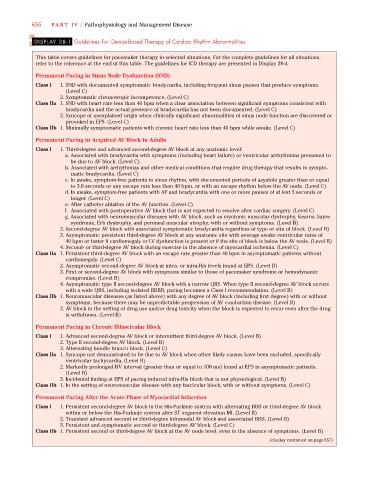
                   DISPLAY 28-1 Guidelines For Device-Based Therapy of Cardiac Rhythm Abnormalities
                    This table covers guidelines for pacemaker therapy in selected situations. For the complete guidelines for all situations,
                    refer to the reference at the end of this table. The guidelines for ICD therapy are presented in Display 28-4.
                    Permanent Pacing in Sinus Node Dysfunction (SND)
                    Class I  1. SND with documented symptomatic bradycardia, including frequent sinus pauses that produce symptoms.
                             (Level C)
                            2. Symptomatic chronotropic incompetence. (Level C)
                    Class IIa 1. SND with heart rate less than 40 bpm when a clear association between significant symptoms consistent with
                             bradycardia and the actual presence of bradycardia has not been documented. (Level C)
                            2. Syncope of unexplained origin when clinically significant abnormalities of sinus node function are discovered or
                             provoked in EPS. (Level C)
                    Class IIb 1. Minimally symptomatic patients with chronic heart rate less than 40 bpm while awake. (Level C)
                    Permanent Pacing in Acquired AV Block in Adults
                    Class I  1. Third-degree and advanced second-degree AV block at any anatomic level:
                             a. Associated with bradycardia with symptoms (including heart failure) or ventricular arrhythmias presumed to
                               be due to AV block. (Level C)
                             b. Associated with arrhythmias and other medical conditions that require drug therapy that results in sympto-
                               matic bradycardia. (Level C)
                             c. In awake, symptom-free patients in sinus rhythm, with documented periods of asystole greater than or equal
                               to 3.0 seconds or any escape rate less than 40 bpm, or with an escape rhythm below the AV node. (Level C)
                             d. In awake, symptom-free patients with AF and bradycardia with one or more pauses of at lest 5 seconds or
                               longer. (Level C)
                             e. After catheter ablation of the AV junction. (Level C)
                             f.  Associated with postoperative AV block that is not expected to resolve after cardiac surgery. (Level C)
                             g. Associated with neuromuscular diseases with AV block, such as myotonic muscular dystrophy, Kearns–Sayre
                               syndrome, Erb dystrophy, and peroneal muscular atrophy, with or without symptoms. (Level B)
                            2. Second-degree AV block with associated symptomatic bradycardia regardless of type or site of block. (Level B)
                            3. Asymptomatic persistent third-degree AV block at any anatomic site with average awake ventricular rates of
                             40 bpm or faster if cardiomegaly or LV dysfunction is present or if the site of block is below the AV node. (Level B)
                            4. Second- or third-degree AV block during exercise in the absence of myocardial ischemia. (Level C)
                    Class IIa 1. Persistent third-degree AV block with an escape rate greater than 40 bpm in asymptomatic patients without
                             cardiomegaly. (Level C)
                            2. Asymptomatic second-degree AV block at intra- or infra-His levels found at EPS. (Level B)
                            3. First or second-degree AV block with symptoms similar to those of pacemaker syndrome or hemodynamic
                             compromise. (Level B)
                            4. Asymptomatic type II second-degree AV block with a narrow QRS. When type II second-degree AV block occurs
                             with a wide QRS, including isolated RBBB, pacing becomes a Class I recommendation. (Level B)
                    Class IIb 1. Neuromuscular diseases (as listed above) with any degree of AV block (including first degree) with or without
                             symptoms, because there may be unpredictable progression of AV conduction disease. (Level B)
                            2. AV block in the setting of drug use and/or drug toxicity when the block is expected to recur even after the drug
                             is withdrawn. (Level B)
                    Permanent Pacing in Chronic Bifascicular Block
                    Class I  1. Advanced second-degree AV block or intermittent third-degree AV block. (Level B)
                            2. Type II second-degree AV block. (Level B)
                            3. Alternating bundle branch block. (Level C)
                    Class IIa 1. Syncope not demonstrated to be due to AV block when other likely causes have been excluded, specifically
                             ventricular tachycardia. (Level B)
                            2. Markedly prolonged HV interval (greater than or equal to 100 ms) found at EPS in asymptomatic patients.
                             (Level B)
                            3. Incidental finding at EPS of pacing induced infra-His block that is not physiological. (Level B)
                    Class IIb 1. In the setting of neuromuscular disease with any fascicular block, with or without symptoms. (Level C)
                    Permanent Pacing After the Acute Phase of Myocardial Infarction
                    Class I  1. Persistent second-degree AV block in the His-Purkinje system with alternating BBB or third-degree AV block
                             within or below the His-Purkinje system after ST segment elevation MI. (Level B)
                            2. Transient advanced second or third-degree infranodal AV block and associated BBB. (Level B)
                            3. Persistent and symptomatic second or third-degree AV block. (Level C)
                    Class IIb 1. Persistent second or third-degree AV block at the AV node level, even in the absence of symptoms. (Level B)
                                                                                                (display continued on page 657)

