


Page 681 - Cardiac Nursing
P. 681
09
                                /1/
                                     49
                                           P
                                        AM
                         04.
                       5-7
                           qxd
                               7
                    p65
                                             g
         LWB K34 0-c 28_ p65 5-7 04. qxd  7 /1/ 09  9: 49  AM  P a a g e e  657  Ap tar a a
               0-c
         L L LWB
         LWBK340-c28_p655-704.qxd  7/1/09  9:9:49 AM  Page 657 Aptara
            K34
                                               657
                                                  Ap
                                                    tar
                 28_
                                                              C HAPTER 2 8 / Pacemakers and Implantable Defibrillators  657
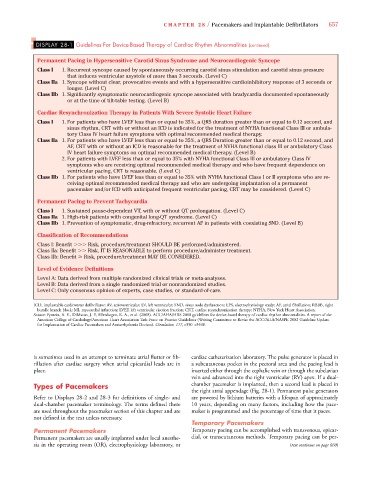
                    DISPLAY 28-1 Guidelines For Device-Based Therapy of Cardiac Rhythm Abnormalities (continued)
                    Permanent Pacing in Hypersensitive Carotid Sinus Syndrome and Neurocardiogenic Syncope
                    Class I  1. Recurrent syncope caused by spontaneously occurring carotid sinus stimulation and carotid sinus pressure
                              that induces ventricular asystole of more than 3 seconds. (Level C)
                    Class IIa 1. Syncope without clear, provocative events and with a hypersensitive cardioinhibitory response of 3 seconds or
                              longer. (Level C)
                    Class IIb 1. Significantly symptomatic neurocardiogenic syncope associated with bradycardia documented spontaneously
                              or at the time of tilt-table testing. (Level B)
                    Cardiac Resynchronization Therapy in Patients With Severe Systolic Heart Failure
                    Class I  1. For patients who have LVEF less than or equal to 35%, a QRS duration greater than or equal to 0.12 second, and
                              sinus rhythm, CRT with or without an ICD is indicated for the treatment of NYHA functional Class III or ambula-
                              tory Class IV heart failure symptoms with optimal recommended medical therapy.
                    Class IIa 1. For patients who have LVEF less than or equal to 35%, a QRS Duration greater than or equal to 0.12 second, and
                              AF, CRT with or without an ICD is reasonable for the treatment of NYHA functional class III or ambulatory Class
                              IV heart failure symptoms on optimal recommended medical therapy. (Level B)
                            2. For patients with LVEF less than or equal to 35% with NYHA functional Class III or ambulatory Class IV
                              symptoms who are receiving optimal recommended medical therapy and who have frequent dependence on
                              ventricular pacing, CRT is reasonable. (Level C)
                    Class IIb 1. For patients who have LVEF less than or equal to 35% with NYHA functional Class I or II symptoms who are re-
                              ceiving optimal recommended medical therapy and who are undergoing implantation of a permanent
                              pacemaker and/or ICD with anticipated frequent ventricular pacing, CRT may be considered. (Level C)
                    Permanent Pacing to Prevent Tachycardia
                    Class I  1. Sustained pause-dependent VT, with or without QT prolongation. (Level C)
                    Class IIa 1. High-risk patients with congenital long-QT syndrome. (Level C)
                    Class IIb 1. Prevention of symptomatic, drug-refractory, recurrent AF in patients with coexisting SND. (Level B)
                    Classification of Recommendations
                    Class I: Benefit     Risk, procedure/treatment SHOULD BE performed/administered.
                    Class IIa: Benefit    Risk, IT IS REASONABLE to perform procedure/administer treatment.
                    Class IIb: Benefit   Risk, procedure/treatment MAY BE CONSIDERED.

                    Level of Evidence Definitions
                    Level A: Data derived from multiple randomized clinical trials or meta-analyses.
                    Level B: Data derived from a single randomized trial or nonrandomized studies.
                    Level C: Only consensus opinion of experts, case studies, or standard-of-care.

                   ICD, implantable cardioverter defibrillator; AV, atrioventricular; LV, left ventricular; SND, sinus node dysfunction; EPS, electrophysiology study; AF, atrial fibrillation; RBBB, right
                    bundle branch block; MI, myocardial infarction; LVEF, left ventricular ejection fraction; CRT, cardiac resynchronization therapy; NYHA, New York Heart Association.
                   Source: Epstein, A. E., DiMarco, J. P., Ellenbogen, K. A., et al. (2008). ACC/AHA/HRS 2008 guidelines for device-based therapy of cardiac rhythm abnormalities. A report of the
                    American College of Cardiology/American Heart Association Task Force on Practice Guidelines (Writing Committee to Revise the ACC/AHA/NASPE 2002 Guideline Update
                    for Implantation of Cardiac Pacemakers and Antiarrhythmia Devices). Circulation, 117, e350–e3408.7 7


                   is sometimes used in an attempt to terminate atrial flutter or fib-  cardiac catheterization laboratory. The pulse generator is placed in
                   rillation after cardiac surgery when atrial epicardial leads are in  a subcutaneous pocket in the pectoral area and the pacing lead is
                   place.                                              inserted either through the cephalic vein or through the subclavian
                                                                       vein and advanced into the right ventricular (RV) apex. If a dual-
                   Types of Pacemakers                                 chamber pacemaker is implanted, then a second lead is placed in
                                                                       the right atrial appendage (Fig. 28-1). Permanent pulse generators
                   Refer to Displays 28-2 and 28-3 for definitions of single- and  are powered by lithium batteries with a lifespan of approximately
                   dual-chamber pacemaker terminology. The terms defined there  10 years, depending on many factors, including how the pace-
                   are used throughout the pacemaker section of this chapter and are  maker is programmed and the percentage of time that it paces.
                   not defined in the text unless necessary.
                                                                       Temporary Pacemakers
                   Permanent Pacemakers                                Temporary pacing can be accomplished with transvenous, epicar-
                   Permanent pacemakers are usually implanted under local anesthe-  dial, or transcutaneous methods. Temporary pacing can be per-
                   sia in the operating room (OR), electrophysiology laboratory, or                    (text continues on page 660)
                                                                                                                     0
                                                                                                                     0

