


Page 685 - Cardiac Nursing
P. 685
7
/1/
09
qxd
p65
5-7
04.
661
Ap
tar
g
49
AM
P
K34
0-c
28_
LWB K34 0-c 28_ p65 5-7 04. qxd 7 /1/ 09 9: 49 AM P a a g e e 661 Ap tar a a
LWB
LWBK340-c28_p655-704.qxd 7/1/09 9:9:49 AM Page 661 Aptara
C HAPTER 2 8 / Pacemakers and Implantable Defibrillators 661
ic
ric
ric
c
lar w
lar w
lar w
lar w
t
tri
Ven cricular war w
n
tri
tr
tr
t
tr
lar w
u
c
c
u
u
u
u
u
w
w w w w w
u
u
wires
lar w
lar w
ar w
ar w
w
w
w
w
w
w
w
Atr
Atria
Atria
Atri
Atria
Atria w
Atria
Atria
Atri
al wwires
al al al
w
w
Atria
Atria
Atria
Pacing cables
Transvenous Pacing cable
pacing wire
Single chamber Dual chamber
pulse generator pulse generator
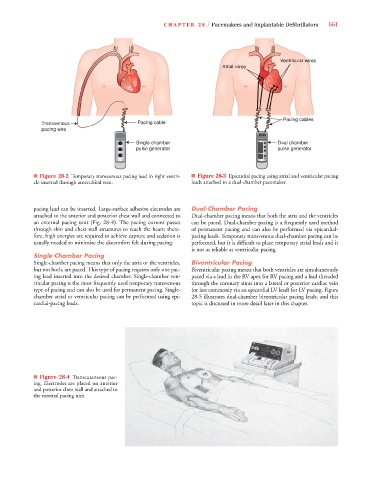
■ Figure 28-2 Temporary transvenous pacing lead in right ventri- ■ Figure 28-3 Epicardial pacing using atrial and ventricular pacing
cle inserted through antecubital vein. leads attached to a dual-chamber pacemaker.
pacing lead can be inserted. Large-surface adhesive electrodes are Dual-Chamber Pacing
attached to the anterior and posterior chest wall and connected to Dual-chamber pacing means that both the atria and the ventricles
an external pacing unit (Fig. 28-4). The pacing current passes can be paced. Dual-chamber pacing is a frequently used method
through skin and chest wall structures to reach the heart; there- of permanent pacing and can also be performed via epicardial-
fore, high energies are required to achieve capture and sedation is pacing leads. Temporary transvenous dual-chamber pacing can be
usually needed to minimize the discomfort felt during pacing. performed, but it is difficult to place temporary atrial leads and it
is not as reliable as ventricular pacing.
Single-Chamber Pacing
Single-chamber pacing means that only the atria or the ventricles, Biventricular Pacing
but not both, are paced. This type of pacing requires only one pac- Biventricular pacing means that both ventricles are simultaneously
ing lead inserted into the desired chamber. Single-chamber ven- paced via a lead in the RV apex for RV pacing and a lead threaded
tricular pacing is the most frequently used temporary transvenous through the coronary sinus into a lateral or posterior cardiac vein
type of pacing and can also be used for permanent pacing. Single- (or less commonly via an epicardial LV lead) for LV pacing. Figure
chamber atrial or ventricular pacing can be performed using epi- 28-5 illustrates dual-chamber biventricular pacing leads, and this
cardial-pacing leads. topic is discussed in more detail later in this chapter.
■ Figure 28-4 Transcutaneous pac-
ing. Electrodes are placed on anterior
and posterior chest wall and attached to
the external pacing unit.

