


Page 687 - Cardiac Nursing
P. 687
7
                                /1/
                                 09
                           qxd
                    p65
                       5-7
                         04.
                                               663
                                                  Ap
                                                    tar
                                             g
                                     49
                                        AM
                                           P
                 28_
         LWBK340-c28_p655-704.qxd  7/1/09  9:9:49 AM  Page 663 Aptara
         L L LWB K34 0-c 28_ p65 5-7 04. qxd  7 /1/ 09  9: 49  AM  P a a g e e  663  Ap tar a a
         LWB
            K34
               0-c
                                                              C HAPTER 2 8 / Pacemakers and Implantable Defibrillators  663
                   generator through the pacing lead to the myocardium, through  the only way to alter its pacing parameters is with a program-
                   the myocardium, and back to the pulse generator, thus complet-  mer that communicates with the pacemaker through a wand
                   ing the circuit. 23,24                              placed over the pulse generator. A temporary pulse generator is
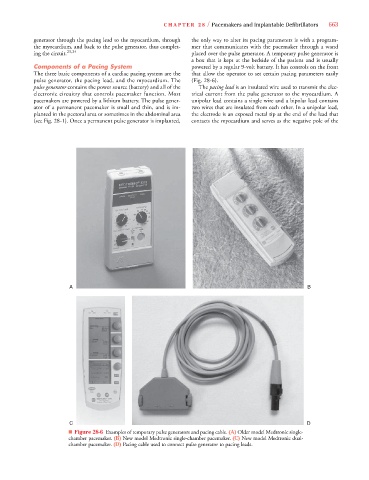
                                                                       a box that is kept at the bedside of the patient and is usually
                   Components of a Pacing System                       powered by a regular 9-volt battery. It has controls on the front
                   The three basic components of a cardiac pacing system are the  that allow the operator to set certain pacing parameters easily
                   pulse generator, the pacing lead, and the myocardium. The  (Fig. 28-6).
                   pulse generator contains the power source (battery) and all of the  The pacing lead is an insulated wire used to transmit the elec-
                   electronic circuitry that controls pacemaker function. Most  trical current from the pulse generator to the myocardium. A
                   pacemakers are powered by a lithium battery. The pulse gener-  unipolar lead contains a single wire and a bipolar lead contains
                   ator of a permanent pacemaker is small and thin, and is im-  two wires that are insulated from each other. In a unipolar lead,
                   planted in the pectoral area or sometimes in the abdominal area  the electrode is an exposed metal tip at the end of the lead that
                   (see Fig. 28-1). Once a permanent pulse generator is implanted,  contacts the myocardium and serves as the negative pole of the


                               A                                                                             B


                               C                                                                            D
                              ■ Figure 28-6 Examples of temporary pulse generators and pacing cable. (A) Older model Medtronic single-
                              chamber pacemaker. (B) New model Medtronic single-chamber pacemaker. (C) New model Medtronic dual-
                              chamber pacemaker. (D) Pacing cable used to connect pulse generator to pacing leads.

