


Page 689 - Cardiac Nursing
P. 689
AM
                                     49
                                                  Ap
                                           P
                               7
                                 09
                                /1/
                       5-7
                         04.
                           qxd
                    p65
                                                    tar
                                               665
                                             g
            K34
               0-c
                 28_
         LWB K34 0-c 28_ p65 5-7 04. qxd  7 /1/ 09  9: 49  AM  P a a g e e  665  Ap tar a a
         LWBK340-c28_p655-704.qxd  7/1/09  9:9:49 AM  Page 665 Aptara
         LWB
                                                              C HAPTER 2 8 / Pacemakers and Implantable Defibrillators  665
                   Asynchronous (Fixed-Rate) Pacing                    pacemaker programmer. In temporary pacing, the output dial on
                   A pacemaker programmed to an asynchronous mode paces at the  the face of the pulse generator controls stimulus strength and can
                   programmed rate regardless of intrinsic cardiac activity. This  be set and changed easily by the operator. Temporary pulse gener-
                   mode can result in competition between the pacemaker and the  ators usually are capable of delivering a stimulus of from 0.1 to
                   heart’s own electrical activity. Asynchronous pacing in the ventri-  20 mA.
                   cle is unsafe because of the potential for pacing stimuli to fall in
                   the vulnerable period of repolarization and cause ventricular fib-  Sensing
                   rillation (VF). Asynchronous pacing in the atria is less dangerous  The sensing circuit controls how sensitive the pacemaker is to in-
                   but can cause atrial fibrillation.                   trinsic cardiac depolarizations. Intrinsic activity is measured in
                                                                       millivolts (mV), and the higher the number, the larger the intrin-
                   Demand Pacing                                       sic signal. For example, a 10-mV QRS complex is larger than a
                   The term demand means that the pacemaker paces only when the  2-mV QRS. When pacemaker sensitivity needs to be increased to
                   heart fails to depolarize on its own, that is, the pacemaker fires only  make the pacemaker “see” smaller signals, the sensitivity number
                   “on demand.” In the demand mode, the pacemaker’s sensing circuit  must be decreased. For example, a sensitivity of 2 mV is more sen-
                   is capable of sensing intrinsic cardiac activity and inhibiting pacer  sitive than one of 5 mV.
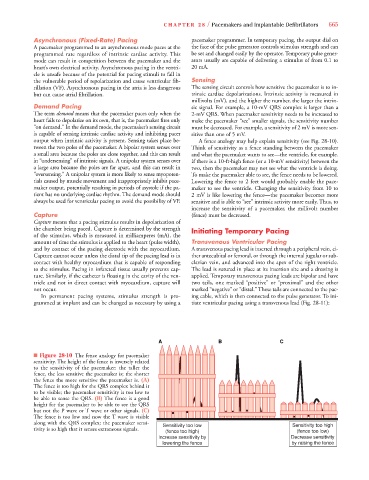
                   output when intrinsic activity is present. Sensing takes place be-  A fence analogy may help explain sensitivity (see Fig. 28-10).
                   tween the two poles of the pacemaker. A bipolar system senses over  Think of sensitivity as a fence standing between the pacemaker
                   a small area because the poles are close together, and this can result  and what the pacemaker wants to see—the ventricle, for example.
                   in “undersensing” of intrinsic signals. A unipolar system senses over  If there is a 10-ft-high fence (or a 10-mV sensitivity) between the
                   a large area because the poles are far apart, and this can result in  two, then the pacemaker may not see what the ventricle is doing.
                   “oversensing.” A unipolar system is more likely to sense myopoten-  To make the pacemaker able to see, the fence needs to be lowered.
                   tials caused by muscle movement and inappropriately inhibit pace-  Lowering the fence to 2 feet would probably enable the pace-
                   maker output, potentially resulting in periods of asystole if the pa-  maker to see the ventricle. Changing the sensitivity from 10 to
                   tient has no underlying cardiac rhythm. The demand mode should  2 mV is like lowering the fence—the pacemaker becomes more
                   always be used for ventricular pacing to avoid the possibility of VF.  sensitive and is able to “see” intrinsic activity more easily. Thus, to
                                                                       increase the sensitivity of a pacemaker, the millivolt number
                   Capture                                             (fence) must be decreased.
                   Capture means that a pacing stimulus results in depolarization of
                   the chamber being paced. Capture is determined by the strength  Initiating Temporary Pacing
                   of the stimulus, which is measured in milliamperes (mA), the
                   amount of time the stimulus is applied to the heart (pulse width),  Transvenous Ventricular Pacing
                   and by contact of the pacing electrode with the myocardium.  A transvenous pacing lead is inserted through a peripheral vein, ei-
                   Capture cannot occur unless the distal tip of the pacing lead is in  ther antecubital or femoral, or through the internal jugular or sub-
                   contact with healthy myocardium that is capable of responding  clavian vein, and advanced into the apex of the right ventricle.
                   to the stimulus. Pacing in infarcted tissue usually prevents cap-  The lead is sutured in place at its insertion site and a dressing is
                   ture. Similarly, if the catheter is floating in the cavity of the ven-  applied. Temporary transvenous pacing leads are bipolar and have
                   tricle and not in direct contact with myocardium, capture will  two tails, one marked “positive” or “proximal” and the other
                   not occur.                                          marked “negative” or “distal.” These tails are connected to the pac-
                     In permanent pacing systems, stimulus strength is pro-  ing cable, which is then connected to the pulse generator. To ini-
                   grammed at implant and can be changed as necessary by using a  tiate ventricular pacing using a transvenous lead (Fig. 28-11):


                                                            A                  B                    C
                   ■ Figure 28-10 The fence analogy for pacemaker
                   sensitivity. The height of the fence is inversely related
                   to  the sensitivity of the  pacemaker: the taller the
                   fence, the less sensitive the pacemaker is; the shorter
                   the fence the more sensitive the pacemaker is. (A)
                   The fence is too high for the QRS complex behind it
                   to be visible; the pacemaker sensitivity is too low to
                   be able to sense the QRS. (B) The fence is a good
                   height for the pacemaker to be able to see the QRS
                   but not the P wave or T wave or other signals. (C)
                   The fence is too low and now the T wave is visible
                   along with the QRS complex; the pacemaker sensi-  Sensitivity too low                Sensitivity too high
                   tivity is so high that it senses extraneous signals.
                                                              (fence too high)                           (fence too low)
                                                            Increase sensitivity by                    Decrease sensitivity
                                                             lowering the fence                        by raising the fence

