


Page 686 - Cardiac Nursing
P. 686
LWBK340-c28_p655-704.qxd  7/1/09  9:49 AM  Page 662 Aptara


                  662    PA R T  IV / Pathophysiology and Management Disease


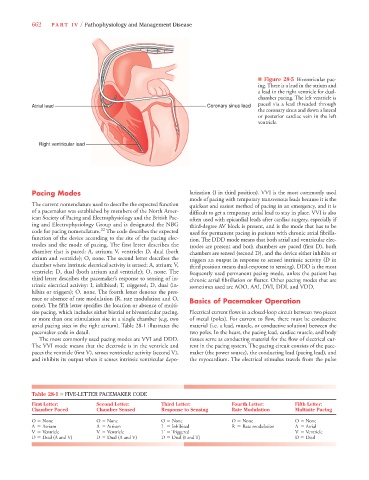
                                                                                            ■ Figure 28-5 Biventricular pac-
                                                                                            ing. There is a lead in the atrium and
                                                                                            a lead in the right ventricle for dual-
                                                                                            chamber pacing. The left ventricle is
                  Atrial lead                                               Coronary sinus lead  paced via a lead threaded through
                                                                                            the coronary sinus and down a lateral
                                                                                            or posterior cardiac vein in the left
                                                                                            ventricle.


                     Right ventricular lead


                  Pacing Modes                                        larization (I in third position). VVI is the most commonly used
                                                                      mode of pacing with temporary transvenous leads because it is the
                  The current nomenclature used to describe the expected function  quickest and easiest method of pacing in an emergency, and it is
                  of a pacemaker was established by members of the North Amer-  difficult to get a temporary atrial lead to stay in place. VVI is also
                  ican Society of Pacing and Electrophysiology and the British Pac-  often used with epicardial leads after cardiac surgery, especially if
                  ing and Electrophysiology Group and is designated the NBG  third-degree AV block is present, and is the mode that has to be
                                         22
                  code for pacing nomenclature. The code describes the expected  used for permanent pacing in patients with chronic atrial fibrilla-
                  function of the device according to the site of the pacing elec-  tion. The DDD mode means that both atrial and ventricular elec-
                  trodes and the mode of pacing. The first letter describes the  trodes are present and both chambers are paced (first D), both
                  chamber that is paced: A, atrium; V, ventricle; D, dual (both  chambers are sensed (second D), and the device either inhibits or
                  atrium and ventricle); O, none. The second letter describes the  triggers an output in response to sensed intrinsic activity (D in
                  chamber where intrinsic electrical activity is sensed: A, atrium; V,  third position means dual-response to sensing). DDD is the most
                  ventricle; D, dual (both atrium and ventricle); O, none. The  frequently used permanent pacing mode, unless the patient has
                  third letter describes the pacemaker’s response to sensing of in-  chronic atrial fibrillation or flutter. Other pacing modes that are
                  trinsic electrical activity: I, inhibited; T, triggered; D, dual (in-  sometimes used are AOO, AAI, DVI, DDI, and VDD.
                  hibits or triggers); O, none. The fourth letter denotes the pres-
                  ence or absence of rate modulation (R, rate modulation and O,  Basics of Pacemaker Operation
                  none). The fifth letter specifies the location or absence of multi-
                  site pacing, which includes either biatrial or biventricular pacing,  Electrical current flows in a closed-loop circuit between two pieces
                  or more than one stimulation site in a single chamber (e.g. two  of metal (poles). For current to flow, there must be conductive
                  atrial pacing sites in the right atrium). Table 28-1 illustrates the  material (i.e. a lead, muscle, or conductive solution) between the
                  pacemaker code in detail.                           two poles. In the heart, the pacing lead, cardiac muscle, and body
                     The most commonly used pacing modes are VVI and DDD.  tissues serve as conducting material for the flow of electrical cur-
                  The VVI mode means that the electrode is in the ventricle and  rent in the pacing system. The pacing circuit consists of the pace-
                  paces the ventricle (first V), senses ventricular activity (second V),  maker (the power source), the conducting lead (pacing lead), and
                  and inhibits its output when it senses intrinsic ventricular depo-  the myocardium. The electrical stimulus travels from the pulse


                  Table 28-1 ■ FIVE-LETTER PACEMAKER CODE
                  First Letter:         Second Letter:       Third Letter:          Fourth Letter:       Fifth Letter:
                  Chamber Paced         Chamber Sensed       Response to Sensing    Rate Modulation      Multisite Pacing
                  O   None              O   None             O   None               O   None             O   None
                  A   Atrium            A   Atrium           I   Inhibited          R   Rate modulation  A   Atrial
                  V   Ventricle         V   Ventricle        T   Triggered                               V   Ventricle
                  D   Dual (A and V)    D   Dual (A and V)   D   Dual (I and T)                          D   Dual

