


Page 734 - Cardiac Nursing
P. 734
LWBK340-c29_p705-721.qxd  6/30/09  12:04 AM  Page 710 Aptara Inc.


                  710    PA R T  IV / Pathophysiology and Management of Heart Disease

                  subvalvular deformity, with a maximum score of 4 in each division.  thetic valve of choice in mitral stenosis is a mechanical prosthesis,
                  Patients with a total echo score of  8 respond most favorably. 13  because patients already require life-long anticoagulation because
                  Balloon valvuloplasty has been associated with complications in-  of atrial fibrillation. For young women who wish to become preg-
                  cluding systemic embolization (1% to 3%), severe mitral regur-  nant, a bioprosthesis may be recommended.
                  gitation (3% to 5%), and death (0% to 1%). 14  An atrial septal
                  defect also may occur in as many as 10% of patients undergoing
                  balloon valvuloplasty as a result of the transseptal approach, but  TRICUSPID VALVE DISEASE
                  the defect closes or decreases in most patients.  15  Results have
                  been promising, with the average gradient reduction being ap-
                  proximately 18 to 6 mm Hg and, on the average, an increase in  Tricuspid regurgitation is primarily “functional” rather than struc-
                  calculated valve area of 50% to 100%. Mitral balloon valvulo-  tural and occurs secondary to dilation of the right ventricle and the
                  plasty is reserved for patients who continue to be symptomatic  annulus of the tricuspid valve. Functional tricuspid regurgitation
                  despite adequate medical therapy. Mitral balloon valvuloplasty  frequently accompanies mitral stenosis and pulmonary hyperten-
                  may be used in women who experience hemodynamic decom-  sion because of the increased pressure and volume load on the right
                  pensation during pregnancy due to mitral stenosis as it offers less  ventricle. Symptoms include signs of right-sided heart failure, large
                  risk to the fetus than mitral valve replacement and cardiopul-  V waves in their right atrial or central venous pressure trace, and
                  monary bypass.                                      pulsatile neck veins. Other causes of tricuspid regurgitation include
                                                                      trauma, infective endocarditis, right atrial tumor, and tricuspid
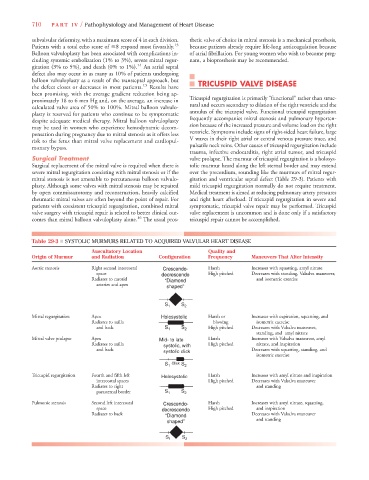
                  Surgical Treatment                                  valve prolapse. The murmur of tricuspid regurgitation is a holosys-
                  Surgical replacement of the mitral valve is required when there is  tolic murmur heard along the left sternal border and may extend
                  severe mitral regurgitation coexisting with mitral stenosis or if the  over the precordium, sounding like the murmurs of mitral regur-
                  mitral stenosis is not amenable to percutaneous balloon valvulo-  gitation and ventricular septal defect (Table 29-3). Patients with
                  plasty. Although some valves with mitral stenosis may be repaired  mild tricuspid regurgitation normally do not require treatment.
                  by open commissurotomy and reconstruction, heavily calcified  Medical treatment is aimed at reducing pulmonary artery pressures
                  rheumatic mitral valves are often beyond the point of repair. For  and right heart afterload. If tricuspid regurgitation in severe and
                  patients with coexistent tricuspid regurgitation, combined mitral  symptomatic, tricuspid valve repair may be performed. Tricuspid
                  valve surgery with tricuspid repair is related to better clinical out-  valve replacement is uncommon and is done only if a satisfactory
                  comes than mitral balloon valvuloplasty alone. 16  The usual pros-  tricuspid repair cannot be accomplished.


                  Table 29-3 ■ SYSTOLIC MURMURS RELATED TO ACQUIRED VALVULAR HEART DISEASE
                                      Auscultatory Location                 Quality and
                  Origin of Murmur    and Radiation         Configuration    Frequency     Maneuvers That Alter Intensity

                  Aortic stenosis     Right second intercostal              Harsh         Increases with squatting, amyl nitrate
                                        space                decrescendo    High pitched  Decreases with standing, Valsalva maneuver,
                                      Radiates to carotid     Diamond                       and isometric exercise
                                        arteries and apex     shaped”


                                                              S 1  S 2
                  Mitral regurgitation  Apex                     y          Harsh or      Increases with expiration, squatting, and
                                      Radiates to axilla                      blowing       isometric exercise
                                        and back              S S  S        High pitched  Decreases with Valsalva maneuver,
                                                                                            standing, and  amyl nitrate
                  Mitral valve prolapse  Apex               Mid  to late    Harsh         Increases with Valsalva maneuver, amyl
                                      Radiates to axilla       systolic, with  High pitched  nitrate, and inspiration
                                        and back               systolic click             Decreases with squatting, standing, and
                                                                                            isometric exercise
                                                              S 1  Click  S 2
                  Tricuspid regurgitation  Fourth and fifth left   Holosystolic  Harsh     Increases with amyl nitrate and inspiration
                                        intercostal spaces                  High pitched  Decreases with Valsalva maneuver
                                      Radiates to right                                     and standing
                                        parasternal border    S 1  S 2
                  Pulmonic stenosis   Second left intercostal               Harsh         Increases with amyl nitrate, squatting,
                                        space                decrescendo    High pitched    and inspiration
                                      Radiates to back         Diamond                    Decreases with Valsalva maneuver
                                                               shaped”                      and standing

                                                              S 1   S S 2

