


Page 735 - Cardiac Nursing
P. 735
M
                                     4 A
                                        M
                                          Pa
                                          Pa
                    70
                    70
                   p
                                     4 A
                   p
                                              11
                                            e 7
                                              11
                                                A
                                              11
                                           g
                                          Pa
                                           g
                                            e 7
                                           g
                                   2:0
                              /30
                              /30
                             6
                           xd
                             6
                                    1
                                   1
                                /09
                                /09
                                /09
                      5-7
                        21.
                      5-7
                                   2:0
                                   1
                          q
                           xd
                          q
                        21.
                          q
         LWB
         LWB
            K34
                                                      c.
                                                      c.
         LWBK340-c29_ pp705-721.qxd  6/30/09  12:04 AM  Page 711 Aptara Inc.
                 29_
                 29_
                 29_
            K34
               0-c
               0-c
                                                 p
                                                  t
                                                  t
                                                A
                                                 p
                                                 p
                                                  ara
                                                   a
                                                     In
                                                     In
                                                  ara
                                                   a
                                                                      C HAPTER 2 9 / Acquired Valvular Heart Disease  711
                     Acquired tricuspid stenosis is uncommon, recognized in approx-
                   imately 5% of patients with rheumatic heart disease, and usually
                                                           17
                   does not occur without involvement of the mitral valve. Tricuspid
                   stenosis has a pathologic process similar to that of mitral stenosis.
                   The murmur of tricuspid stenosis is comparable to the murmur of
                   mitral stenosis, including an opening snap followed by a diastolic
                   rumble. The murmur of tricuspid stenosis is a diastolic decrescendo
                   murmur along the left sternal border (see Table 29-2). Common
                   symptoms of tricuspid stenosis include fatigue, minimal orthopnea,
                   paroxysmal nocturnal dyspnea, hepatomegaly, and anasarca.
                      PROSTHETIC VALVES
                   Prosthetic cardiac valves have been used since the mid 1960s to
                   treat acquired valvular heart disease. Because no “perfect” pros-
                   thetic valve exists, the patient with valvular heart disease is man-
                   aged medically as long as it is safely feasible. Timing of valve re-
                   placement depends on the patient’s functional status, ventricular
                   dysfunction, and the natural course of the lesion.
                     Before a decision is made to use a particular valve, factors in
                   valve design, specifically durability, thrombogenic potential, and
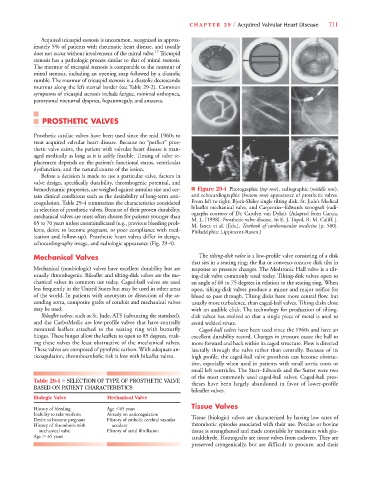
                   hemodynamic properties, are weighed against annulus size and cer-  ■ Figure 29-4 Photographic (top row), radiographic (middle row),
                   tain clinical conditions such as the desirability of long-term anti-  and echocardiographic (bottom row) appearance of prosthetic valves.
                   coagulation. Table 29-4 summarizes the characteristics considered  From left to right: Bjork-Shiley single tilting disk, St. Jude’s Medical
                   in selection of prosthetic valves. Because of their proven durability,  bileaflet mechanical valve, and Carpentier–Edwards xenograft (radi-
                   mechanical valves are most often chosen for patients younger than  ographs courtesy of Dr. Carolyn van Dyke). (Adapted from Garcia,
                                                                       M. L. [1998]. Prosthetic valve disease. In E. J. Topol, R. M. Califf, J.
                   65 to 70 years unless contraindicated (e.g., previous bleeding prob-  M. Isner, et al. [Eds.], Textbook of cardiovascular medicine [p. 580].
                   lems, desire to become pregnant, or poor compliance with med-  Philadelphia: Lippincott-Raven.)
                   ication and follow-up). Prosthetic heart valves differ in design,
                   echocardiography image, and radiologic appearance (Fig. 29-4).
                   Mechanical Valves                                     The tilting-disk valve is a low-profile valve consisting of a disk
                                                                       that sits in a seating ring; the flat or convexo-concave disk tilts in
                   Mechanical (nonbiologic) valves have excellent durability but are  response to pressure changes. The Medtronic Hall valve is a tilt-
                   usually thrombogenic. Bileaflet and tilting-disk valves are the me-  ing-disk valve commonly used today. Tilting-disk valves open to
                   chanical valves in common use today. Caged-ball valves are used  an angle of 60 to 75 degrees in relation to the seating ring. When
                   less frequently in the United States but may be used in other areas  open, tilting-disk valves produce a minor and major orifice for
                   of the world. In patients with aneurysm or dissection of the as-  blood to pass through. Tilting disks have more central flow, but
                   cending aorta, composite grafts of conduit and mechanical valves  usually more turbulence, than caged-ball valves. Tilting disks close
                   may be used.                                        with an audible click. The technology for production of tilting-
                     Bileaflet valves, such as St. Jude, ATS (advancing the standard),  disk valves has evolved so that a single piece of metal is used to
                   and the CarboMedic are low-profile valves that have centrally  avoid welded struts.
                   mounted  leaflets attached to the seating ring with  butterfly  Caged-ball valves have been used since the 1960s and have an
                   hinges. These hinges allow the leaflets to open to 85 degrees, mak-  excellent durability record. Changes in pressure cause the ball to
                   ing these valves the least obstructive of the mechanical valves.  move forward and back within its caged structure. Flow is directed
                   These valves are composed of pyrolytic carbon. With adequate an-  laterally through the valve rather than centrally. Because of its
                   ticoagulation, thromboembolic risk is low with bileaflet valves.  high profile, the caged-ball valve prosthesis can become obstruc-
                                                                       tive, especially when used in patients with small aortic roots or
                                                                       small left ventricles. The Starr–Edwards and the Sutter were two
                                                                       of the most commonly used caged-ball valves. Caged-ball pros-
                   Table 29-4 ■ SELECTION OF TYPE OF PROSTHETIC VALVE
                                                                       theses  have  been  largely abandoned in  favor of  lower-profile
                   BASED ON PATIENT CHARACTERISTICS
                                                                       bileaflet valves.
                   Biologic Valve          Mechanical Valve
                                                                       Tissue Valves
                   History of bleeding     Age  65 years
                   Inability to take warfarin  Already on anticoagulation
                   Desire to become pregnant  History of embolic cerebral vascular   Tissue (biologic) valves are characterized by having low rates of
                   History of thrombosis with  accident                thrombotic episodes associated with their use. Porcine or bovine
                     mechanical valve      History of atrial fibrillation  tissue is strengthened and made nonviable by treatment with glu-
                   Age   65 years                                      taraldehyde. Homografts are tissue valves from cadavers. They are
                                                                       preserved cryogenically, but are difficult to procure, and their

