


Page 736 - Cardiac Nursing
P. 736
/09
                                /09
                                    1
                              /30
                              /30
                                /09
                                   1
                                     4 A
                                     4 A
                                        M
                                   1
                                   2:0
                                   2:0
                      5-7
                        21.
                        21.
                    70
                    70
                      5-7
                          q
                           xd
                             6
                             6
                          q
                          q
                           xd
                                        M
                                                  t
                                                  t
                                                  ara
                                                 p
                                                 p
                                                 p
                                                  ara
                                                     In
                                                      c.
                                                      c.
                                                   a
                                                   a
                                                     In
                                           g
                                           g
                                           g
                                          Pa
                                          Pa
                                          Pa
                                            e 7
                                              12
                                                A
                                                A
                                            e 7
                                              12
                                              12
               0-c
            K34
                 29_
                 29_
         LWB K34 0-c 29_ p p pp705-721.qxd  6/30/09  12:04 AM  Page 712 Aptara Inc.
         LWB
         LWBK340-c29_
                  712    PA R T  I V / Pathophysiology and Management of Heart Disease
                  longevity has not been well proven. The main advantages of tissue
                  valves are the associated low rates of thromboembolism and the
                  subsequent decrease in patient morbidity when anticoagulant
                  therapy is not required. Nonthrombogenicity is particularly im-
                  portant for those patients in whom long-term anticoagulation
                  should be avoided, such as children, young adult women, those
                  older than 70 years, or those with a history of bleeding.
                     The Hancock porcine valve, the Medtronic Mosaic porcine
                  bioprosthesis (treated with  -oleic acid to retard calcification),
                  and the Carpentier–Edwards porcine valve are xenografts using
                  porcine aortic valves preserved with glutaraldehyde under pres-
                  sure, mounted on a stent. 18  The Carpentier–Edwards pericardial
                  bioprosthesis is made of leaflets fashioned from bovine peri-
                  cardium fixed without pressure in glutaraldehyde.
                     Stentless bioprosthetic porcine xenograft valves such as the St.
                  Jude Medical-Toronto, the Medtronic Freestyle Stentless, and the
                  Edwards Prima Plus porcine bioprosthesis have been developed to
                  improve the durability and enhance the hemodynamic perform-
                  ance of porcine aortic valves. Stentless aortic biological valves were
                  developed secondary to the recognition that conventional bio-
                  prosthesis have limitations of long-term durability and residual
                  obstruction that may impede left ventricular mass regression. 19  ■ Figure 29-5 Illustration of Ross procedure. Suture line of pul-
                  Use of the stentless aortic bioprosthesis has resulted in enhanced  monary homograft is shown. (From Elkins, R. C. [1998]. Valve repair
                  survival and hemodynamic superiority. 20  It is expected that re-  and valve replacement in children, including the Ross procedure. In
                  ducing mechanical stress on valve leaflets, and the associated de-  L. R. Kaiser, I. L. Kron, & T. L. Spray [Eds.], Mastery of cardiothoracic
                                                                      surgery [p. 947]. Philadelphia: Lippincott-Raven.)
                  generation of the bioprosthesis, may be slowed.
                     Homografts or allografts from human cadavers are virtually free
                  of any associated thrombosis. They are especially useful in pa-
                  tients with small aortic roots or in patients with active endo-  of technological advances, such as endoscopic and surgical equip-
                  carditis. Earlier homografts were preserved with glutaraldehyde  ment, have been developed to evolve towards more complex,
                  and  demonstrated early  failure. Homografts are now stored  video- and robot-assisted procedures. 25  Although patients under-
                  “fresh” after harvesting in an antibiotic solution and are then cry-  going minimally invasive valve surgery still require cardiopul-
                  opreserved, increasing their longevity to at least 10 years. Valve  monary bypass, classic median sternotomy may be avoided, thus
                  failure is uncommon and usually the result of progressive valve  reducing pain, improving cosmetic results, and expediting recov-
                  incompetence. 21  Aortic allografts have demonstrated excellent  ery. Endoscopic mitral and tricuspid repair is feasible even after
                  freedom from thromboembolism, endocarditis, and progressive  previous cardiac surgery. 26  As minimally invasive valve surgery
                  valve incompetence.  21  Because of lack of availability, use of ho-  continues to evolve, it will likely become a mainstay in the treat-
                  mografts has been limited.                          ment of valvular heart surgery.
                     In the Ross procedure (also known as pulmonary autograft), the  Aortic valve replacement can be performed through an upper
                  aortic valve is replaced with a pulmonary autograft, and the native  “T” ministernotomy without intraoperative difficulties. Postop-
                  pulmonary valve is replaced with a pulmonic allograft. Although this  erative pain is reduced and recovery is expedited, with patients
                  procedure introduced by Donald Ross in 1967 was originally devel-  discharged to home as early as postoperative day 3.  27  Compared
                  oped for pediatric application, it has been expanded to adult surgery  with patients with median sternotomy, patients undergoing mi-
                       22
                  as well. In patients undergoing the Ross procedure, the native pul-  tral valve replacement through the right parasternal approach
                  monary valve is excised and then implanted in the aortic position  had a shortened  length of stay and reduced  direct  hospital
                  (autograft); a pulmonary homograft (allograft) is implanted into the  costs. 28  Most clinical series demonstrates that minimally inva-
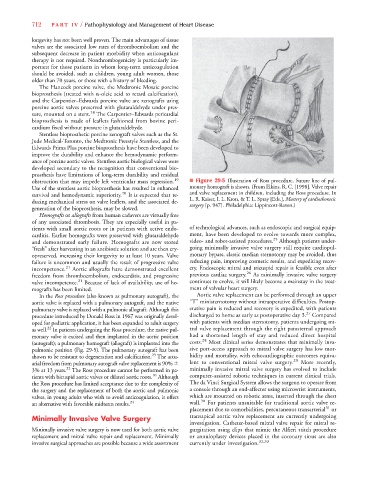
                  pulmonic position (Fig. 29-5). The pulmonary autograft has been  sive port-access approach to mitral valve surgery has low mor-
                                                          23
                  shown to be resistant to degeneration and calcification. The actu-  bidity and mortality, with echocardiographic outcomes equiva-
                  arial freedom from pulmonary autograft valve replacement is 90%    lent to conventional mitral valve surgery. 29  More recently,
                              22
                  3% at 13 years. The Ross procedure cannot be performed in pa-  minimally invasive mitral valve surgery has evolved to include
                                                          10
                  tients with bicuspid aortic valves or dilated aortic roots. Although  computer-assisted robotic techniques in current clinical trials.
                  the Ross procedure has limited acceptance due to the complexity of  The da Vinci Surgical System allows the surgeon to operate from
                  the surgery and the replacement of both the aortic and pulmonic  a console through an end-affecter using microwrist instruments,
                  valves, in young adults who wish to avoid anticoagulation, it offers  which are mounted on robotic arms, inserted through the chest
                  an alternative with favorable midterm results. 24   wall. 30  For patients unsuitable for traditional aortic valve re-
                                                                      placement due to comorbidities, percutaneous transarterial 31  or
                  Minimally Invasive Valve Surgery                    transapical aortic valve replacement are currently undergoing
                                                                      investigation. Catheter-based mitral valve repair for mitral re-
                  Minimally invasive valve surgery is now used for both aortic valve  gurgitation using clips that mimic the Alfieri stitch procedure
                  replacement and mitral valve repair and replacement. Minimally  or annuloplasty devices placed in the coronary sinus are also
                  invasive surgical approaches are possible because a wide assortment  currently under investigation. 32,33

