


Page 763 - Cardiac Nursing
P. 763
CHAPTER 31 / Adult Congenital Heart Disease  739


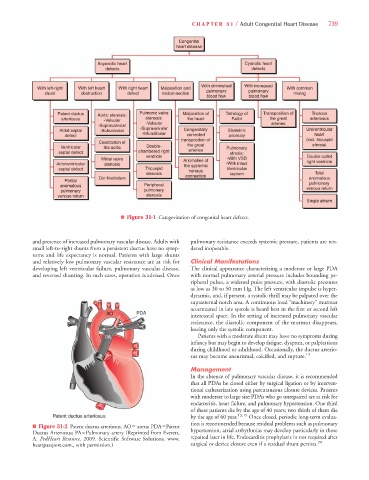
                                         n Figure 31-1 Categorization of congenital heart defects.


            and presence of increased pulmonary vascular disease. Adults with  pulmonary resistance exceeds systemic pressure, patients are ren-
            small left-to-right shunts from a persistent ductus have no symp-  dered inoperable.
            toms and life expectancy is normal. Patients with large shunts
            and relatively low pulmonary vascular resistance are at risk for  Clinical Manifestations
            developing left ventricular failure, pulmonary vascular disease,  The clinical appearance characterizing a moderate or large PDA
            and reversed shunting. In such cases, operation is advised. Once  with normal pulmonary arterial pressure includes bounding pe-
                                                               ripheral pulses, a widened pulse pressure, with diastolic pressures
                                                               as low as 30 to 50 mm Hg. The left ventricular impulse is hyper-
                                                               dynamic, and, if present, a systolic thrill may be palpated over the
                                                               suprasternal notch area. A continuous loud “machinery” murmur
                                                               accentuated in late systole is heard best in the first or second left
                                                               intercostal space. In the setting of increased pulmonary vascular
                                                               resistance, the diastolic component of the murmur disappears,
                                                               leaving only the systolic component.
                                                                  Patients with a moderate shunt may have no symptoms during
                                                               infancy but may begin to develop fatigue, dyspnea, or palpitations
                                                               during childhood or adulthood. Occasionally, the ductus arterio-
                                                               sus may become aneurismal, calcified, and rupture. 13

                                                               Management
                                                               In the absence of pulmonary vascular disease, it is recommended
                                                               that all PDAs be closed either by surgical ligation or by interven-
                                                               tional catheterization using percutaneous closure devices. Patients
                                                               with moderate to large size PDAs who go unrepaired are at risk for
                                                               endarteritis, heart failure, and pulmonary hypertension. One third
                                                               of these patients die by the age of 40 years; two thirds of them die
                                                               by the age of 60 year. 13,19  Once closed, periodic long-term evalua-
                                                               tion is recommended because residual problems such as pulmonary
            n Figure 31-2 Patent ductus arteriosus. AO5 aorta; PDA5Patent
            Ductus Arteriosus; PA5Pulmonary artery (Reprinted from Everett,  hypertension, atrial arrhythmias may develop particularly in those
            A. PedHeart Resource. 2009. Scientific Software Solutions. www.  repaired later in life. Endocarditis prophylaxis in not required after
                                                                                                         20
            heartpassport.com., with permission.)              surgical or device closure even if a residual shunt persists.

