


Page 765 - Cardiac Nursing
P. 765
CHAPTER 31 / Adult Congenital Heart Disease  741


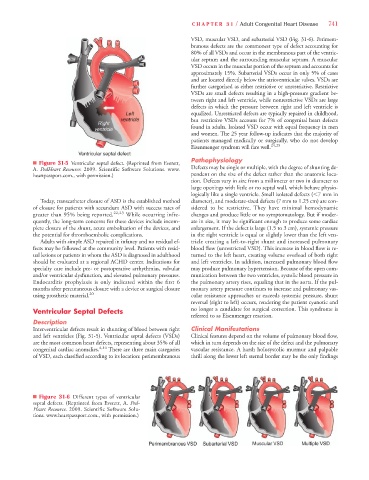
                                                               VSD, muscular VSD, and subarterial VSD (Fig. 31-6). Perimem-
                                                               branous defects are the commonest type of defect accounting for
                                                               80% of all VSDs and occur in the membranous part of the ventric-
                                                               ular septum and the surrounding muscular septum. A muscular
                                                               VSD occurs in the muscular portion of the septum and accounts for
                                                               approximately 15%. Subarterial VSDs occur in only 5% of cases
                                                               and are located directly below the atrioventricular valves. VSDs are
                                                               further categorized as either restrictive or unrestrictive. Restrictive
                                                               VSDs are small defects resulting in a high-pressure gradient be-
                                                               tween right and left ventricle, while nonrestrictive VSDs are large
                                                               defects in which the pressure between right and left ventricle is
                                                               equalized. Unrestricted defects are typically repaired in childhood,
                                                               but restrictive VSDs account for 7% of congenital heart defects
                                                               found in adults. Isolated VSD occur with equal frequency in men
                                                               and women. The 25 year follow-up indicates that the majority of
                                                               patients managed medically or surgically, who do not develop
                                                               Eisenmenger syndrom will fare well. 24,25
                                                               Pathophysiology
            n Figure 31-5 Ventricular septal defect. (Reprinted from Everett,
            A. PedHeart Resource. 2009. Scientific Software Solutions. www.  Defects may be single or multiple, with the degree of shunting de-
            heartpassport.com., with permission.)              pendent on the size of the defect rather than the anatomic loca-
                                                               tion. Defects vary in size from a millimeter or two in diameter to
                                                               large openings with little or no septal wall, which behave physio-
                                                               logically like a single ventricle. Small isolated defects (,7 mm in
              Today, transcatheter closure of ASD is the established method  diameter), and moderate-sized defects (7 mm to 1.25 cm) are con-
            of closure for patients with secundum ASD with success rates of  sidered to be restrictive.  They have minimal hemodynamic
            greater than 95% being reported.  22,23  While occurring infre-  changes and produce little or no symptomatology. But if moder-
            quently, the long-term concerns for these devices include incom-  ate in size, it may be significant enough to produce some cardiac
            plete closure of the shunt, acute embolization of the devices, and  enlargement. If the defect is large (1.5 to 3 cm), systemic pressure
            the potential for thromboembolic complications.    in the right ventricle is equal or slightly lower than the left ven-
              Adults with simple ASD repaired in infancy and no residual ef-  tricle creating a left-to-right shunt and increased pulmonary
            fects may be followed at the community level. Patients with resid-  blood flow (unrestricted VSD). This increase in blood flow is re-
            ual lesions or patients in whom the ASD is diagnosed in adulthood  turned to the left heart, creating volume overload of both right
            should be evaluated at a regional ACHD center. Indications for  and left ventricles. In addition, increased pulmonary blood flow
            specialty care include pre- or postoperative arrhythmias, valvular  may produce pulmonary hypertension. Because of the open com-
            and/or ventricular dysfunction, and elevated pulmonary pressures.  munication between the two ventricles, systolic blood pressure in
            Endocarditis prophylaxis is only indicated within the first 6  the pulmonary artery rises, equaling that in the aorta. If the pul-
            months after percutaneous closure with a device or surgical closure  monary artery pressure continues to increase and pulmonary vas-
            using prosthetic material. 20                      cular resistance approaches or exceeds systemic pressure, shunt
                                                               reversal (right to left) occurs, rendering the patient cyanotic and
            Ventricular Septal Defects                         no longer a candidate for surgical correction. This syndrome is
                                                               referred to as Eisenmenger reaction.
            Description
            Interventricular defects result in shunting of blood between right  Clinical Manifestations
            and left ventricles (Fig. 31-5). Ventricular septal defects (VSDs)  Clinical features depend on the volume of pulmonary blood flow,
            are the most common heart defects, representing about 35% of all  which in turn depends on the size of the defect and the pulmonary
            congenital cardiac anomalies. 4,14  There are three main categories  vascular resistance. A harsh holosystolic murmur and palpable
            of VSD, each classified according to its location: perimembranous  thrill along the lower left sternal border may be the only findings


            n Figure 31-6 Different types of ventricular
            septal defects. (Reprinted from Everett, A. Ped-
            Heart Resource. 2009. Scientific Software Solu-
            tions. www.heartpassport.com., with permission.)

