


Page 766 - Cardiac Nursing
P. 766
742    P AR T IV / Pathophysiology and Management of Heart Disease


           of a small or moderate defect. A normal splitting second sound in-
           dicates the pulmonary arterial pressure is below systemic pressure.
           In large shunts, the murmur is lower in intensity, a mid-diastolic
           “flow murmur” and third heart sound are heard at the apex, and a
           right ventricular impulse is palpable.

           Management
           Patients with small VSD (,7 mm in diameter) have minimal he-
           modynamic changes and produce little or no symptoms. There-
           fore, they do not require surgical intervention. In the absence of
           high or fixed pulmonary vascular obstructive disease, surgical cor-
           rection is indicated in patients with moderate to large left-to-right
           shunt. VSD closure will be considered if the Q p /Q s is higher than
           2:1. According to the 2007 guidelines, endocarditis prophylaxis is
           no longer indicated, except for patients with prosthetic material
           (e.g. patch for VSD closure) with residua or within the first 6
           months after an operation in which prosthetic material is
           placed. 20
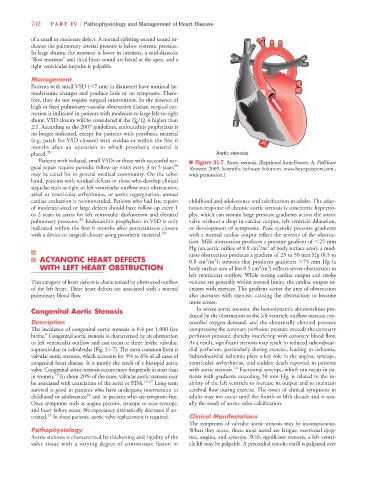
              Patients with isolated, small VSDs or those with successful sur-  n Figure 31-7 Aortic stenosis. (Reprinted from Everett, A. PedHeart
           gical repair require periodic follow-up visits every 3 to 5 years 26  Resource. 2009. Scientific Software Solutions. www.heartpassport.com.,
           may be cared for in general medical community. On the other  with permission.)
           hand, patients with residual defects or those who develop clinical
           sequelae such as right or left ventricular outflow tract obstruction,
           atrial or ventricular arrhythmias, or aortic regurgitation, annual
           cardiac evaluation is recommended. Patients who had late repairs  childhood and adolescence and calcification in adults. The adap-
           of moderate-sized or large defects should have follow-up every 1  tation response of chronic aortic stenosis is concentric hypertro-
           to 2 years to assess for left ventricular dysfunction and elevated  phy, which can sustain large pressure gradients across the aortic
           pulmonary pressures. 26  Endocarditis prophylaxis in VSD is only  valve without a drop in cardiac output, left ventricle dilatation,
           indicated within the first 6 months after percutaneous closure  or development of symptoms. Peak systolic pressure gradients
           with a device or surgical closure using prosthetic material. 20  with a normal cardiac output reflect the severity of the obstruc-
                                                               tion. Mild obstruction produces a pressure gradient of ,25 mm
                                                                                     2
                                                                                        2
                                                               Hg (an aortic orifice of 0.8 cm /m of body surface area); a mod-
                                                               erate obstruction produces a gradient of 25 to 50 mm Hg (0.5 to
              ACYANOTIC HEART DEFECTS                          0.8 cm /m ); stenosis that produces gradients .75 mm Hg (a
                                                                    2
                                                                       2
              WITH LEFT HEART OBSTRUCTION                      body surface area of less 0.5 cm /m ) reflects severe obstruction to
                                                                                        2
                                                                                      2
                                                               left ventricular outflow. While resting cardiac output and stroke
           This category of heart defects is characterized by obstructed outflow  volume are generally within normal limits, the cardiac output in-
           of the left heart. These heart defects are associated with a normal  creases with exercise. The gradient across the area of obstruction
           pulmonary blood flow.                                also increases with exercise, causing the obstruction to become
                                                               more severe.
           Congenital Aortic Stenosis                            In severe aortic stenosis, the hemodynamic abnormalities pro-
                                                               duced by the obstruction to the left ventricle outflow increase my-
           Description                                         ocardial oxygen demand, and the abnormally elevated pressure
           The incidence of congenital aortic stenosis is 0.4 per 1,000 live  compressing the coronary perfusion pressure exceeds the coronary
                4
           births. Congenital aortic stenosis is characterized by an obstruction  perfusion pressure, thereby interfering with coronary blood flow.
           to left ventricular outflow and can occur at three levels: valvular,  As a result, significant stenosis may result in reduced subendocar-
           supravalvular, or subvalvular (Fig. 31-7). The most common form is  dial perfusion, particularly during exercise, leading to ischemia.
           valvular aortic stenosis, which accounts for 3% to 6% of all cases of  Subendocardial ischemia plays a key role in the angina, syncope,
           congenital heart disease. It is mostly the result of a bicuspid aortic  ventricular arrhythmias, and sudden death reported in patients
           valve. Congenital aortic stenosis occurs more frequently in men than  with aortic stenosis. 14  Exertional syncope, which can occur in pa-
                   13
           in women. In about 20% of the cases, valvular aortic stenosis may  tients with gradients exceeding 50 mm Hg, is related to the in-
           be associated with coarctation of the aorta or PDA. 13,27  Long-term  ability of the left ventricle to increase its output and to maintain
           survival is good in patients who have undergone intervention in  cerebral flow during exercise. The onset of clinical symptoms in
           childhood or adolescence 28  and in patients who are symptom-free.  adults may not occur until the fourth or fifth decade and is usu-
           Once symptoms such as angina pectoris, syncope or near-syncope,  ally the result of aortic valve calcification.
           and heart failure occur, life expectancy dramatically decreases if un-
                13
           treated. In these patients, aortic valve replacement is required.  Clinical Manifestations
                                                               The symptoms of valvular aortic stenosis may be inconspicuous.
           Pathophysiology                                     When they occur, those most noted are fatigue, exertional dysp-
           Aortic stenosis is characterized by thickening and rigidity of the  nea, angina, and syncope. With significant stenosis, a left ventri-
           valve tissue with a varying degree of commissure fusion in  cle lift may be palpable. A precordial systolic thrill is palpated over

