


Page 782 - Cardiac Nursing
P. 782
2
                                        009
                                    0
                                     6
                                        009
                                             2:0
                                               4 A
                                            1
                                             2:0
                          68.
                             qx
                        3-7
                          68.
                               d
                                  0
                                   /
                                 3
                                  0
                                                 A
                                                    Pa
                                                       e 7
                                                  M
                                                  M
                                                         5
                                                               ara
                                                               ara
                                                          8
                                                            Apt
                                                 A
                                                 A
                                                 A
                                                 A
                                                 A
                                                 A
                                                 A
                                                 A
                                                 A
            K34
            K34
                0-c
                     p7
                  32_
         LWBK340-c32_p7553-768.qxd  30/06/2009  12:04 AM  Page 758 Aptara
         LWB K34 0-c 32_ p7 5 3-7 68. qx d  3 0 / 0 6 / / 2 009  1 2:0 4 A M  Pa g g e 7 5 8  Apt ara
         LWB
                  758    PA R T  V / Health Promotion and Disease Prevention
                                                                      aged 18 years and older participated in at least some light to mod-
                     PHYSICAL ACTIVITY                                erate leisure-time physical activity lasting 10 minutes or more per
                                                                           4
                                                                      session. Thus, a large proportion of the American public could be
                  The roles of physical activity and physicalfitness in preventing car-  targeted for public health interventions to increase physical activity.
                  diovascular disease and controlling cardiovascular disease riskfac-  Studies of the effects on cardiovascular disease of both on-the-job
                  tors are well established. In 2007, the American College of Sports  and leisure-time activity indicate that in general, people who are
                  Medicine and the American Heart Association recommended that  more physically active or physically fit tend to have CHD less often
                  “all healthy adults aged 18 to 65 years need moderate-intensity  than sedentary or less fit people. CHD tends to be less severe and
                  aerobic physical activity for a minimum of 30 minutes on five days  occurs at a later age among those who are physically active com-
                  each week or vigorous-intensity aerobic activity for a minimum of  pared with those who are sedentary. 56  When data from cohort
                  20 minutes on three days each week.” 54  Data analyzed using the  studies of occupational physical activity and CHD risk were
                  1996 Surgeon General’s Report on Physical Activity recommen-  pooled, the risk for CHD death for those with low-level occupa-
                  dations (at least 30 minutes of moderate-intensity physical activ-  tional activity was almost twice that of those with high-level ac-
                  ity on most days of the week) (Figs. 32-5 and 32-6) show that  tivity, and the MI risk was 40% higher in the sedentary group. 57
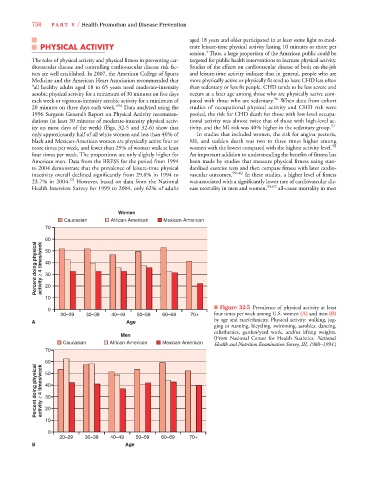
                  only approximately half of all white women andless than 40% of  In studies that included women, the risk for angina pectoris,
                  black and Mexican-American women are physically active four or  MI, and sudden death was two to three times higher among
                  more times per week, andfewer than 25% of women walk at least  women with the lowest compared with the highest activity level. 58
                  four times per week. The proportions are only slightly higher for  An important addition to understanding the benefits of fitness has
                  American men. Data from the BRFSS for the periodfrom 1994  been made by studies that measure physical fitness using stan-
                  to 2004 demonstrate that the prevalence ofleisure-time physical  dardized exercise tests and then compare fitness with later cardio-
                  inactivity overall declined significantly from 29.8% in 1994 to  vascular outcomes. 59–62  In these studies, a higher level of fitness
                  23.7% in 2004. 55  However,based on data from the National  was associated with a significantly lower rate of cardiovascular dis-
                  Health Interview Survey for 1999 to 2004, only 62% of adults  ease mortality in men and women, 59,62  all-cause mortality in men
                                               Women
                             Caucasian      African-American  Mexican-American
                       70
                       60
                    Percent doing physical activity ≥ 4 times/week  40
                       50
                       30
                       20
                       10
                                                                              ■ Figure 32-5 Prevalence of physical activity at least
                        0
                            20–29   30–39   40–49    50–59   60–69    70+     four times per week among U.S. women (A) and men (B)
                                                                              by age and race/ethnicity. Physical activity: walking, jog-
                  A                              Age
                                                                              ging or running, bicycling, swimming, aerobics, dancing,
                                                                              calisthenics, garden/yard work, and/or  lifting weights.
                                               Men
                                                                              (From National Center for Health Statistics.  National
                             Caucasian      African-American  Mexican-American  Health and Nutrition Examination Survey, III, 1988–1994.)
                       70
                       60
                    Percent doing physical activity ≥ 4 times/week  40
                       50
                       30
                       20
                       10
                        0
                           20–29    30–39   40–49   50–59    60–69    70+
                  B                              Age

