


Page 783 - Cardiac Nursing
P. 783
1
1
1
009
009
009
4 A
A
A
2:0
2:0
4 A
/
0
0
0
0
/
/
2
2
6
6
/
e 7
5
5
g
g
e 7
Apt
ara
ara
9
9
Apt
A
A
A
A
A
A
M
Pa
Pa
A
A
M
0
p7
0-c
p7
5
32_
0-c
L L LWB
LWBK340-c32_32_p7553-768.qxd 30/06/2009 12:04 AM Page 759 Aptara
LWB
K34
K34
d
d
3
32_
3
qx
3-7
3-7
68.
qx
68.
C HAPTER 32 / Coronary Heart Disease Risk Factors 759
Women
Caucasian African-American Mexican-American
30
≥ 4 times/week 25
20
Percent walking 15
10
5
0
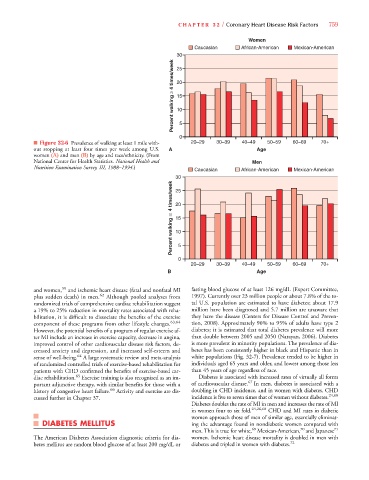
■ Figure 32-6 Prevalence of walking at least 1 mile with- 20–29 30–39 40–49 50–59 60–69 70+
out stopping at least four times per week among U.S. A Age
women (A) and men (B) by age and race/ethnicity. (From
National Center for Health Statistics. National Health and Men
Nutrition Examination Survey, III, 1988–1994.)
Caucasian African-American Mexican-American
30
4 times/week 25
20
15
Percent walking 10
5
0
20–29 30–39 40–49 50–59 60–69 70+
B Age
and women, 59 and ischemic heart disease (fatal and nonfatal MI fasting blood glucose of at least 126 mg/dL (Expert Committee,
plus sudden death) in men. 62 Although pooled analyses from 1997). Currently over 23 million people or about 7.8% of the to-
randomized trials of comprehensive cardiac rehabilitation suggest tal U.S. population are estimated to have diabetes; about 17.9
a 19% to 25% reduction in mortality rates associated with reha- million have been diagnosed and 5.7 million are unaware that
bilitation, it is difficult to dissociate the benefits of the exercise they have the disease (Centers for Disease Control and Preven-
component of these programs from other lifestyle changes. 63,64 tion, 2008). Approximately 90% to 95% of adults have type 2
However, the potential benefits of a program of regular exercise af- diabetes; it is estimated that total diabetes prevalence will more
ter MI include an increase in exercise capacity, decrease in angina, than double between 2005 and 2050 (Narayan, 2006). Diabetes
improved control of other cardiovascular disease risk factors, de- is more prevalent in minority populations. The prevalence of dia-
creased anxiety and depression, and increased self-esteem and betes has been consistently higher in black and Hispanic than in
sense of well-being. 64 A large systematic review and meta-analysis white populations (Fig. 32-7). Prevalence tended to be higher in
of randomized controlled trials of exercise-based rehabilitation for individuals aged 65 years and older, and lowest among those less
patients with CHD confirmed the benefits of exercise-based car- than 45 years of age regardless of race.
65
diac rehabilitation. Exercise training is also recognized as an im- Diabetes is associated with increased rates of virtually all forms
portant adjunctive therapy, with similar benefits for those with a of cardiovascular disease. 67 In men, diabetes is associated with a
history of congestive heart failure. 66 Activity and exercise are dis- doubling in CHD incidence, and in women with diabetes, CHD
cussed further in Chapter 37. incidence is five to seven times that of women without diabetes. 24,68
Diabetes doubles the rate of MI in men and increases the rate of MI
in women four to six fold. 24,26,68 CHD and MI rates in diabetic
women approach those of men of similar age, essentially eliminat-
DIABETES MELLITUS ing the advantage found in nondiabetic women compared with
69
70
men. This is true for white, Mexican-American, and Japanese 71
The American Diabetes Association diagnostic criteria for dia- women. Ischemic heart disease mortality is doubled in men with
betes mellitus are random blood glucose of at least 200 mg/dL or diabetes and tripled in women with diabetes. 72

